

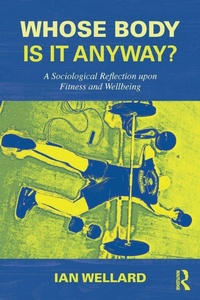
Whose Body is it Anyway?
A sociological reflection upon fitness and wellbeing
1st Edition
Published on 27. September 2018
Book
Paperback/Softback
118 pages
978-1-138-95951-4 (ISBN)
Description
There is a widespread interest in wellbeing, the healthy body and public health. However, there are also many simplistic and uncritical interpretations of what wellbeing or a healthy body should 'look like'. By focusing upon wellbeing through examples taken from fitness-related activities, which are often considered unproblematic routes to achieving wellbeing and greater public health, this book explores contemporary understandings of the body and the conflicting ways in which it is considered, in different contexts, times and spaces, either as the possession of the individual or that of society (or both).
Whose Body Is It Anyway? adopts an embodied approach, employing sociological theory along with examples drawn from empirical research collected through participation (by the author) in an intense period of physical training. The intention is to explore the embodied experiences of 'doing' an intensive period of physical activity and, subsequently, attempt to understand, in more depth, the range of personal, social, psychological and physical factors that undoubtedly contribute to engaging in such an activity.
The emerging story reveals much about the physical and emotional experience of a body being put through intensive exercise, not only in terms of contrasting forms of pleasure and pain, but also various socio-cultural 'issues' relating to relationships of power, trust and the role of 'expert' health advisor. Written in a clear and engaging style, the book provides an accessible introduction of more complex theoretical explanations which will appeal to academics and practitioners involved in broad aspects of sport, physical activity, health and wellbeing.
Whose Body Is It Anyway? adopts an embodied approach, employing sociological theory along with examples drawn from empirical research collected through participation (by the author) in an intense period of physical training. The intention is to explore the embodied experiences of 'doing' an intensive period of physical activity and, subsequently, attempt to understand, in more depth, the range of personal, social, psychological and physical factors that undoubtedly contribute to engaging in such an activity.
The emerging story reveals much about the physical and emotional experience of a body being put through intensive exercise, not only in terms of contrasting forms of pleasure and pain, but also various socio-cultural 'issues' relating to relationships of power, trust and the role of 'expert' health advisor. Written in a clear and engaging style, the book provides an accessible introduction of more complex theoretical explanations which will appeal to academics and practitioners involved in broad aspects of sport, physical activity, health and wellbeing.
More details
Language
English
Place of publication
London
United Kingdom
Publishing group
Taylor & Francis Ltd
Target group
College/higher education
Illustrations
13 s/w Abbildungen, 11 s/w Photographien bzw. Rasterbilder, 2 s/w Zeichnungen, 2 s/w Tabellen
2 Tables, black and white; 2 Line drawings, black and white; 11 Halftones, black and white; 13 Illustrations, black and white
Dimensions
Height: 234 mm
Width: 156 mm
Thickness: 7 mm
Weight
207 gr
ISBN-13
978-1-138-95951-4 (9781138959514)
Copyright in bibliographic data and cover images is held by Nielsen Book Services Limited or by the publishers or by their respective licensors: all rights reserved.
Schweitzer Classification
Other editions
Additional editions
Book
09/2018
1st Edition
Routledge
€205.60
Shipment within 10-20 days
E-Book
09/2018
1st Edition
Routledge
€55.49
Available for download
E-Book
09/2018
Routledge
€55.49
Available for download
Person
Ian Wellard is a sociologist of Sport and the Body. His main research interests relate to embodied practices, physical activity, gender and sport. Much of this research has been generated through ethnographic studies, which draw upon qualitative and reflexive approaches to the ways in which embodied identities are constructed and negotiated. His previous publications include Researching Embodied Sport (2015), Sport, Fun and Enjoyment (2013), Sport, Masculinities and the Body (2009) and Rethinking Gender and Youth Sport (2007), all published by Routledge.
Content
1. Introduction 2. Being Trained and Training One's Body 3. Health and Fitness 'Knowledge': Theorising (Fitness) Body Reflexive Practices 4. What Pain? 5. Embodied Pleasure and Pain in Fitness Related Practices 6. Metamorphosis 7. Identities and Power: I'm in Control? 8. Final Thoughts