

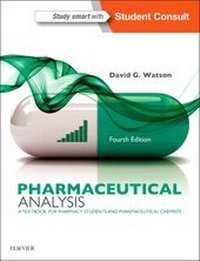
Pharmaceutical Analysis
A Textbook for Pharmacy Students and Pharmaceutical Chemists
4th Edition
Published on 26. July 2016
Book
Paperback/Softback
480 pages
978-0-7020-6989-5 (ISBN)
Description
Pharmaceutical analysis forms a core part of any pharmacy programme, as well as being essential for pharmacology and medicinal chemistry courses.
Pharmaceutical analysis determines the purity, concentration, active compounds, shelf life, rate of absorption in the body, identity, stability, rate of release etc. of a drug. Testing a pharmaceutical product involves a variety of analyses, and the analytical processes described in this book are used in industries as diverse as food, beverages, cosmetics, detergents, metals, paints, water, agrochemicals, biotechnological products and pharmaceuticals.
The mathematics involved is notoriously difficult, but this much-praised textbook, now revised and updated for its fourth edition, guides a student through the complexities with clear writing and the author's expertise from many years' teaching pharmacy students. There is continuous learning reinforcement throughout the book by way of worked calculation examples and self-assessment test questions.
Worked calculation examples
Self-assessment
Additional problems (self tests)
Practical boxes
Key points boxes
New chapter on electrochemical biosensors.
New chapter on the quality control of biotechnologically produced drugs.
Extended chapter on molecular emission spectroscopy.
Now comes with an e-book on StudentConsult.
Self-assessment is interactive in the accompanying online e-book.
65 online animations show concepts such as ionization partitioning of drug molecules etc.
~
Pharmaceutical analysis determines the purity, concentration, active compounds, shelf life, rate of absorption in the body, identity, stability, rate of release etc. of a drug. Testing a pharmaceutical product involves a variety of analyses, and the analytical processes described in this book are used in industries as diverse as food, beverages, cosmetics, detergents, metals, paints, water, agrochemicals, biotechnological products and pharmaceuticals.
The mathematics involved is notoriously difficult, but this much-praised textbook, now revised and updated for its fourth edition, guides a student through the complexities with clear writing and the author's expertise from many years' teaching pharmacy students. There is continuous learning reinforcement throughout the book by way of worked calculation examples and self-assessment test questions.
Worked calculation examples
Self-assessment
Additional problems (self tests)
Practical boxes
Key points boxes
New chapter on electrochemical biosensors.
New chapter on the quality control of biotechnologically produced drugs.
Extended chapter on molecular emission spectroscopy.
Now comes with an e-book on StudentConsult.
Self-assessment is interactive in the accompanying online e-book.
65 online animations show concepts such as ionization partitioning of drug molecules etc.
~
More details
Edition
4th Revised edition
Language
English
Place of publication
London
United Kingdom
Target group
College/higher education
Pharmacy
Biochemistry
Chemistry
Edition type
Revised edition
Illustrations
Approx. 450 illustrations
Dimensions
Height: 246 mm
Width: 189 mm
ISBN-13
978-0-7020-6989-5 (9780702069895)
Copyright in bibliographic data and cover images is held by Nielsen Book Services Limited or by the publishers or by their respective licensors: all rights reserved.
Schweitzer Classification
Other editions
New editions
Book
06/2020
5th Edition
Elsevier
€56.00
Shipment within 10-20 days
Additional editions
David G. Watson
Pharmaceutical Analysis E-Book
A Textbook for Pharmacy Students and Pharmaceutical Chemists
E-Book
12/2015
4th Edition
Elsevier
€38.99
Available for download
Previous edition
Book
07/2012
3rd Edition
Churchill Livingstone
€69.51
Article exhausted; check for reprint
Content
Chapter 1 Control of the quality of analytical methods Chapter 2 Physical and chemical properties of drug molecules Chapter 3 Titrimetic and chemical analysis methods by RuAngelie Edrada-Ebel Chapter 4 Ultraviolet and visible spectroscopy Chapter 5 Infrared spectrophotometry Chapter 6 Atomic spectrophotometry Chapter 7 Molecular emission spectroscopy Chapter 8 Nuclear magnetic resonance spectroscopy Chapter 9 Mass spectrometry Chapter 10 Chromatographic theory Chapter 11 Gas chromatography Chapter 12 High-pressure liquid chromatography Chapter 13 Thin-layer chromatography Chapter 14 High-performance capillary electrophoresis Chapter 15 Extraction methods in pharmaceutical analysis Chapter 16 Methods used in the quality control of biotechnologically produced drugs