

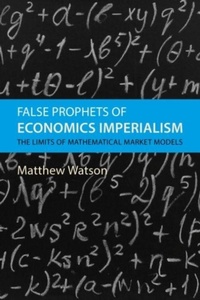
False Prophets of Economics Imperialism
The Limits of Mathematical Market Models
Published on 25. July 2024
Book
Hardback
312 pages
978-1-78821-766-8 (ISBN)
Description
This book studies the methodological revolution that has resulted in economists' mathematical market models being exported across the social sciences. The ensuing process of economics imperialism has struck fear into subject specialists worried that their disciplinary knowledge will subsequently count for less. Yet even though mathematical market models facilitate important abstract thought experiments, they are no substitute for carefully contextualised empirical investigations of real social phenomena. The two exist on completely different ontological planes, producing very different types of explanation.
In this deeply researched and wide-ranging intellectual history, Matthew Watson surveys the evolution of modern economics and its modelling methodology. With its origins in Jevons and Robbins and its culmination in Samuelson, Arrow and Debreu, he charts the escape from reality that has allowed economists' hypothetical mathematical models to speak to increasingly self-referential mathematical truths. These are shown to perform badly as social truths, consequently imposing strict epistemic limits on economics imperialism.
The book is a formidable analysis of the epistemic limitations of modern-day economics and marks a significant counter to its methodology's encroachment across the wider social sciences.
In this deeply researched and wide-ranging intellectual history, Matthew Watson surveys the evolution of modern economics and its modelling methodology. With its origins in Jevons and Robbins and its culmination in Samuelson, Arrow and Debreu, he charts the escape from reality that has allowed economists' hypothetical mathematical models to speak to increasingly self-referential mathematical truths. These are shown to perform badly as social truths, consequently imposing strict epistemic limits on economics imperialism.
The book is a formidable analysis of the epistemic limitations of modern-day economics and marks a significant counter to its methodology's encroachment across the wider social sciences.
Reviews / Votes
A powerful intellectual history of how a particular kind of economic reasoning gained dominance and came to shape not only economics but also the wider social sciences and public life... thorough and compelling... bridges history of economics, political economy, economic methodology, and history of science, appealing to audiences interested in understanding the movements and rationale of how scientific discourses are captured by particular methodologies and ideologies... Watson warns that economic imperialism reduces complex moral and political issues to technical problems, discussing how it contributes to the depoliticization of public life by silencing dissenting voices. -- Danielle Guizzo, writing in 'History of Political Economy' The most thorough and persuasive account that exists of the origins of the cognitive authority of modern economics - and the sometimes rather tenuous claims on which that authority rests. A brilliant achievement that could really only have been written by Matthew Watson but which we can all learn from. -- Colin Hay, Professor of Political Sciences, Sciences Po, Paris False Prophets of Economics Imperialism is a tour de force! It challenges the economics orthodoxy with sharp interrogations, multidisciplinary insights and careful and robust analysis of the history of the dismal discipline and its dominance of our academic and policy worlds today. This authoritative book should be read by anyone interested in how mathematical modelling came to rule the roost in economic thinking and policymaking, and why this should not be the case. -- Shirin Rai, Distinguished Research Professor of Politics and International Relations, SOAS, University of London In this brilliant book, Matthew Watson reveals how economics transformed itself into the imperialist discipline that it has become today. He charts how, as economists became increasingly preoccupied with mathematical rigour, the field changed from being a study of the real economy to 'a science of choice'. Stripped of its relationship with actual economic activities, this concept of market choice could, in theory, be applied to every aspect of social life - from climate change to the history of slavery in the United States. This study demonstrates the ironic path through which economics had to make itself increasingly uneconomic in order to become the discipline that sought to treat every other field through the lens of the market. Watson's book is essential reading for students of economic history, political economy and economic sociology who hope to understand and to challenge economics imperialism today. -- Jacqueline Best, Full Professor, School of Political Studies, University of OttawaMore details
Language
English
Place of publication
Newcastle upon Tyne
United Kingdom
Target group
Professional and scholarly
Dimensions
Height: 234 mm
Width: 161 mm
Thickness: 31 mm
Weight
614 gr
ISBN-13
978-1-78821-766-8 (9781788217668)
Copyright in bibliographic data and cover images is held by Nielsen Book Services Limited or by the publishers or by their respective licensors: all rights reserved.
Schweitzer Classification
Other editions
Additional editions
E-Book
07/2024
1st Edition
Agenda Publishing
from
€139.99
Available for download
E-Book
07/2024
1st Edition
Agenda Publishing
€139.99
Available for download
Person
Matthew Watson is Professor of Political Economy in the Department of Politics and International Studies at the University of Warwick, UK. His books include Foundations of International Political Economy (2005), The Political Economy of International Capital Mobility (2007) and Uneconomic Economics and the Crisis of the Model World (2014).
Content
Introduction: economics imperialism and social science
1. Setting the scene: scientific unification through the use of mathematical models
2. True in the model versus true in the world: mathematical postulation, proof-making activities and economic theory
3. The autonomy of the world within the model: philosophical reflections on hypothetical mathematical modelling in economics
4. Marginalism as proto-imperialist move 1: Jevons and the search for enumerated principles of economic behaviour
5. Economization as proto-imperialist move 2: Robbins and the search for an analytical definition of economics
6. Maximization as proto-imperialist move 3: Samuelson and the search for operationally meaningful mathematical theorems
7. Axiomatization as proto-imperialist move 4: Arrow-Debreu and the search for economically meaningful existence theorems
Conclusion: metamathematical limits to economics imperialism
1. Setting the scene: scientific unification through the use of mathematical models
2. True in the model versus true in the world: mathematical postulation, proof-making activities and economic theory
3. The autonomy of the world within the model: philosophical reflections on hypothetical mathematical modelling in economics
4. Marginalism as proto-imperialist move 1: Jevons and the search for enumerated principles of economic behaviour
5. Economization as proto-imperialist move 2: Robbins and the search for an analytical definition of economics
6. Maximization as proto-imperialist move 3: Samuelson and the search for operationally meaningful mathematical theorems
7. Axiomatization as proto-imperialist move 4: Arrow-Debreu and the search for economically meaningful existence theorems
Conclusion: metamathematical limits to economics imperialism