

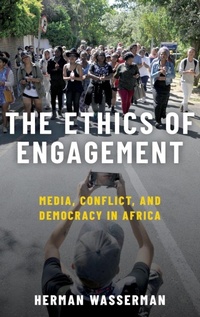
The Ethics of Engagement
Media, Conflict and Democracy in Africa
Published on 3. March 2021
Book
Hardback
216 pages
978-0-19-091733-3 (ISBN)
Description
How can an "ethics of listening" guide the media to contribute to the deepening of democracy in Africa?
In Africa, the media plays a significant role in conflict management and resolution. Which conflicts the media report, which are ignored, and how conflicts are represented can have a profound impact on the outcomes. While the media can in some cases ensure the stability of African democracy, critics have pointed out that in other cases, the media actually increases tensions in areas of conflict. The media tends to privilege only elite voices, offering superficial coverage of marginalized groups in a way that increases polarization.
In The Ethics of Engagement, Herman Wasserman explores the ethics of the media in conflicts that arise during transitions to democracy in Africa. He examines the roles, responsibilities, and obligations of media in contexts of high socioeconomic inequality. In doing so, he looks at ethnic and racial polarization in the histories of colonialism, post-colonial authoritarianism, and hybrid regimes. Taking a critical view of the normative guidelines and professional identities of journalism inherited from contexts outside of Africa, he argues that a more reciprocal and collaborative approach is needed. He develops a new ethics of engagement that would require the media to facilitate the resolution of conflicts across differences of ethnicity, citizenship, and class. A central point of this theory is the development of an "ethics of listening" which would enable the media to conceive of their role as facilitators in democratic deliberation and community-building. Wasserman applies his ethics of listening to case studies across the African continent. He finds that by following this new model of conduct, the media may actually deepen democracy and help de-escalate conflict. This original study provides a useful framework for reimaging the media's role in transitional democracies in Africa--and across the globe.
In Africa, the media plays a significant role in conflict management and resolution. Which conflicts the media report, which are ignored, and how conflicts are represented can have a profound impact on the outcomes. While the media can in some cases ensure the stability of African democracy, critics have pointed out that in other cases, the media actually increases tensions in areas of conflict. The media tends to privilege only elite voices, offering superficial coverage of marginalized groups in a way that increases polarization.
In The Ethics of Engagement, Herman Wasserman explores the ethics of the media in conflicts that arise during transitions to democracy in Africa. He examines the roles, responsibilities, and obligations of media in contexts of high socioeconomic inequality. In doing so, he looks at ethnic and racial polarization in the histories of colonialism, post-colonial authoritarianism, and hybrid regimes. Taking a critical view of the normative guidelines and professional identities of journalism inherited from contexts outside of Africa, he argues that a more reciprocal and collaborative approach is needed. He develops a new ethics of engagement that would require the media to facilitate the resolution of conflicts across differences of ethnicity, citizenship, and class. A central point of this theory is the development of an "ethics of listening" which would enable the media to conceive of their role as facilitators in democratic deliberation and community-building. Wasserman applies his ethics of listening to case studies across the African continent. He finds that by following this new model of conduct, the media may actually deepen democracy and help de-escalate conflict. This original study provides a useful framework for reimaging the media's role in transitional democracies in Africa--and across the globe.
Reviews / Votes
Wasserman's book is engaging and accessible...The Ethics of Engagement is a great book to read, with lots of food for thought for media companies, newsrooms, editors and journalists, academics and consumers of media. * Glenda Daniels, Wits University, Daily Maverick newspaper * Wasserman has written a wonderfully current, positive and important book, one that will be discussed and referred to for many years to come. * Andre Vlok, Herald * In this book of great relevance to the post-truth era, Wasserman masterfully revisits the important question of media ethics: If conflictual relations are part and parcel of society, and indeed, of democracy, how does the media provide for an ethics of representation informed by a careful negotiation and navigation of the delicate balancing act that does justice to the nuanced complexities of the sensibilities at stake? * Francis Nyamnjoh, Professor of Anthropology, University of Cape Town * This is a magnificent book, brilliant in depth and profound in analysis and problem resolution. It sets a new standard of international engagement with the resources of the South instructing the world. This dynamic alternative theory, the ethics of dialogic listening set in culture and structures, will revolutionize media education and as a normative framework for peace will transform the media's role in conflict worldwide. * Clifford Christians, Professor Emeritus of Communication, Journalism, and Media Studies, University of Illinois * Drawing examples from different countries, this book casts a critical eye over Africa's democratic journey and examines the link between media, conflict and democracy. It contends that the relationship between media and democracy in Africa is complex, giving rise to fundamental questions about the media's ability to perform democracy affirming roles prescribed by Western journalistic norms. The book offers a vital critique of the capacity of media to intervene ethically in conflicts, which inevitably arise out of transitions to democracy, and to foster democratic culture in the context of Africa's historical, structural and socio-economic realities. * Audrey Gadzekpo, Professor of Communication Studies, University of Ghana * In a book that grapples with tough and hard-hitting subjects, particularly the oft-perceived relationship between conflict, media and democracy, Herman Wasserman shows why he remains the to-go-to expert on media studies in the Global South with another brave yet refreshingly rigorous analysis on conflicts and how, despite obvious twists and turns, the media could positively contribute toward the path of democratization. * Bruce Mutsvairo, Professor of Journalism, Auburn University *More details
Language
English
Place of publication
New York
United States
Target group
Professional and scholarly
Product notice
sewn/stitched
Cloth over boards
Dimensions
Height: 239 mm
Width: 165 mm
Thickness: 23 mm
Weight
476 gr
ISBN-13
978-0-19-091733-3 (9780190917333)
Copyright in bibliographic data and cover images is held by Nielsen Book Services Limited or by the publishers or by their respective licensors: all rights reserved.
Schweitzer Classification
Other editions
Additional editions
E-Book
11/2020
1st Edition
OUP eBook
€56.49
Available for download
E-Book
11/2020
1st Edition
OUP eBook
€56.49
Available for download
Person
Herman Wasserman is Professor of Media Studies at the University of Cape Town, South Africa. He has published widely on journalism in Africa, media ethics, and global media. He is Editor-in Chief of African Journalism Studies, Editor of the Annals of the International Communication Association and Associate Editor of Communication Theory. He is a Fellow of the International Communication Association and his awards include the Georg Foster Prize from the Alexander von Humboldt Foundation and the Neva Prize for Journalism Theory from the University of St Petersburg.
Content
Acknowledgments
Chapter 1: Introduction and Overview
Chapter 2: Characterizing Conflict, Defining the Media
Chapter 3: Media, Conflict, and Democratization
Chapter 4: Media Ethics, Professionalism, Codes, and Accountability
Chapter 5: Listening for Peace: Towards Alternative Ethics of Engagement
Chapter 6: Conclusion
Chapter 1: Introduction and Overview
Chapter 2: Characterizing Conflict, Defining the Media
Chapter 3: Media, Conflict, and Democratization
Chapter 4: Media Ethics, Professionalism, Codes, and Accountability
Chapter 5: Listening for Peace: Towards Alternative Ethics of Engagement
Chapter 6: Conclusion