

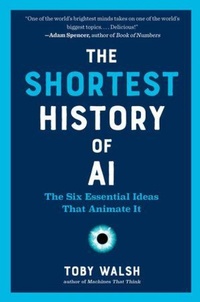
The Shortest History of AI
The Six Essential Ideas That Animate It
Published on 4. November 2025
Book
Paperback/Softback
224 pages
979-8-89303-089-1 (ISBN)
Description
Since Alan Turing first posed the question "Can machines think?" artificial intelligence has evolved from a speculative idea to a transformative force. The Shortest History of AI traces this evolution, from Ada Lovelace's visionary work to IBM's groundbreaking defeat of the chess world champion and the revolutionary emergence of ChatGPT.
Revealing how many "overnight" successes were decades in the making, this accessible and illuminating book tells AI's history through the six main ways it functions:
It uses symbols to represent common concepts and ideas.
It chooses its best possible move based on the information it is given.
It simulates human expertise by following simple rules.
It learns based on its past experiences.
It assesses its mistakes and learns to avoid making them again in the future.
It computes probability based on the evidence it's provided with.
Fast-paced and rich with facts, The Shortest History of AI explores how artificial intelligence is being created-and how it will continue to transform and affect our lives now and in the future.
The Shortest History books deliver thousands of years of history in one riveting, fast-paced read.
Revealing how many "overnight" successes were decades in the making, this accessible and illuminating book tells AI's history through the six main ways it functions:
It uses symbols to represent common concepts and ideas.
It chooses its best possible move based on the information it is given.
It simulates human expertise by following simple rules.
It learns based on its past experiences.
It assesses its mistakes and learns to avoid making them again in the future.
It computes probability based on the evidence it's provided with.
Fast-paced and rich with facts, The Shortest History of AI explores how artificial intelligence is being created-and how it will continue to transform and affect our lives now and in the future.
The Shortest History books deliver thousands of years of history in one riveting, fast-paced read.
Reviews / Votes
"This enjoyable, wide-ranging, and compact survey explains where we began and where we now find ourselves. An entertaining and concise tour." -- Kirkus "This history of AI in six simple ideas is so informative and easy to digest. Essential reading!" -- Dr. Karl Kruszelnicki "One of the world's brightest minds takes on one of the world's biggest topics. . . . Delicious!" -- Adam SpencerMore details
Series
Language
English
Place of publication
New York
United States
Product notice
Paperback (trade)
Unsewn / adhesive bound
Illustrations
B&W photos and illustrations throughout
Dimensions
Height: 196 mm
Width: 128 mm
Thickness: 18 mm
Weight
206 gr
ISBN-13
979-8-89303-089-1 (9798893030891)
Copyright in bibliographic data and cover images is held by Nielsen Book Services Limited or by the publishers or by their respective licensors: all rights reserved.
Schweitzer Classification
Other editions
Additional editions
E-Book
11/2025
The Experiment
€12.49
Available for download
Person
Toby Walsh is one of the world's leading researchers in artificial intelligence. He is a professor of artificial intelligence at the University of New South Wales and chief scientist at its new AI institute, UNSW.ai. Walsh has been profiled by The New York Times and is the author of four previous books about AI for general readers, including Machines Behaving Badly and Faking It: Artificial Intelligence in a Human World. The winner of multiple prestigious awards, including the Humboldt Prize and the Celestino Eureka Prize for Promoting Understanding of Science, his X (formerly Twitter) account was voted in the top ten to follow to keep abreast of developments in AI.
Content
Introduction: How it begins
PART 1: THE SYMBOLIC ERA
Idea #1: Searching for answers
Idea #2: Making the best move
Idea #3: Following rules
INTERMISSION
The Robots are coming
PART 2: THE LEARNING ERA
Idea #4: Artificial brains
Idea #5: Rewarding success
Idea #6: Reasoning about beliefs
PART 3: THE FUTURE
Achieving AI
Image Credits
Thanks
Endnotes
Index
PART 1: THE SYMBOLIC ERA
Idea #1: Searching for answers
Idea #2: Making the best move
Idea #3: Following rules
INTERMISSION
The Robots are coming
PART 2: THE LEARNING ERA
Idea #4: Artificial brains
Idea #5: Rewarding success
Idea #6: Reasoning about beliefs
PART 3: THE FUTURE
Achieving AI
Image Credits
Thanks
Endnotes
Index