

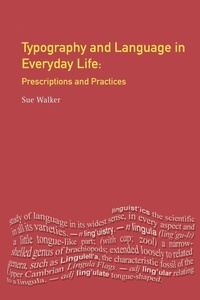
Typography & Language in Everyday Life
Prescriptions and Practices
1st Edition
Published on 13. December 2000
Book
Paperback/Softback
224 pages
978-0-582-35755-6 (ISBN)
Description
An illustrated discussion of the relationship between the graphic and linguistic elements of language, using familiar typographic examples from letter-writing conventions to the house style of printers and publishers. Language has graphic as well as linguistic aspects to it, and it is argued here that there are many opportunities for collaboration between typographers and applied linguistics. Organised in two parts, the first introduces aspects of typographic theory and history, and suggests areas of applied linguistics that offer approaches to the study of graphic language. The case studies in the second part examine everyday examples of display typography, house style and typing manuals, and letter-writing, from both theoretical and historical perspectives. Intended for a wide audience, including those unfamiliar with either these issues or the broad concepts in applied linguistics.
More details
Series
Language
English
Place of publication
London
United Kingdom
Publishing group
Taylor & Francis Ltd
Target group
Professional and scholarly
Dimensions
Height: 234 mm
Width: 156 mm
Thickness: 12 mm
Weight
351 gr
ISBN-13
978-0-582-35755-6 (9780582357556)
Copyright in bibliographic data and cover images is held by Nielsen Book Services Limited or by the publishers or by their respective licensors: all rights reserved.
Schweitzer Classification
Other editions
Additional editions
Book
01/2017
1st Edition
Routledge
€207.50
Shipment within 10-20 days
E-Book
06/2014
1st Edition
Routledge
€80.49
Available for download
E-Book
06/2014
1st Edition
Routledge
€80.49
Available for download
Person
Sue Walker is head of the Department of Typography and Graphic Communication at the University of Reading, and has published widely in this area, most notably on typography for children.
Content
1. Introduction 2. Describing typographic articulation 3. Prescription, authority, formality and status 4. Prescription and practice for non-experts 5. Prescription in house style and typing manuals 6. Letter writing 7. Ways forward for typographers and applied linguists ReferencesIndex