

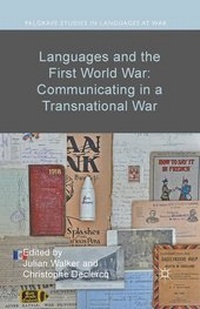
Languages and the First World War: Communicating in a Transnational War
Published on 9. June 2017
Book
Paperback/Softback
XII, 279 pages
978-1-349-71543-5 (ISBN)
Description
This book examines language change and documentation during the First World War. With contributions from international academics, the chapters cover all aspects of communicating in a transnational war including languages at the front; interpretation, translation and parallels between languages; communication with the home front; propaganda and language manipulation; and recording language during the war. This book will appeal to a wide readership, including linguists and historians and is complemented by the sister volume Languages and the First World War: Representation and Memory which examines issues around the representation and memory of the war such as portrayals in letters and diaries, documentation of language change, and the language of remembering the war.
Reviews / Votes
More details
Series
Edition
1st ed. 2016
Language
English
Place of publication
London
United Kingdom
Target group
College/higher education
Professional and scholarly
Illustrations
2 s/w Tabellen
2 Tables, black and white; XII, 279 p.
Dimensions
Height: 21.6 cm
Width: 14 cm
ISBN-13
978-1-349-71543-5 (9781349715435)
DOI
10.1057/9781137550309
Schweitzer Classification
Other editions
Additional editions
Julian Walker | Christophe Declercq
Languages and the First World War: Communicating in a Transnational War
Book
05/2016
Palgrave Macmillan
€139.09
Shipment within 10-20 days
Julian Walker | Christophe Declercq
Languages and the First World War: Communicating in a Transnational War
E-Book
05/2016
1st Edition
Palgrave Macmillan
€128.39
Available for download
Persons
Julian Walker is an educator at the British Library, an artist and writer. His books on language include Discovering Words, Team Talk: Sporting Words and their Origins and Trench Talk: Words of the First World War.Christophe Declercq is a lecturer in translation (University College London, UK and University of Antwerp, Belgium) who has been working on Belgian refugees in Britain for well over a decade. On the subject, he has spoken widely at conferences in both Britain and Belgium, has worked with the BBC and VRT (Belgian television) and manages several social media outlets.