

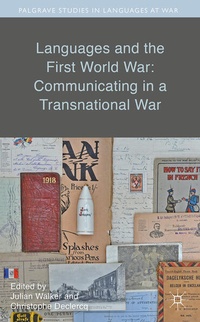
Languages and the First World War: Communicating in a Transnational War
Published on 26. May 2016
Book
Hardback
XII, 279 pages
978-1-137-55029-3 (ISBN)
Description
Julian Walker is an educator at the British Library, an artist and writer. His books on language include
Discovering Words, Team Talk: Sporting Words and their Origins
and
Trench Talk: Words of the First World War
.
Christophe Declercq is a lecturer in translation (University College London, UK and University of Antwerp, Belgium) who has been working on Belgian refugees in Britain for well over a decade. On the subject, he has spoken widely at conferences in both Britain and Belgium, has worked with the BBC and VRT (Belgian television) and manages several social media outlets.
Christophe Declercq is a lecturer in translation (University College London, UK and University of Antwerp, Belgium) who has been working on Belgian refugees in Britain for well over a decade. On the subject, he has spoken widely at conferences in both Britain and Belgium, has worked with the BBC and VRT (Belgian television) and manages several social media outlets.
Reviews / Votes
"Scholars and doctoral students in areas such as First World War Studies, transcultural studies, sociolinguistics, and the cultural history of war will find much of interest here." (Heather Merle Benbow, First World War Studies, Vol. 9 (2), March, 2019)
More details
Series
Edition
2016 ed.
Language
English
Place of publication
London
United Kingdom
Target group
Professional and scholarly
Illustrations
XII, 279 p.
Dimensions
Height: 222 mm
Width: 145 mm
Thickness: 21 mm
Weight
504 gr
ISBN-13
978-1-137-55029-3 (9781137550293)
DOI
10.1057/9781137550309
Schweitzer Classification
Other editions
Additional editions
Julian Walker | Christophe Declercq
Languages and the First World War: Communicating in a Transnational War
Book
06/2017
Palgrave Macmillan
€96.29
The article will not be published
Julian Walker | Christophe Declercq
Languages and the First World War: Communicating in a Transnational War
E-Book
05/2016
1st Edition
Palgrave Macmillan
€128.39
Available for download
Persons
Julian Walker is an educator at the British Library, an artist and writer. His books on language include Discovering Words, Team Talk: Sporting Words and their Origins and Trench Talk: Words of the First World War.
Christophe Declercq is a lecturer in translation (University College London, UK and University of Antwerp, Belgium) who has been working on Belgian refugees in Britain for well over a decade. On the subject, he has spoken widely at conferences in both Britain and Belgium, has worked with the BBC and VRT (Belgian television) and manages several social media outlets.
Christophe Declercq is a lecturer in translation (University College London, UK and University of Antwerp, Belgium) who has been working on Belgian refugees in Britain for well over a decade. On the subject, he has spoken widely at conferences in both Britain and Belgium, has worked with the BBC and VRT (Belgian television) and manages several social media outlets.
Content
PART I: LANGUAGE AT THE FRONT.- Chapter 1:'The.."parlez" is not going on very well "avec moi." Learning and using "trench French" on the Western Front'.- Chapter 2: "We did not speak a common language": African soldiers and communication in the French Army, 1914-18.- Chapter 3: Habsburg Languages at War: "The linguistic confusion at the tower of Babel couldn't have been much worse".- Chapter 4: Fritz and Tommy: Across the Barbed Wire.- Chapter 5: Caught in the crossfire; interpreters during the First World War.- PART II: WRITING HOME.- Chapter 6: Poetry, parables and codes: translating the letters of Indian soldiers.- Chapter 7: "Dear Mother, I am very sorry I cannot write to you in Welsh..." - Censorship and the Welsh language in the First World War.- Chapter 8: Sociolinguistic aspects of Italian war propaganda: Literacy, dialects and popular speech in the Italian trench journal L'Astico.- Chapter 9: Belgium and the semantic flux of Flemish, French and Flemings.- PART III:THE HOME FRONT.- Chapter 10: Malta in the First World War: Demon Kaiser or Colonizer?.- Chapter 11: From Hatred to Hybridisation: the German Language in Occupied France, 1914-1918.- Chapter 12: Persuasion vs. Deception: The Connotative Shifts of "Propaganda" and Their Critical Implications.- Chapter 13: Linguistic syncretism as a marker of ethnic purity? Jeroom Leuridan on language developments among Flemish soldiers during the First World War.- PART IV: COLLECTING CONFLICT WORDS.- Chapter 14: English Words in War-Time: Andrew Clark and living language history 1914-18.- Chapter 15: 'Extraordinary Cheeriness and Good Will': The Uses and Documentation of First World War Slang.