

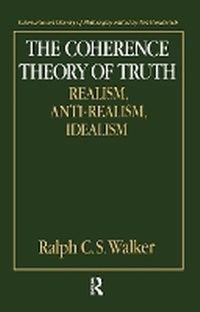
The Coherence Theory of Truth
Realism, Anti-Realism, Idealism
1st Edition
Published on 17. November 1988
Book
Hardback
260 pages
978-0-415-01868-5 (ISBN)
Description
First published in 1988. Clarifies the coherence theory and critically discusses the standard objections to it as well as those who can be interpreted as advocating it. This book should be of interest to students of philosophy and epistemology and professional philosophers. In the view of the author, contemporary philosophy the coherence theory of truth occupies rather an odd position. On the one hand a number of textbook arguments against it are widely accepted, arguments which make it look as though the theory is hardly worth serious attention. On the other hand some of the principal currents of philosophical thought seem to be flowing away from the traditional conception of truth and towards a different conception, one which some of its supporters and some of its detractors have recognized as taking truth to consist in coherence. In the first two chapters the author tries to clarify what the coherence theory is (and is not), to show that it deserves serious attention, and to exhibit the pressures that can drive one towards it. Also attempted is to show how it relates to various other things that philosophers have said about truth, and also to idealism and anti-realism.
More details
Language
English
Place of publication
London
United Kingdom
Publishing group
Taylor & Francis Ltd
Target group
College/higher education
Academic and Postgraduate
Dimensions
Height: 216 mm
Width: 138 mm
ISBN-13
978-0-415-01868-5 (9780415018685)
Copyright in bibliographic data and cover images is held by Nielsen Book Services Limited or by the publishers or by their respective licensors: all rights reserved.
Schweitzer Classification
Other editions
Additional editions
E-Book
11/2024
1st Edition
Routledge
€73.99
Available for download
E-Book
11/2024
1st Edition
Routledge
€73.99
Available for download
Content
Preface and acknowledgements, The coherence theory, Coherence, correspondence, and anti-realism, Descartes and Spinoza, Kant, Fichte and Hegel, Kant again: the problem of synthesis, Wittgenstein, Concepts and similarities, The coherence theory of knowledge, Putnam, Davidson, and Quine, Conclusion