

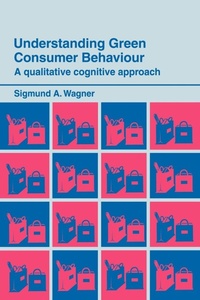
Understanding Green Consumer Behaviour
A Qualitative Cognitive Approach
1st Edition
Published on 24. April 2003
Book
Paperback/Softback
304 pages
978-0-415-31619-4 (ISBN)
Description
Despite a century of intensive research into the human mind, our understanding of how people in everyday life actually make choices and solve problems is surprisingly limited. Through the study of green, environmentally friendly consumers, this book examines basic aspects of the working of the human mind, and recommends a fundamental re-orientation regarding the ideas and methods which are applied in contemporary cognitive research. It addresses such questions as:
How do consumers develop 'meaning' regarding green products?
How are such processes subconsciously structured by certain activities of the mind?
How intelligent and successful are consumers in assessing the environmentally friendly attributes of products in daily life?
Adopting an interdisciplinary approach, drawing on insights from psychology and anthropology as well as the author's own intensive field research, the book's interdisciplinary framework allows the author to develop an understanding of the entire cognitive process. Taking an international approach, and incorporating original, ground-breaking anthropological and cognitive research, this book is a must read for advanced students of consumer behaviour, the sociology of consumption and behavioural psychology.
How do consumers develop 'meaning' regarding green products?
How are such processes subconsciously structured by certain activities of the mind?
How intelligent and successful are consumers in assessing the environmentally friendly attributes of products in daily life?
Adopting an interdisciplinary approach, drawing on insights from psychology and anthropology as well as the author's own intensive field research, the book's interdisciplinary framework allows the author to develop an understanding of the entire cognitive process. Taking an international approach, and incorporating original, ground-breaking anthropological and cognitive research, this book is a must read for advanced students of consumer behaviour, the sociology of consumption and behavioural psychology.
More details
Series
Language
English
Place of publication
London
United Kingdom
Publishing group
Taylor & Francis Ltd
Target group
College/higher education
Professional and scholarly
Dimensions
Height: 234 mm
Width: 156 mm
Thickness: 17 mm
Weight
471 gr
ISBN-13
978-0-415-31619-4 (9780415316194)
Copyright in bibliographic data and cover images is held by Nielsen Book Services Limited or by the publishers or by their respective licensors: all rights reserved.
Schweitzer Classification
Other editions
Additional editions
E-Book
09/2002
Routledge
€79.49
Available for download
E-Book
09/2002
Routledge
€79.49
Available for download

Book
11/1997
1st Edition
Routledge
€379.00
Shipment within 15-20 days
Person
Sigmund A. Wagner
Content
1. A Cognitive Study into Environmentally-Orientated Consumption 1.1 The green consumer 1.2 A research program for consumer behaviour 1.3 Researching green consumer behaviour 2. Cognitive Consumer Research 2.1 Understanding understanding 2.2 Knowledge structures 2.3 Experience, knowledge structure development and intelligence 2.4 Research questions on green consumer cognition 2.5 Conclusions 3. Empirical Research into Green Consumer Behaviour 3.1 Qualitative versus quantitative cognitive research 3.2 Data collection 3.3 Data analysis 3.4 Conclusions 4. Classification of Consumers 4.1 Classification and cluster analysis 4.2 Analyses of scattergrams and correlation matrices 4.3 Hierarchical cluster analyses 4.4 Sensitivity analyses 4.5 Paradigmatic subjects and cognitive categories 4.6 Conclusions 5. Interpretation of Knowledge Structures 5.1 Knowledge content 5.2 Cognitive operations 5.3 Schematic nature of knowledge 6. Experience and Learning: Problem-Solving Behaviour of the Green Consumer 6.1 Familiarity and learning 6.2 Ability and successful green consumer behaviour 6.3 Conclusions 7. The Beginning of Knowledge 7.1 A new approach to cognition 7.2 Conceptual fruitfulness of contextual research 7.3 Practical relevance of contextual research 7.4 Issues for future research