

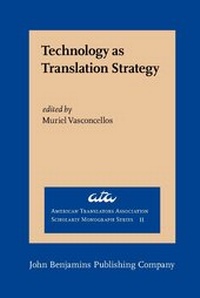
Technology as Translation Strategy
Published on 1. January 1988
Book
Hardback
248 pages
978-90-272-3177-2 (ISBN)
Description
The papers in this volume tell the story of a profession that is responding in a number of different ways to the advances in computer technology - of professionals who are streamlining their work, reducing repetitive tasks, eliminating manual operations, and in general increasing their productivity while at the same time achieving a more interesting and relaxed environment.
More details
Series
Language
English
Place of publication
Amsterdam
Netherlands
Target group
Professional and scholarly
Dimensions
Height: 245 mm
Width: 164 mm
Weight
620 gr
ISBN-13
978-90-272-3177-2 (9789027231772)
Copyright in bibliographic data and cover images is held by Nielsen Book Services Limited or by the publishers or by their respective licensors: all rights reserved.
Schweitzer Classification
Other editions
Additional editions
Muriel Vasconcellos
Technology as Translation Strategy
E-Book
01/1988
1st Edition
John Benjamins Publishing Company
€136.99
Available for download
Person
Content
1. Editor's notes; 2. Section I: the translator and ... word processing; 3. Word processing and the independent translator: A revolution in working procedures (by Sachs, Steven); 4. Translator strategies for getting the most out of word processing (by Kingscott, Geoffrey); 5. System networking for translators (by Grimes, William J.); 6. Nuts and bolts for translators: how do I get a on this #$&*@* computer? (by Smith, Kim L.); 7. The ideal workstation? Perspective of the independent translator (by Park, William M.); 8. The ideal workstation? Perspective of the In-house translator (by Vaumoron, Jean A.); 9. Introducing future translators to word processing (by Bowen, David); 10. Section II: The translator and ... the lexical data base (edited by Melby, Alan K.); 11. Introduction to lexical data bases; 12. Termium: The structure of its linguistic data (by Leonhardt, Christine); 13. Automation of terminology in the international organizations; 14. United nations (by Cassar, Nigel); 15. World Bank (by Alvey, John); 16. International Monetary Fund (by Guilmard, Patrice); 17. BTUSB: a terminology data bank for Venezuela (by Raventos de Castro, Dolores); 18. Strategies for the sharing of lexical data bases (by Melby, Alan K.); 19. Automated lookup: Autoterm of ALP systems (by Good, Robert L.); 20. Mercury: A tool for the management of specialized terminology (by Wright, Jr., Leland D.); 21. The ideal lexical database systems: A checklist of desirable features (by Melby, Alan K.); 22. Section III: the translator ... machine translation; 23. A translator's map of machine translation (by Lawson, Veronica); 24. Two Aspects of interactive machine translation (by Weaver, Alan); 25. Getting smart in many languages: MT with an option of processing (by Smart, John M.); 26. The role of the translator in making an MT system Work: Perspective of a Developer (by Ryan, Joann P.); 27. Making an MT system work: perspective of a translator (by Santangelo, Susana); 28. The translator and the postediting experience (by McElhaney, Terrence); 29. The translator and the dictionary experience (by Wheeler, Peter J.); 30. MT in large organizations: Systran at the commission of the European Communities (by Pigott, Ian M.); 31. MT in large organizations: revolution in the workplace (by Datta, Jean); 32. MT in a service service bureau: its uses and limitations (by Eng, Dawn); 33. Information-only machine translation: A feasibilty study (by Newman, Patricia E.); 34. MT and the independent translator (by Shaeffer, Leonard A.); 35. Factors in the evaluation of MT: A pragmatic approach (by Klein, Fred); 36. Factors in the evaluation of MT: formal vs functional approaches (by Vasconcellos, Muriel); 37. Roundup; 38. Deciding on the level of computer participation in translation (by Peterson-Boogaard, Jill E.); 39. Future perspectives in Translation technologies (by Hutchins, W. John); 40. Contributors; 41. Call for proposal: translator and interpreter training and foreign language pedagogy; 42. Corporate members; 43. Institutional members