

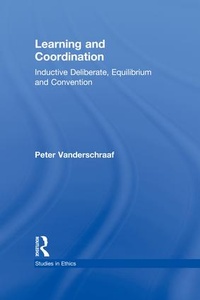
Learning and Coordination
Inductive Deliberation, Equilibrium and Convention
1st Edition
Published on 13. May 2016
Book
Paperback/Softback
244 pages
978-1-138-99530-7 (ISBN)
Description
Vanderschraaf develops a new theory of game theory equilibrium selection in this book. The new theory defends general correlated equilibrium concepts and suggests a new analysis of convention.
More details
Series
Language
English
Place of publication
London
United Kingdom
Publishing group
Taylor & Francis Ltd
Target group
College/higher education
Dimensions
Height: 234 mm
Width: 156 mm
Weight
453 gr
ISBN-13
978-1-138-99530-7 (9781138995307)
Copyright in bibliographic data and cover images is held by Nielsen Book Services Limited or by the publishers or by their respective licensors: all rights reserved.
Schweitzer Classification
Other editions
Additional editions
E-Book
01/2014
1st Edition
Routledge
€69.99
Available for download
E-Book
01/2014
1st Edition
Routledge
€69.99
Available for download

Book
03/2001
1st Edition
Routledge
€206.40
Shipment within 15-20 days
Person
Peter Vanderschraaf is Assistant Professor in the Department of Philosophy and Social and Decision Sciences at Carnegie Mellon University.
Content
1. Social Interactions and Principles of Rational Decision; 1.0 Introduction; 1.1 Examples of Social Coordination Problems; 1.2 Noncooperative Games; 1.3 Nash Equilibrium; 1.4 Examples Revisited; 1.5 Equilibrium-in-Beliefs; 1.6 Conclusions; 2. Rationalizability and Correlated Equilibrium Concepts; 2.0 Introduction; 2.1 Rationalizability; 2.3 Correlated Equilibrium Concepts; 3. Equilibrium Selection via Inductive Dynamic Deliberation; 3.0 Introduction; 3.1 The Dirichlet Rule; 3.2 Inductive Deliberation with Endogenous Correlation; 3.3 Correlating With Stages of the World; 3.4 Dirichlet Dynamics With Imperfect Memory; 3.5 Random Sampling Dirichlet Deliberation; 3.6 Deliberators With Variable States; 4. The Emergence of Social Convention; 4.0 Introduction; 4.1 Lewis' Characterization of Conventions; 4.2 Convention as Correlated Equilibrium; 4.3 Dynamical Explanations of Conventions; References; Index