

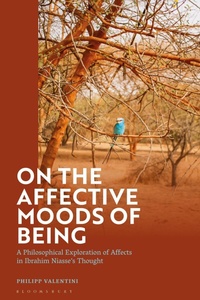
On the Affective Moods of Being
A Philosophical Exploration of Affects in Ibrahim Niasse's Thought
Will be published approx. on 5. February 2026
Book
Hardback
224 pages
978-1-350-53018-8 (ISBN)
Description
Placing Senegalese scholar and Sufi Shaykh, Ibrahim Niasse (1900-1975), in dialogue with the German philosopher Martin Heidegger (1889-1976), this book considers meditations on Being through the affects of human experience.
At the heart of the divergence between these two philosophers lies a fundamental difference in their conceptions of time: Heidegger views death as the definitive end of existence, whereas Niasse envisions existence as oriented toward apocatastasis-a return to divine origin. Yet Philipp Valentini moves beyond this contrast to examine how both philosophers root their inquiries into Being in the realm of human affect. He draws compelling parallels between their treatments of shared affective states such as dismay, vengeance, relationality (being with another), and the experience of slow, extended time.
While previous studies have approached the relationship between Heidegger and the Islamicate intellectual tradition either historically or through speculative hybridization, Valentini offers a more nuanced comparative analysis. Through an insightful juxtaposition of modern Sufi and Heideggerian thought, Valentini reveals how both thinkers engage affect under the guidance of overarching metaphysical ideas. Ultimately, On the Affective Moods of Being invites readers to reflect on a profound question: what guiding idea should shape our affective experience of Being?
At the heart of the divergence between these two philosophers lies a fundamental difference in their conceptions of time: Heidegger views death as the definitive end of existence, whereas Niasse envisions existence as oriented toward apocatastasis-a return to divine origin. Yet Philipp Valentini moves beyond this contrast to examine how both philosophers root their inquiries into Being in the realm of human affect. He draws compelling parallels between their treatments of shared affective states such as dismay, vengeance, relationality (being with another), and the experience of slow, extended time.
While previous studies have approached the relationship between Heidegger and the Islamicate intellectual tradition either historically or through speculative hybridization, Valentini offers a more nuanced comparative analysis. Through an insightful juxtaposition of modern Sufi and Heideggerian thought, Valentini reveals how both thinkers engage affect under the guidance of overarching metaphysical ideas. Ultimately, On the Affective Moods of Being invites readers to reflect on a profound question: what guiding idea should shape our affective experience of Being?
Reviews / Votes
Philipp Valentini has developed a dynamic approach to the study of two key intellectual figures, one that allows for an alternative path to the understanding of "Being" current, especially in the "West". Islamic philosophy considers existence to be conceptually indefinable. In modern times, however, both "Western" and "Islamic" intellectuals tend to reduce everything to the single question, 'What is Being? As if "Being" could be an object in itself. Niasse and Heidegger taught against this typically modern foible. Whether or not their teachings offer a viable alternative to such reductionism is, of course, for progeny to decide. * Anthony F. Shaker, a scholar of Islamicate intellectual history and German thought, has authored Reintroducing Philosophy: Thinking as the Gathering of Civilization (2020) and Modernity, Civilization and the Return to History (2017). He has also translated Sadr al-Din Qunawi's I'jaz al-bayan (2025), with a new Arabic edition (2025), and four books from Ghazali I?ya? al-?ulum (2013-25), and has published numerous papers. * A highly successful meditation on resonances across cultures from the likes of Heidegger and Niasse. Both dense and lucid, one is never lost in this lyrical discussion, but rather heartened by the glimpses of new light that occur on every page. * Todd Lawson, Associate Professor Emeritus of Islamic Thought, University of Toronto, Canada *More details
Language
English
Place of publication
London
United Kingdom
Publishing group
Bloomsbury Publishing PLC
Target group
Professional and scholarly
Illustrations
10 bw illus
Dimensions
Height: 222 mm
Width: 145 mm
Thickness: 17 mm
Weight
441 gr
ISBN-13
978-1-350-53018-8 (9781350530188)
Copyright in bibliographic data and cover images is held by Nielsen Book Services Limited or by the publishers or by their respective licensors: all rights reserved.
Schweitzer Classification
Other editions
Additional editions
Philipp Valentini
On the Affective Moods of Being
A Philosophical Exploration of Affects in Ibrahim Niasse's Thought
E-Book
01/2026
1st Edition
Bloomsbury Academic
€94.49
Available for download
Philipp Valentini
On the Affective Moods of Being
A Philosophical Exploration of Affects in Ibrahim Niasse's Thought
E-Book
01/2026
1st Edition
Bloomsbury Academic
€94.49
Available for download
Person
Philipp Valentini earned his PhD at the university of Fribourg, Switzerland (2020). His research focuses on intercultural philosophical investigation of Being and its relation to the body, as well as comparing the West African and Maghrebi Philosophical Sufi tradition with the continental European philosophical canon.
Content
Introduction
1. Adam's Confusion
2. Ibrahim and the Plant-human Tonality
3. Solomon and the Tonality of Being-with-another-than-self
4. Moses and the Labour of Learning to Endure the Long Passing of Time
5. Jesus and the Tone of Vengeance
6. Muhammad's Multiple Paternal Tones: The Keystone of Niasse's Soteriological Thinking
7. The Decision Prior to Any Decision in Heidegger and Niasse. Making the Earth Habitable' vs 'Circling the Muhammadan Election'.
1. Adam's Confusion
2. Ibrahim and the Plant-human Tonality
3. Solomon and the Tonality of Being-with-another-than-self
4. Moses and the Labour of Learning to Endure the Long Passing of Time
5. Jesus and the Tone of Vengeance
6. Muhammad's Multiple Paternal Tones: The Keystone of Niasse's Soteriological Thinking
7. The Decision Prior to Any Decision in Heidegger and Niasse. Making the Earth Habitable' vs 'Circling the Muhammadan Election'.