

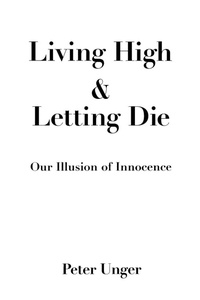
Living High and Letting Die
Our Illusion of Innocence
Published on 3. October 1996
Book
Paperback/Softback
200 pages
978-0-19-510859-0 (ISBN)
Description
By contributing a few hundred dollars to a charity like UNICEF, a prosperous person can ensure that fewer poor children die, and that more will live reasonably long, worthwhile lives. Even when knowing this, however, most people send nothing, and almost all of the rest send little. What is the moral status of this behavior? To such common cases of letting die, our untutored response is that, while it is not very good, neither is the conduct wrong. What is the source of this lenient assessment? In this contentious new book, one of our leading philosophers argues that our intuitions about ethical cases are generated not by basic moral values, but by certain distracting psychological dispositions that all too often prevent us from reacting in accord with our commitments. Through a detailed look at how these tendencies operate, Unger shows that, on the good morality that we already accept, the fatally unhelpful behavior is monstrously wrong. By uncovering the eminently sensible ethics that we've already embraced fully, and by confronting us with empirical facts and with easily followed instructions for lessening serious suffering appropriately and effectively, Unger's book points the way to a compassionate new moral philosophy.
Reviews / Votes
"A major work of fundamental importance both to moral philosophy and to the poor of this world....Important in a practical way, as well as in an academic way."--Peter Singer, Monash University and author of Animal Liberation "A terrifically powerful piece of work, and its publication will make a nuclear-sized explosion."--Jonathan Bennett, Syracuse University "Unger challenges our moral beliefs with arguments that are always powerful, and often original. Everyone who can understand these arguments ought, I believe, to read and think about this book."--Derek Parfit, Oxford University One of the most significant works of ethics published this decade. * Peter Singer, London Review of Books *More details
Language
English
Place of publication
New York
United States
Target group
Professional and scholarly
Illustrations
line figures
Dimensions
Height: 234 mm
Width: 156 mm
Thickness: 11 mm
Weight
313 gr
ISBN-13
978-0-19-510859-0 (9780195108590)
Copyright in bibliographic data and cover images is held by Nielsen Book Services Limited or by the publishers or by their respective licensors: all rights reserved.
Schweitzer Classification
Other editions
Additional editions
Book
10/1996
Oxford University Press Inc
€230.40
Shipment within 15-20 days
E-Book
06/1996
1st Edition
OUP eBook
€31.49
Available for download
E-Book
06/1996
1st Edition
OUP eBook
€31.49
Available for download
Person
Peter Unger is Professor of Philosophy at New York University. He is the author of Ignorance (OUP 1975, 2002), Philosophical Relativity (1984, OUP 2002), and Identity, Consciousness, and Value (OUP 1990).
Content
1: Illusions of Innocence: An Introduction
2: Living High and Letting Die: A Puzzle About Behavior Toward People in Great Need
3: Living High, Stealing and Letting Die: The Main Truth of Some Related Puzzles
4: Between Some Rocks and Some Hard Places: On Causing and Preventing Serious Loss
5: Between Some Harder Rocks and Rockier Hard Places: On Distortional Separating and Revelatory Grouping
6: Living High and Letting Die Reconsidered: On the Costs of a Morally Decent Life
7: Metaethics, Better Ethics: From Complex Semantics to Simple Decency
2: Living High and Letting Die: A Puzzle About Behavior Toward People in Great Need
3: Living High, Stealing and Letting Die: The Main Truth of Some Related Puzzles
4: Between Some Rocks and Some Hard Places: On Causing and Preventing Serious Loss
5: Between Some Harder Rocks and Rockier Hard Places: On Distortional Separating and Revelatory Grouping
6: Living High and Letting Die Reconsidered: On the Costs of a Morally Decent Life
7: Metaethics, Better Ethics: From Complex Semantics to Simple Decency