

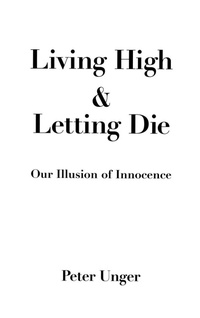
Living High and Letting Die
Our Illusion of Innocence
Published on 3. October 1996
Book
Hardback
200 pages
978-0-19-507589-2 (ISBN)
Description
Unger contends that our institutions about ethical cases are generated not by basic moral values, but by certain distracting moral mechanisms that encourage deceptive reactions.
In the first part of the book, he argues that, appearances to the contrary, our basic moral values are quite close to what philosophers now call act consequentialism. He details the nature of the most potent of the mechanisms that cause us to have false intuitions, and explains how, by blinding us to our basic moral values, they generate those reactions.
In the second part of the book Unger proposes a complex and novel metaethics, arguing that each of us can easily generate either a lenient or tough context for our ethical assessments. In Unger's view we almost always generate lenient contexts, in which we can correctly make permissive judgments about our behaviour. If we generate tough contexts, however, we will judge our ordinary behaviour to be morally wrong. Even while we can allow that most of our moral judgements to date have been correct, we can still assert that our basic moral values, and so most likely ethical reality itself, are actively compassionate and very demanding of us.
Unger's conclusions - that many of our moral judgements are in error, and accordingly much of our behaviour is grossly immoral - will be controversial and have a strong impact on the field of ethics.
In the first part of the book, he argues that, appearances to the contrary, our basic moral values are quite close to what philosophers now call act consequentialism. He details the nature of the most potent of the mechanisms that cause us to have false intuitions, and explains how, by blinding us to our basic moral values, they generate those reactions.
In the second part of the book Unger proposes a complex and novel metaethics, arguing that each of us can easily generate either a lenient or tough context for our ethical assessments. In Unger's view we almost always generate lenient contexts, in which we can correctly make permissive judgments about our behaviour. If we generate tough contexts, however, we will judge our ordinary behaviour to be morally wrong. Even while we can allow that most of our moral judgements to date have been correct, we can still assert that our basic moral values, and so most likely ethical reality itself, are actively compassionate and very demanding of us.
Unger's conclusions - that many of our moral judgements are in error, and accordingly much of our behaviour is grossly immoral - will be controversial and have a strong impact on the field of ethics.
Reviews / Votes
A book on a topic of great importance, written with much moral passion by a skilful and ingenious philosopher. * London Review of Books, 4 September 1997 * Fascinating new book. What is most exciting about Unger's book is that he seeks to use a paradigmatically non-consequentialist moral method to establish a quintessentially consequentialist conclusion... intriguing new ethical methodology. Unger's conclusion is unsettling, and the arguments he advances in favour of it engaging, original, and thought-provoking. * Tim Mulgan, Mind Vo.109 No.434 * One of the most significant works of ethics published this decade. * Peter Singer, London Review of Books *More details
Language
English
Place of publication
New York
United States
Target group
Professional and scholarly
Illustrations
line figures
Dimensions
Height: 235 mm
Width: 157 mm
Thickness: 15 mm
Weight
448 gr
ISBN-13
978-0-19-507589-2 (9780195075892)
Copyright in bibliographic data and cover images is held by Nielsen Book Services Limited or by the publishers or by their respective licensors: all rights reserved.
Schweitzer Classification
Other editions
Additional editions
Book
10/1996
Oxford University Press Inc
€50.50
Shipment within 15-20 days
E-Book
06/1996
1st Edition
OUP eBook
€31.49
Available for download
E-Book
06/1996
1st Edition
OUP eBook
€31.49
Available for download
Person
Peter Unger is Professor of Philosophy at New York University. He is the author of Ignorance (OUP 1975, 2002), Philosophical Relativity (1984, OUP 2002), and Identity, Consciousness, and Value (OUP 1990).