

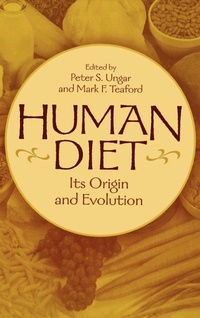
Human Diet
Its Origin and Evolution
Published on 30. March 2002
Book
Hardback
216 pages
978-0-89789-736-5 (ISBN)
Description
Diet is key to understanding the past, present, and future of our species. Much of human evolutionary success can be attributed to our ability to consume a wide range of foods. On the other hand, recent changes in the types of foods we eat may lie at the root of many of the health problems we face today. To deal with these problems, we must understand the evolution of the human diet.
Studies of traditional peoples, non-human primates, human fossil and archaeological remains, nutritional chemistry, and evolutionary medicine, to name just a few, all contribute to our understanding of the evolution of the human diet. Still, as analyses become more specialized, researchers become more narrowly focused and isolated. This volume attempts to bring together authors schooled in a variety of academic disciplines so that we might begin to build a more cohesive view of the evolution of the human diet. The book demonstrates how past diets are reconstructed using both direct analogies with living traditional peoples and non-human primates, and studies of the bones and teeth of fossils. An understanding of our ancestral diets reveals how health relates to nutrition, and conclusions can be drawn as to how we may alter our current diets to further our health.
Studies of traditional peoples, non-human primates, human fossil and archaeological remains, nutritional chemistry, and evolutionary medicine, to name just a few, all contribute to our understanding of the evolution of the human diet. Still, as analyses become more specialized, researchers become more narrowly focused and isolated. This volume attempts to bring together authors schooled in a variety of academic disciplines so that we might begin to build a more cohesive view of the evolution of the human diet. The book demonstrates how past diets are reconstructed using both direct analogies with living traditional peoples and non-human primates, and studies of the bones and teeth of fossils. An understanding of our ancestral diets reveals how health relates to nutrition, and conclusions can be drawn as to how we may alter our current diets to further our health.
More details
Language
English
Place of publication
United States
Publishing group
Bloomsbury Publishing Plc
Target group
College/higher education
Professional and scholarly
Dimensions
Height: 235 mm
Width: 157 mm
Thickness: 17 mm
Weight
508 gr
ISBN-13
978-0-89789-736-5 (9780897897365)
Copyright in bibliographic data and cover images is held by Nielsen Book Services Limited or by the publishers or by their respective licensors: all rights reserved.
Schweitzer Classification
Other editions
Additional editions
E-Book
03/2002
1st Edition
Praeger Publishers Inc
€91.49
Available for download
Persons
PETER S. UNGAR is Associate Professor of Anthropology, University of Arkansas.
MARK F. TEAFORD is Professor, Dept. of Cell Biology and Anatomy, The Johns Hopkins University School of Medicine.
MARK F. TEAFORD is Professor, Dept. of Cell Biology and Anatomy, The Johns Hopkins University School of Medicine.
Content
Perspectives on the Evolution of Human Diet by Peter S. Unger and Mark F. Teaford Evolution, Diet, and Health by S. Boyd Eaton, Stanley B. Eaton III, and Loren Cordain Post-Pleistocene Human Evolution: Bioarchaeology of the Agriculture Transition by Clark Spencer Larsen Early Childhood Health in Foragers by Sara Stinson Meat-Eating, Grandmothering, and the Evolution of Early Human Diets by James O'Connell, Kristen Hawkes, and Nicholas Blurton Jones A Two-Stage Model of Increased Dietary Quality in Early Hominid Evolution: The Role of Fiber by Nancy Lou Conklin-Brittain, Richard W. Wrangham, and Catherine C. Smith Plants of the Apes I: Is There a Hominoid Model for the Origins of the Hominoid Diet? by Peter S. Rodman Hunter-Gatherer Diets: Wild Foods Signal Relief from Diseases of Affluence by Katharine Milton Hominid Dietary Niches from Proxy Chemical Indicators in Fossils: The Swartkrans Example by Julia Lee-Thorp Paleontological Evidence for the Diets of African Plio-Pleistocene Hominids with Special Reference to Early Homo by Mark F. Teaford, Peter S. Ungar, and Frederick E. Grine Bibliography Index