

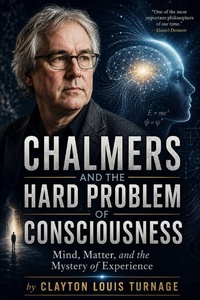
Chalmers and the Hard Problem of Consciousness
Description
What if science explained everything about the brain-except the one thing that matters most?
A brain can be scanned, mapped, stimulated, modeled, and measured. Neurons fire, information moves, memories form, words are spoken, and behavior unfolds according to physical processes. Yet one question remains stubbornly unresolved: why does any of it feel like something from the inside?
In Chalmers and the Hard Problem of Consciousness: Mind, Matter, and the Mystery of Experience, Clayton Louis Turnage explores one of the most important philosophical challenges of the modern age. David Chalmers did not reject neuroscience, artificial intelligence, or physical explanation. Instead, he asked whether they had truly explained consciousness-or only explained the functions surrounding it.
Why does pain hurt? Why does red appear red? Why is there an inner world at all?
This book guides readers through the great consciousness debate with cinematic clarity and intellectual force, examining Chalmers' famous distinction between the "easy problems" and the "hard problem," the zombie argument, Mary's room, naturalistic dualism, panpsychism, machine minds, Integrated Information Theory, and the fierce disputes with critics such as Daniel Dennett, Patricia Churchland, Keith Frankish, and leading neuroscientists.
At stake is more than philosophy. The hard problem reaches into the future of artificial intelligence, the moral status of animals and machines, the limits of neuroscience, and the possibility that reality itself may be deeper than materialism has allowed.
As part of The Consciousness & Reality Series, this volume brings the entire arc of the series to a decisive question: if the universe is lawful, mathematical, informational, evolutionary, and perhaps computational, why is any of it experienced?
Chalmers' lasting contribution was not that he solved consciousness. It was that he made it impossible to pretend the mystery had already disappeared.
For readers interested in philosophy of mind, consciousness studies, neuroscience, artificial intelligence, metaphysics, panpsychism, and the future of human thought, this book offers a powerful introduction to the mystery at the center of modern reality.
The brain may process the world. But consciousness is the question of why the world appears at all.