

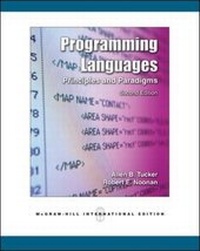
Programming Languages
2nd Edition
Published on 16. November 2006
Book
Paperback/Softback
623 pages
978-0-07-125439-7 (ISBN)
Description
Tucker and Noonan's new approach emphasizes a thorough, hands-on treatment of key issues in programming language design, providing a balanced mix of explanation and experimentation. Opening chapters present the fundamental principals of programming languages, while optional companion chapters provide implementation-based, hands-on experience that delves even deeper. This edition also includes a greatly expanded treatment of the four major programming paradigms, incorporating a number of the most current languages such as Perl and Python. Special topics presented include event-handling, concurrency, and an all-new chapter on correctness. Overall, this edition provides both broad and deep coverage of language design principles and the major paradigms, allowing users the flexibility of choosing what topics to emphasize.
More details
Edition
2nd edition
Language
English
Place of publication
London
United States
Publishing group
McGraw-Hill Education - Europe
Target group
College/higher education
Illustrations
Illustrations
Dimensions
Height: 239 mm
Width: 191 mm
Thickness: 25 mm
Weight
1098 gr
ISBN-13
978-0-07-125439-7 (9780071254397)
Copyright in bibliographic data and cover images is held by Nielsen Book Services Limited or by the publishers or by their respective licensors: all rights reserved.
Schweitzer Classification
Other editions
Previous edition
Allen Tucker | Robert Noonan
Programming Languages: Principles and Paradigms
Book
12/2001
McGraw-Hill Professional
€118.83
Article exhausted; check for reprint
Content
1 Overview
2 Syntax
3 Lexical and Syntactic Analysis
4 Names
5 Types
6 Type Systems
7 Semantics
8 Semantic Interpretation
9 Functions
10 Function Implementation
11 Memory Management
12 Imperative Programming
13 Object-Oriented Programming
14 Functional Programming
15 Logic Programming
16 Event-Driven Programming
17 Concurrent Programming
18 Program Correctness
A. Definition of Clite
B. Discrete Math Review
Glossary
Bibliography
2 Syntax
3 Lexical and Syntactic Analysis
4 Names
5 Types
6 Type Systems
7 Semantics
8 Semantic Interpretation
9 Functions
10 Function Implementation
11 Memory Management
12 Imperative Programming
13 Object-Oriented Programming
14 Functional Programming
15 Logic Programming
16 Event-Driven Programming
17 Concurrent Programming
18 Program Correctness
A. Definition of Clite
B. Discrete Math Review
Glossary
Bibliography