

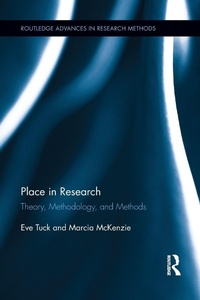
Place in Research
Theory, Methodology, and Methods
1st Edition
Published on 7. December 2015
Book
Paperback/Softback
216 pages
978-1-138-63968-3 (ISBN)
Description
Bridging environmental and Indigenous studies and drawing on critical geography, spatial theory, new materialist theory, and decolonizing theory, this dynamic volume examines the sometimes overlooked significance of place in social science research. There are often important divergences and even competing logics at work in these areas of research, some which may indeed be incommensurable. This volume explores how researchers around the globe are coming to terms - both theoretically and practically - with place in the context of settler colonialism, globalization, and environmental degradation. Tuck and McKenzie outline a trajectory of critical place inquiry that not only furthers empirical knowledge, but ethically imagines new possibilities for collaboration and action.
Critical place inquiry can involve a range of research methodologies; this volume argues that what matters is how the chosen methodology engages conceptually with place in order to mobilize methods that enable data collection and analyses that address place explicitly and politically. Unlike other approaches that attempt to superficially tag on Indigenous concerns, decolonizing conceptualizations of land and place and Indigenous methods are central, not peripheral, to practices of critical place inquiry.
Critical place inquiry can involve a range of research methodologies; this volume argues that what matters is how the chosen methodology engages conceptually with place in order to mobilize methods that enable data collection and analyses that address place explicitly and politically. Unlike other approaches that attempt to superficially tag on Indigenous concerns, decolonizing conceptualizations of land and place and Indigenous methods are central, not peripheral, to practices of critical place inquiry.
Reviews / Votes
Tuck and McKenzie uncover important areas for further research: work that links materiality to critical questions of environment, economy and society; theorisations of space and place; as well as ongoing theorisation of place in research.I consider it an invaluable companion text for anyone researching in place.
-Susan Germein,Western Sydney University, Australia
More details
Series
Language
English
Place of publication
London
United Kingdom
Publishing group
Taylor & Francis Ltd
Target group
College/higher education
Illustrations
3 s/w Abbildungen, 3 s/w Photographien bzw. Rasterbilder, 3 s/w Tabellen
3 Tables, black and white; 3 Halftones, black and white; 3 Illustrations, black and white
Dimensions
Height: 229 mm
Width: 152 mm
Thickness: 12 mm
Weight
321 gr
ISBN-13
978-1-138-63968-3 (9781138639683)
Copyright in bibliographic data and cover images is held by Nielsen Book Services Limited or by the publishers or by their respective licensors: all rights reserved.
Schweitzer Classification
Other editions
Additional editions
Book
12/2016
1st Edition
Routledge
€78.17
Withdrawn from sale
Book
09/2014
1st Edition
Routledge
€231.50
Shipment within 15-20 days
E-Book
08/2014
1st Edition
Routledge
€63.49
Available for download
E-Book
08/2014
1st Edition
Routledge
€63.49
Available for download
Persons
Eve Tuck is Associate Professor of Critical Race and Indigenous Studies in the Department of Social Justice Education at Ontario Institute for Studies in Education (OISE), University of Toronto.
Marcia McKenzie is an Associate Professor in the Department of Educational Foundations and Director of the Sustainability Education Research Institute at the University of Saskatchewan.
Marcia McKenzie is an Associate Professor in the Department of Educational Foundations and Director of the Sustainability Education Research Institute at the University of Saskatchewan.
Content
1. Introduction to Place in Research PART I 2. Conceptualizing Place 3. Decolonizing Perspectives on Place PART II 4. Methodologies of Critical Place Inquiry 5. Methods of Critical Place Inquiry 6. Indigenous Methods of Critical Place Inquiry 7. Ethical Imperatives of Critical Place Inquiry