

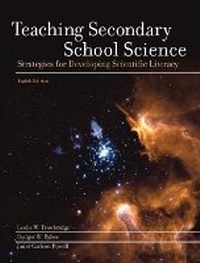
Teaching Secondary School Science
Strategies for Developing Scientific Literacy
8th Edition
Published on 11. November 2003
Book
Paperback/Softback
464 pages
978-0-13-099234-5 (ISBN)
Description
For Middle and Secondary Science Methods and Curriculum courses.
Solidly grounded in current recommendations of the National Science Education Standards, this text offers teaching guidance and strategies for physical, biological, and earth science courses for middle school, junior high, and high school. The Authors' extensive curriculum development experience imbues the text with a practical focus. Their collective knowledge of the field balances coverage of the theory and research behind the strategies they present. Also, inherent in the text is a description of the role of constructivism in science teaching and the connection between science and society including how technological development is driven by societal needs.
Solidly grounded in current recommendations of the National Science Education Standards, this text offers teaching guidance and strategies for physical, biological, and earth science courses for middle school, junior high, and high school. The Authors' extensive curriculum development experience imbues the text with a practical focus. Their collective knowledge of the field balances coverage of the theory and research behind the strategies they present. Also, inherent in the text is a description of the role of constructivism in science teaching and the connection between science and society including how technological development is driven by societal needs.
More details
Edition
8th edition
Language
English
Place of publication
United States
Publishing group
Pearson Education (US)
Target group
Professional and scholarly
Dimensions
Height: 274 mm
Width: 210 mm
Thickness: 22 mm
Weight
960 gr
ISBN-13
978-0-13-099234-5 (9780130992345)
Copyright in bibliographic data and cover images is held by Nielsen Book Services Limited or by the publishers or by their respective licensors: all rights reserved.
Schweitzer Classification
Other editions
New editions
Rodger Bybee | Janet Carlson Powell | Leslie Trowbridge
Teaching Secondary School Science
Strategies for Developing Scientific Literacy
Book
08/2007
9th Edition
Pearson
€194.35
Article exhausted; check different version
Previous edition

Leslie W. Trowbridge | Rodger W. Bybee | Janet Carlson Powell
Teaching Secondary School Science
Strategies for Developing Scientific Literacy
Book
09/1999
7th Edition
Pearson
€53.22
Article exhausted; check for reprint
Content
I. INTRODUCTION.
1. Becoming a Science Teacher.
2. Beginning Your Instructional Theory.
II. HISTORICAL PERSPECTIVES AND CONTEMPORARY TRENDS.
3. Historical Perspectives on Science Education.
4. National Standards and Scientific Literacy.
III. GOALS AND OBJECTIVES.
5. The Goals of Science Teaching.
6. The Objectives of Science Teaching.
IV. CURRICULUM PERSPECTIVES.
7. Designing a School Science Curriculum.
8. The Middle School Science Curriculum.
9. The High School Science Curriculum.
10. Science and Other Disciplines: Interdisciplinary Approaches to Curriculum.
V. PLANNING FOR INSTRUCTION AND ASSESSMENT.
11. Inquiry and Conceptual Change.
12. Questioning and Discussion.
13. Investigation and Problem Solving.
14. Demonstration and Laboratory Work.
15. Models for Effective Science Teaching.
16. Planning for Effective Science Teaching.
17. Assessing Student Learning.
VI. UNDERSTANDING AND WORKING WITH STUDENTS.
18. The Psychological Basis for Effective Science Teaching.
19. Individual Differences in Science Classrooms.
20. Teaching Science for Gender and Cultural Differences.
21. Controversy in the Classroom.
22. Classroom Management and Conflict Resolution.
VII. INDUCTION AND PROFESSIONAL DEVELOPMENT.
23. Materials for Science Teaching.
24. Student Teaching and Professional Growth.
Appendix A: Teaching Science Activities.
Appendix B: Daily Lesson Plans.
1. Becoming a Science Teacher.
2. Beginning Your Instructional Theory.
II. HISTORICAL PERSPECTIVES AND CONTEMPORARY TRENDS.
3. Historical Perspectives on Science Education.
4. National Standards and Scientific Literacy.
III. GOALS AND OBJECTIVES.
5. The Goals of Science Teaching.
6. The Objectives of Science Teaching.
IV. CURRICULUM PERSPECTIVES.
7. Designing a School Science Curriculum.
8. The Middle School Science Curriculum.
9. The High School Science Curriculum.
10. Science and Other Disciplines: Interdisciplinary Approaches to Curriculum.
V. PLANNING FOR INSTRUCTION AND ASSESSMENT.
11. Inquiry and Conceptual Change.
12. Questioning and Discussion.
13. Investigation and Problem Solving.
14. Demonstration and Laboratory Work.
15. Models for Effective Science Teaching.
16. Planning for Effective Science Teaching.
17. Assessing Student Learning.
VI. UNDERSTANDING AND WORKING WITH STUDENTS.
18. The Psychological Basis for Effective Science Teaching.
19. Individual Differences in Science Classrooms.
20. Teaching Science for Gender and Cultural Differences.
21. Controversy in the Classroom.
22. Classroom Management and Conflict Resolution.
VII. INDUCTION AND PROFESSIONAL DEVELOPMENT.
23. Materials for Science Teaching.
24. Student Teaching and Professional Growth.
Appendix A: Teaching Science Activities.
Appendix B: Daily Lesson Plans.