

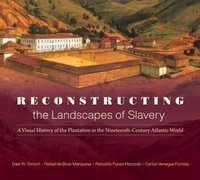
Reconstructing the Landscapes of Slavery
A Visual History of the Plantation in the Nineteenth-Century Atlantic World
Published on 19. April 2021
Book
Paperback/Softback
176 pages
978-1-4696-6312-8 (ISBN)
Description
Assessing a unique collection of more than eighty images, this innovative study of visual culture reveals the productive organization of plantation landscapes in the nineteenth-century Atlantic world. These landscapes-from cotton fields in the Lower Mississippi Valley to sugar plantations in western Cuba and coffee plantations in Brazil's Paraiba Valley-demonstrate how the restructuring of the capitalist world economy led to the formation of new zones of commodity production. By extension, these environments radically transformed slave labor and the role such labor played in the expansion of the global economy.
Artists and mapmakers documented in surprising detail how the physical organization of the landscape itself made possible the increased exploitation of enslaved labor. Reading these images today, one sees how technologies combined with evolving conceptions of plantation management that reduced enslaved workers to black bodies. Planter control of enslaved people's lives and labor maximized the production of each crop in a calculated system of production. Nature, too, was affected: the massive increase in the scale of production and new systems of cultivation increased the land's output. Responding to world economic conditions, the replication of slave-based commodity production became integral to the creation of mass markets for cotton, sugar, and coffee, which remain at the center of contemporary life.
Artists and mapmakers documented in surprising detail how the physical organization of the landscape itself made possible the increased exploitation of enslaved labor. Reading these images today, one sees how technologies combined with evolving conceptions of plantation management that reduced enslaved workers to black bodies. Planter control of enslaved people's lives and labor maximized the production of each crop in a calculated system of production. Nature, too, was affected: the massive increase in the scale of production and new systems of cultivation increased the land's output. Responding to world economic conditions, the replication of slave-based commodity production became integral to the creation of mass markets for cotton, sugar, and coffee, which remain at the center of contemporary life.
More details
Language
English
Place of publication
Chapel Hill
United States
Target group
Professional and scholarly
Product notice
Paperback (trade)
Illustrations
84 colour plates, 1 map, 1 table
Dimensions
Height: 251 mm
Width: 226 mm
Thickness: 13 mm
Weight
570 gr
ISBN-13
978-1-4696-6312-8 (9781469663128)
Copyright in bibliographic data and cover images is held by Nielsen Book Services Limited or by the publishers or by their respective licensors: all rights reserved.
Schweitzer Classification
Other editions
Additional editions

Dale W. Tomich | Rafael de Bivar Marquese | Carlos Venegas Fornias
Reconstructing the Landscapes of Slavery
A Visual History of the Plantation in the Nineteenth-Century Atlantic World
E-Book
03/2021
The University of North Carolina Press
€24.49
Available for download
Persons
Dale W. Tomich is professor emeritus of sociology at Binghamton University.
Reinaldo Funes Monzote is professor of history at the University of Havana.
Carlos Venegas Fornias is a researcher at Centro de Investigaciones Juan Marinello in Havana.
Rafael de Bivar Marquese is professor of history at the University of Sao Paulo in Brazil.
Reinaldo Funes Monzote is professor of history at the University of Havana.
Carlos Venegas Fornias is a researcher at Centro de Investigaciones Juan Marinello in Havana.
Rafael de Bivar Marquese is professor of history at the University of Sao Paulo in Brazil.