

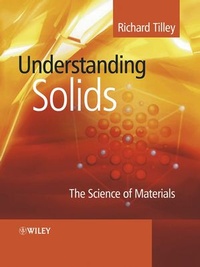
Understanding Solids
The Science of Materials
1st Edition
Published on 27. July 2004
Book
Hardback
616 pages
978-0-470-85275-0 (ISBN)
Description
A modern introduction to the subject taking a unique integrated approach designed to appeal to both science and engineering students. Covering a broad spectrum of topics, this book includes numerous up-to-date examples of real materials with relevant applications and a modern treatment of key concepts. The science bias allows this book to be equally accessible to engineers, chemists and physicists.
* Carefully structured into self-contained bite-sized chapters to enhance student understanding
* Questions have been designed to reinforce the concepts presented
* Includes coverage of radioactivity
* Relects a rapidly growing field from the science perspective
* Carefully structured into self-contained bite-sized chapters to enhance student understanding
* Questions have been designed to reinforce the concepts presented
* Includes coverage of radioactivity
* Relects a rapidly growing field from the science perspective
Reviews / Votes
"...in nearly 600 pages there is much from which a student will learn." (Chemistry World, Vol.2, No.4, April 2005) "...excellent, up--to--date and highly readable...I have no hesitation in recommending it to anyone..." (Journal of Materials Technology, Vol 19 (4) 2005)More details
Edition
1., Auflage
Language
English
Place of publication
Chichester
United Kingdom
Publishing group
John Wiley and Sons Ltd
Target group
College/higher education
Illustrations
Illustrations
Dimensions
Height: 25.4 cm
Width: 20 cm
Thickness: 40 mm
Weight
1468 gr
ISBN-13
978-0-470-85275-0 (9780470852750)
Schweitzer Classification
Other editions
New editions
Book
04/2013
2nd Edition
Wiley
€169.00
Shipment within 15-20 days
Additional editions
Book
07/2004
1st Edition
Wiley
€55.90
Article exhausted; check different version
Content
PREFACE.
PART 1. STRUCTURES AND MICROSTRUCTURES.
Chapter 1. The Electron Structure of Atoms.
Chapter 2. Chemical Bonding.
Chapter 3. States of Aggregation.
Chapter 4. Phase Diagrams.
Chapter 5. Crystallography and Crystal Structures.
PART 2. CLASSES OF MATERIALS.
Chapter 6. Metals, Ceramics, Polymers and Composites.
PART 3. REACTIONS AND TRANSFORMATIONS.
Chapter 7. Diffusion.
Chapter 8. Reactions and Transformations.
Chapter 9. Oxidation and Reduction.
PART 4. PHYSICAL PROPERTIES.
Chapter 10. Mechanical Properties of Solids.
Chapter 11. Insulating Solids.
Chapter 12. Magnetic Solids.
Chapter 13. Electronic Conductivity in Solids.
Chapter 14. Optical Aspects of Solids.
Chapter 15. Thermal Properties.
PART 5. NUCLEAR PROPERTIES OF SOLIDS.
Chapter 16. Radioactivity and Nuclear Reactions.
ANSWERS TO PROBLEMS AND EXERCISES.
INDEX.
PART 1. STRUCTURES AND MICROSTRUCTURES.
Chapter 1. The Electron Structure of Atoms.
Chapter 2. Chemical Bonding.
Chapter 3. States of Aggregation.
Chapter 4. Phase Diagrams.
Chapter 5. Crystallography and Crystal Structures.
PART 2. CLASSES OF MATERIALS.
Chapter 6. Metals, Ceramics, Polymers and Composites.
PART 3. REACTIONS AND TRANSFORMATIONS.
Chapter 7. Diffusion.
Chapter 8. Reactions and Transformations.
Chapter 9. Oxidation and Reduction.
PART 4. PHYSICAL PROPERTIES.
Chapter 10. Mechanical Properties of Solids.
Chapter 11. Insulating Solids.
Chapter 12. Magnetic Solids.
Chapter 13. Electronic Conductivity in Solids.
Chapter 14. Optical Aspects of Solids.
Chapter 15. Thermal Properties.
PART 5. NUCLEAR PROPERTIES OF SOLIDS.
Chapter 16. Radioactivity and Nuclear Reactions.
ANSWERS TO PROBLEMS AND EXERCISES.
INDEX.