

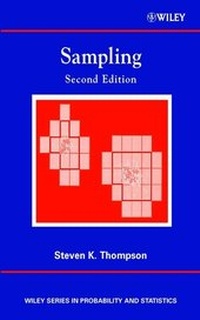
Sampling
2nd Edition
Published on 4. April 2002
Book
Hardback
400 pages
978-0-471-29116-9 (ISBN)
Description
From the reviews of the First Edition:
"A well-written book that deserves to be widely used, both by statistics teachers and by researchers."
-Biometrics
"The explanations are clear and concise, the presentation is extremely pleasing, the references are up to date, and there is an abundance of examples."
-Short Book Reviews
"This is a highly recommended acquisition for any statistician concerned with the collection of sample information."
-Technometrics
All aspects of obtaining, interpreting, and using sample data in a new revised volume
Sampling provides an up-to-date treatment of both classical and modern sampling design and estimation methods, along with sampling methods for rare, clustered, and hard-to-detect populations. This Second Edition's extensive new material includes descriptions of new developments, a wider range of approaches to common problems, historical notes, and increased coverage of topics such as methods that combine design and model-based approaches, adjusting for nonsampling errors, and the use of link-tracing designs. Updated chapters show how relevant sampling methods function within such fields as the biological, environmental, and geological sciences; social and health sciences; and sampling the Internet.
Organized into six sections, this edition covers basic sampling, from simple random to unequal probability sampling; the use of auxiliary data with ratio estimators and regression estimation; sufficient data, model, and design in practical sampling; useful designs such as stratified, cluster and systematic, multistage, double and network sampling; detectability methods for elusive populations; spatial sampling; and adaptive sampling designs. Additional derivations, notes on underlying ideas, exercises, and examples foster a greater mastery of the presented techniques. New numerical examples, small-population examples, and exercises have been added.
Featuring a wider range of topics than other sampling books, Sampling, Second Edition is the ideal reference for scientific researchers and other professionals who use sampling, as well as students in sampling courses.
"A well-written book that deserves to be widely used, both by statistics teachers and by researchers."
-Biometrics
"The explanations are clear and concise, the presentation is extremely pleasing, the references are up to date, and there is an abundance of examples."
-Short Book Reviews
"This is a highly recommended acquisition for any statistician concerned with the collection of sample information."
-Technometrics
All aspects of obtaining, interpreting, and using sample data in a new revised volume
Sampling provides an up-to-date treatment of both classical and modern sampling design and estimation methods, along with sampling methods for rare, clustered, and hard-to-detect populations. This Second Edition's extensive new material includes descriptions of new developments, a wider range of approaches to common problems, historical notes, and increased coverage of topics such as methods that combine design and model-based approaches, adjusting for nonsampling errors, and the use of link-tracing designs. Updated chapters show how relevant sampling methods function within such fields as the biological, environmental, and geological sciences; social and health sciences; and sampling the Internet.
Organized into six sections, this edition covers basic sampling, from simple random to unequal probability sampling; the use of auxiliary data with ratio estimators and regression estimation; sufficient data, model, and design in practical sampling; useful designs such as stratified, cluster and systematic, multistage, double and network sampling; detectability methods for elusive populations; spatial sampling; and adaptive sampling designs. Additional derivations, notes on underlying ideas, exercises, and examples foster a greater mastery of the presented techniques. New numerical examples, small-population examples, and exercises have been added.
Featuring a wider range of topics than other sampling books, Sampling, Second Edition is the ideal reference for scientific researchers and other professionals who use sampling, as well as students in sampling courses.
Reviews / Votes
"This is an informative and clearly written book that will serve as a useful reference for researchers and as an introduction for students " (Statistics in Medical Research, October 2005) "...treats both classical and modern sampling design and estimation methods, along with sampling methods for rare, clustered, and hard to detect populations." (SciTech Book News, Vol. 26, No. 2, June 2002) "...a well written and expanded new edition...an excellent book on an important subject. Highly recommended..." (Choice, Vol. 40, No. 2, October 2002) "This book has never had a competitor. It is the only book that takes a broad approach to sampling...any good personal statistics library should include a copy of this book." (Technometrics, Vol. 44, No. 4, November 2002) "...an ideal reference for scientific researchers and other professionals who use sampling..."(Zentralblatt Math, Vol.1002, No.02, 2003)More details
Series
Edition
2., Auflage
Language
English
Place of publication
New York
United States
Publishing group
John Wiley and Sons Ltd
Target group
College/higher education
Professional and scholarly
Edition type
Revised edition
Illustrations
Ill.
Dimensions
Height: 24 cm
Width: 16.1 cm
Thickness: 24 mm
Weight
680 gr
ISBN-13
978-0-471-29116-9 (9780471291169)
Schweitzer Classification
Other editions

Person
STEVEN K. THOMPSON, PhD, is Professor of Statistics at the Pennsylvania State University. During his career he has served on the faculties of the University of Auckland and the University of Alaska. He is the author of Adaptive Sampling (with George Seber), also published by Wiley.
Content
Preface to the Second Edition.
Preface to the First Edition.
1. Introduction.
PART I: BASIC SAMPLING.
2. Simple Random Sampling.
3. Confidence Intervals.
4. Sample Size.
5. Estimating Proportions, Ratios, and Subpopulation Means.
6. Unequal Probability Sampling.
PART II: MAKING THE BEST USE OF SURVEY DATA.
7. Auxiliary Data and Ratio Estimation.
8. Regression Estimation.
9. The Sufficient Statistic in Sampling.
10. Design and Model.
PART III SOME USEFUL DESIGNS.
11. Stratified Sampling.
12. Cluster and Systematic Sampling.
13. Multistage Designs.
14. Double or Two-Phase Sampling.
PART IV METHODS FOR ELUSIVE AND HARD-TO-DETECT POPULATIONS.
15. Network Sampling and Link-Tracing Designs.
16. Detectability and Sampling.
17. Line and Point Transects.
18. Capture-Recapture Sampling.
19. Line-Intercept Sampling.
PART V SPATIAL SAMPLING.
20. Spatial Prediction or Kriging.
21. Spatial Designs.
22. Plot Shapes and Observational Methods.
PART VI ADAPTIVE SAMPLING.
23. Adaptive Sampling Designs.
24. Adaptive Cluster Sampling.
25. Systematic and Strip Adaptive Cluster Sampling.
26. Stratified Adaptive Cluster Sampling.
Answers to Selected Exercises.
References.
Author Index.
Subject Index.
Preface to the First Edition.
1. Introduction.
PART I: BASIC SAMPLING.
2. Simple Random Sampling.
3. Confidence Intervals.
4. Sample Size.
5. Estimating Proportions, Ratios, and Subpopulation Means.
6. Unequal Probability Sampling.
PART II: MAKING THE BEST USE OF SURVEY DATA.
7. Auxiliary Data and Ratio Estimation.
8. Regression Estimation.
9. The Sufficient Statistic in Sampling.
10. Design and Model.
PART III SOME USEFUL DESIGNS.
11. Stratified Sampling.
12. Cluster and Systematic Sampling.
13. Multistage Designs.
14. Double or Two-Phase Sampling.
PART IV METHODS FOR ELUSIVE AND HARD-TO-DETECT POPULATIONS.
15. Network Sampling and Link-Tracing Designs.
16. Detectability and Sampling.
17. Line and Point Transects.
18. Capture-Recapture Sampling.
19. Line-Intercept Sampling.
PART V SPATIAL SAMPLING.
20. Spatial Prediction or Kriging.
21. Spatial Designs.
22. Plot Shapes and Observational Methods.
PART VI ADAPTIVE SAMPLING.
23. Adaptive Sampling Designs.
24. Adaptive Cluster Sampling.
25. Systematic and Strip Adaptive Cluster Sampling.
26. Stratified Adaptive Cluster Sampling.
Answers to Selected Exercises.
References.
Author Index.
Subject Index.