

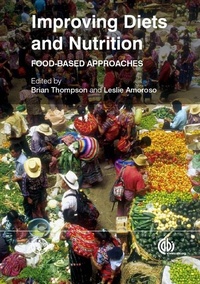
Improving Diets and Nutrition
Food-based Approaches
Published on 28. April 2014
Book
Hardback
454 pages
978-1-78064-299-4 (ISBN)
Description
Nutrition-sensitive, food-based approaches towards hunger and malnutrition are effective, sustainable and long-term solutions. This book discusses the policy, strategic, methodological, technical and programmatic issues associated with such approaches, proposes "best practices" for the design, targeting, implementation and evaluation of specific nutrition-sensitive, food-based interventions and for improved methodologies for evaluating their efficacy and cost-effectiveness, and provides practical lessons for advancing nutrition-sensitive food-based approaches for improving nutrition at policy and programme level.
More details
Series
Language
English
Place of publication
Wallingford
United Kingdom
Target group
College/higher education
Professional and scholarly
Product notice
sewn/stitched
Cloth over boards
Dimensions
Height: 244 mm
Width: 175 mm
Thickness: 30 mm
Weight
1098 gr
ISBN-13
978-1-78064-299-4 (9781780642994)
Copyright in bibliographic data and cover images is held by Nielsen Book Services Limited or by the publishers or by their respective licensors: all rights reserved.
Schweitzer Classification
Other editions
Additional editions
E-Book
04/2014
CABI Publishing
€210.99
Available for download
Persons
, MSc in Human Nutrition, London School of Hygiene and Tropical Medicine, UK, is a nutritionist with over 30 years of international development experience. He is Senior Nutrition Officer in the Nutrition and Consumer Protection Division of FAO dealing with Nutrition Security and Policy. Working initially for ICRC, WFP and UNICEF with the NGO community in Asia over five years, he led nutrition surveys, provided clinical treatment, designed and evaluated emergency relief and recovery programmes including feeding programmes, supported health prevention and promotion activities and coordinated the provision of comprehensive humanitarian aid to refugees and other vulnerable communities. He joined FAO Headquarters in Rome in 1987 and advises Member Countries on the development and implementation of policies, strategies and plans of action for promoting and improving food and nutrition security in both emergency and development contexts. has a Masters in Urban and Regional Planning for Developing Countries with emphasis on food and nutrition security and livelihood issues from the Istituto Universitario di Architettura di Venezia (IUAV), Venice, Italy. She has extensive international experience in food and nutrition security policy and programme-related activities, with childhood, gender and HIV/AIDS components, in Ethiopia, The Gambia and Nicaragua. Since 2007, she has been working as a Nutrition Consultant in the Nutrition Security and Policy Group, Nutrition and Consumer Protection Division, FAO, where she provides advice and support to policy, strategy, capacity building, advocacy and programme activities aimed at improving food and nutrition security among vulnerable population groups. Ms Amoroso also collaborates on several initiatives designed to strengthen linkages between food and nutrition security assessment and decision making at policy and programme level.
Content
a: About the Editors b: Contributors c: Contributor Biographies d: Foreword Preface 1: Preface Preface 2: Address on behalf of the 1 billion hungry project Preface 3: Welcome Address Preface 4: Opening Address e: Acknowledgments f: Introduction Part I: Overview 1: Perspective on Nutritional Problems in Developing Countries: Nutrition Security Through Community Agriculture 2: Food Systems and Human Nutrition: Relationships and Policy Interventions Part II: Policy and Programme Experiences 3: Enhancing the Performance of Food-based Strategies to Improve Micronutrient Status and Associated Health Outcomes in Young Children from Poor Resource Households in Low-income Countries: Challenges and Solutions 4: Food-based Approaches for Combating Malnutrition - Lessons Lost? 5: Critical Issues to Consider in the Selection of Crops in a Food-based Approach to Improve Vitamin A Status - Based on a South African Experience 6: Contribution of Homestead Food Production to Improved Household Food Security and Nutritional Status - Lessons Learned from Bangladesh, Cambodia, Nepal and the Philippines 7: The Under-estimated Impact of Food-based Interventions 8: The Current Nutritional Status in China 9: Integrating Nutrition into Agricultural and Rural Development Policies: the Brazilian Experience of Building an Innovative Food and Nutrition Security Approach 10: Gender Informed Nutrition and Agriculture (GINA) Alliance and Nutrition Collaborative Research Support Program (NCRSP) 11: Guyana's Hinterland Community-based School Feeding Program 12: The Impact of School Food Standards on Children's Eating Habits in England 13: Animal Source Foods as a Food-based Approach to Improve Diet and Nutrition Outcomes 14: Adapting Food-based Strategies to Improve the Nutrition of the Landless: a Review of HKI's Homestead Food Production Programme in Bangladesh 15: The Growing Connection Project - Mexico Case Study 16: Biofortification: a New Tool to Reduce Micronutrient Malnutrition 17: Medium-scale Fortification: a Sustainable Food-based Approach to Improve Diets and Raise Nutrition Levels 18: Optimized Feeding Recommendations and In-home Fortification to Improve the Iron Status in Infants and Young Children in the Republic of Tajikistan: a Pilot Project 19: Towards Long-term Nutritional Security: the Role of Agriculture in Dietary Diversity 20: Building Nutritional Self-reliance Part III: Contribution of FAO Departments and Divisions 21: Measurement of Dietary Diversity for Monitoring the Impact of Food-based Approaches 22: Nutrition Education and Food Security Interventions to Improve Complementary Feeding in Cambodia 23: Activities of the Animal Production and Health Division (AGA) to Improve Food and Nutrition Security 24: The Role of the Plant Production and Protection Division (AGP) in Supporting Crop Diversification for Sustainable Diets and Nutrition 25: Impact of Rural Infrastructures and Agro-Industries Division (AGS) Work for Improving Food and Nutrition Security 26: The Agricultural Development Economics Division of FAO (ESA) Work on Nutrition 27: Towards an Improved Framework for Measuring Undernourishment 28: Gender Dimensions of Food and Nutrition Security: Women's Roles in Ensuring the Success of Food-based Approaches 29: Food-based Approaches for Improving Diets and Raising Levels of Nutrition: The Fish Story 30: Forestry in Improving Food Security and Nutrition 31: Legal and Institutional Aspects of Food and Nutrition Security 32: Food and Agriculture-based Approaches to Safeguarding Nutrition Before, During and After Emergencies: the Experience of FAO 33: Lessons from Support Given to the Implementation of Food Security Programmes in Over 100 Countries: the Feasibility of Integrated Food and Nutrition Security (F&NS) Approaches 34: Using Information Networks to Promote Improved Nutrition and Rural Development: FAO's Experience of Promoting School Milk Programmes 35: FAO Support to the CAADP Process 36: Selected Findings and Recommendations g: Index