

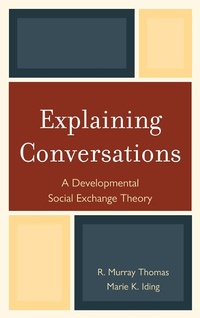
Explaining Conversations
A Developmental Social Exchange Theory
Published on 15. December 2011
Book
Hardback
218 pages
978-0-7657-0872-4 (ISBN)
Description
Explaining Conversations offers a different way of interpreting people's social exchanges than has been available in the past. The book is replete with examples of people's verbal interactions in the form of chats, arguments, debates, and negotiations, both within a culture and across cultures. The volume's subtitle, A Developmental Social-Exchange Theory, identifies a theme featured in Chapters 2 and 5-the typical pattern by which social-exchange skills evolve over the first two decades of life. Throughout the book, the underlying meanings of conversations are interpreted in terms of (a) the needs people seek to fulfill through their conversations, (b) the influence of a person's culture on what is said, (c) individuals' patterns of thought (metacognition) during a conversation, (d) how people's expectations about a conversation affect what they will say, and (e) strategies individuals adopt to achieve their goals. The book includes a chapter designed to guide parents and teachers in promoting young children's and adolescents' social-exchange skills.
Reviews / Votes
Drawing on the analysis of a multitude of conversations, Thomas and Iding get and keep the attention of the reader to state their case in Explaining Conversations: A Developmental Social Exchange Theory. The uninitiated will gain new understandings of this important subject and the initiated will be afforded the opportunity to check what they have learned to date. I recommend this book without reservation. As with any newly created theory, its exploratory nature will bring important heuristic value to scholars and lay persons alike. -- Dale L. Brubaker, Professor Emeritus, University of North Carolina, Greensboro R. Murray Thomas and his colleagues always seem to plow new ground in comparative human development and its application to scholarship, education, and life. This book is no exception. Here, Thomas and Iding turn attention from the more macro elements of that development to its bricks and mortar-social exchange, particularly through conversation. Using vignettes drawn from around the world, the authors clearly propose, amply illustrate, and pointedly apply a new life span theory of conversational social exchange skill development particularly in childhood and adolescence. Bold psycho-social, interactional concepts like 'mind reading' and stages of social exchange skill development are blended with older interactional concepts like culture and human needs. The result is an intellectually and practically appealing volume useful to anyone-scholar, educator, and parent alike-who hopes to lead kids and youths through better conversations. -- James H. Block, Professor Emeritus, University of California Santa Barbara This delightful book will catapult you into new awareness of how our own issues and beliefs affect our social communication skills. The vivid vignettes in this book raise awareness of how we need to hone these skills, to become more sensitive, as well as effective, in understanding the ideas and meanings of others as well as promoting our own ideas and needs in an increasingly multicultural world. -- Alice Honig, Professor Emerita, Syracuse UniversityMore details
Language
English
Place of publication
Northvale NJ
United States
Target group
Professional and scholarly
Product notice
Laminated cover
Dimensions
Height: 239 mm
Width: 162 mm
Thickness: 6 mm
Weight
244 gr
ISBN-13
978-0-7657-0872-4 (9780765708724)
Copyright in bibliographic data and cover images is held by Nielsen Book Services Limited or by the publishers or by their respective licensors: all rights reserved.
Schweitzer Classification
Other editions
Additional editions
E-Book
12/2011
1st Edition
Jason Aronson, Inc.
€93.99
Available for download
E-Book
12/2011
1st Edition
Jason Aronson, Inc.
€93.99
Available for download
Persons
R. Murray Thomas, PhD is professor emeritus at University of California, Santa Barbara's Graduate School of Education. Marie Kathleen Iding, PhD is a professor of Educational Psychology at the University of Hawaii.
Content
Preface
Part I: Introduction
Chapter 1: The Nature of Social Exchanges
Chapter 2: The Anatomy of the Theory
Part II: The Theory Components
Chapter 3: Needs as Motivators
Chapter 4: The Significance of Culture
Chapter 5: Developmental Stairways
Chapter 6: The Role of Issues and Beliefs
Part III: Enhancing Social-Exchange Skill-Development
Chapter 7: Further Features of Exchanges
Chapter 8: Coping with Cross-Cultural Encounters
Chapter 9: Promoting Social-Exchange Skill-Development
Part IV: Afterthoughts
Chapter 10: Unfinished Business
References
Index
About the Authors
Part I: Introduction
Chapter 1: The Nature of Social Exchanges
Chapter 2: The Anatomy of the Theory
Part II: The Theory Components
Chapter 3: Needs as Motivators
Chapter 4: The Significance of Culture
Chapter 5: Developmental Stairways
Chapter 6: The Role of Issues and Beliefs
Part III: Enhancing Social-Exchange Skill-Development
Chapter 7: Further Features of Exchanges
Chapter 8: Coping with Cross-Cultural Encounters
Chapter 9: Promoting Social-Exchange Skill-Development
Part IV: Afterthoughts
Chapter 10: Unfinished Business
References
Index
About the Authors