

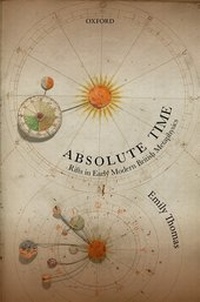
Absolute Time
Rifts in Early Modern British Metaphysics
Published on 5. April 2018
Book
Hardback
254 pages
978-0-19-880793-3 (ISBN)
Description
What is time? This is one of the most fundamental questions we can ask. Traditionally, the answer was that time is a product of the human mind, or of the motion of celestial bodies. In the mid-seventeenth century, a new kind of answer emerged: time or eternal duration is 'absolute', in the sense that it is independent of human minds and material bodies.
Emily Thomas explores the development of absolute time or eternal duration during one of Britain's richest and most creative metaphysical periods, from the 1640s to the 1730s. She introduces an interconnected set of main characters - Henry More, Walter Charleton, Isaac Barrow, Isaac Newton, John Locke, Samuel Clarke, and John Jackson - alongside a large and varied supporting cast, whose metaphysical views are all read in their historical context and given a place in the seventeenth- and eighteenth-century development of thought about time.
Emily Thomas explores the development of absolute time or eternal duration during one of Britain's richest and most creative metaphysical periods, from the 1640s to the 1730s. She introduces an interconnected set of main characters - Henry More, Walter Charleton, Isaac Barrow, Isaac Newton, John Locke, Samuel Clarke, and John Jackson - alongside a large and varied supporting cast, whose metaphysical views are all read in their historical context and given a place in the seventeenth- and eighteenth-century development of thought about time.
Reviews / Votes
Thomas's book contains a number of productive discussions, and it could prove a catalyst for further investigations into early modern spatiotemporal metaphysics. * Edward Slowik, Journal of the History of Philosophy * this is a fascinating book. Whether you agree or disagree with any particular thesis in it, it will make you rethink, look afresh at familiar writings, and with interest at unfamiliar ones * J. J. MacIntosh, H-Albion *More details
Language
English
Place of publication
Oxford
United Kingdom
Target group
College/higher education
Professional and scholarly
Dimensions
Height: 241 mm
Width: 164 mm
Thickness: 21 mm
Weight
542 gr
ISBN-13
978-0-19-880793-3 (9780198807933)
Copyright in bibliographic data and cover images is held by Nielsen Book Services Limited or by the publishers or by their respective licensors: all rights reserved.
Schweitzer Classification
Other editions
Additional editions
E-Book
03/2018
1st Edition
OUP eBook
€44.99
Available for download
E-Book
03/2018
1st Edition
OUP eBook
€52.49
Available for download
Person
Emily Thomas is Assistant Professor in Philosphy at Durham University. She completed her PhD at the University of Cambridge (2013) and held a postdoc at the University of Groningen (2013-2016) before arriving at Durham. She mostly works on space and time in the history of philosophy, and is especially fond of excavating the work of philosophically rich but understudied figures.
Content
Introduction
1: Scene Setting: Time, Philosophy, and Seventeenth Century Britain
2: Henry More and the Development of Absolute Time
3: A Continental Interlude: Time in van Helmont, Gassendi, and Charleton
4: Space and Time in Isaac Barrow: A Modal Relationist Metaphysic
5: Early British Reactions to Absolutism: 1664 to 1687
6: Newton's De Gravitatione on God and his Emanative Effects
7: Locke's Steadfast Time and Space Relationism
8: Later British Reactions to Absolutism: 1690-1704
9: Samuel Clarke's Evolving Morean Absolutism
10: Last Battles over Absolutism: 1704 Onwards
Conclusion
1: Scene Setting: Time, Philosophy, and Seventeenth Century Britain
2: Henry More and the Development of Absolute Time
3: A Continental Interlude: Time in van Helmont, Gassendi, and Charleton
4: Space and Time in Isaac Barrow: A Modal Relationist Metaphysic
5: Early British Reactions to Absolutism: 1664 to 1687
6: Newton's De Gravitatione on God and his Emanative Effects
7: Locke's Steadfast Time and Space Relationism
8: Later British Reactions to Absolutism: 1690-1704
9: Samuel Clarke's Evolving Morean Absolutism
10: Last Battles over Absolutism: 1704 Onwards
Conclusion