

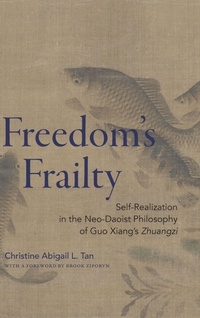
Freedom's Frailty
Self-Realization in the Neo-Daoist Philosophy of Guo Xiang's Zhuangzi
Published on 1. April 2024
Book
Hardback
218 pages
978-1-4384-9746-4 (ISBN)
Description
Draws on Guo Xiang's commentary on the Zhuangzi to construct an account of freedom that is both metaphysical and political.
This book starts with the radical premise that the most coherent way to read the Zhuangzi is through Guo Xiang (d. 312 CE), the classic Daoist text's first and most important commentator, and that the best way to read Guo Xiang is politically. Offering an investigation of the notions of causality, self, freedom, and its political implications, the book provides a comprehensive account of freedom that is both ontological and political, using Guo's notion of self-realization (??zide). This is a conception of freedom that introduces a "dependence-based autonomy," in which freedom is something we achieve and realize through our connection to others. The notion that a subject is born with freedom-and that one can return to it by isolating oneself from others-would be a strange idea not just to Guo but to most Chinese philosophers. Rather, freedom is complex and frail, and only the kind of freedom that is collectively attained through radical dependence can be worth having. In sum, the book makes a new contribution to Chinese philosophical scholarship as well as philosophical debates on freedom.
This book starts with the radical premise that the most coherent way to read the Zhuangzi is through Guo Xiang (d. 312 CE), the classic Daoist text's first and most important commentator, and that the best way to read Guo Xiang is politically. Offering an investigation of the notions of causality, self, freedom, and its political implications, the book provides a comprehensive account of freedom that is both ontological and political, using Guo's notion of self-realization (??zide). This is a conception of freedom that introduces a "dependence-based autonomy," in which freedom is something we achieve and realize through our connection to others. The notion that a subject is born with freedom-and that one can return to it by isolating oneself from others-would be a strange idea not just to Guo but to most Chinese philosophers. Rather, freedom is complex and frail, and only the kind of freedom that is collectively attained through radical dependence can be worth having. In sum, the book makes a new contribution to Chinese philosophical scholarship as well as philosophical debates on freedom.
Reviews / Votes
"the book makes a wonderful contribution to both scholarship on Daoist philosophy and Chinese metaphysics. It will be useful for scholars that are interested in Lao-Zhuang Daoism, later Daoist philosophers of the Xuanxue () school, and also scholars of Chinese Buddhism because of the similarities between Guo's ideas and Buddhist metaphysics. The book's greatest strengths are how it presents Guo's ideas regarding interdependence and his metaphysical account of reality as doing away with linear causality." - Sophia"The greatest strength of this book is that it tries to bridge the divide between Eastern and Western philosophy by engaging the thought of an understudied early medieval thinker, Guo Xiang, in response to a philosophical problem being discussed in the modern Anglophone world-namely, the question of freedom. The author argues that Guo's conceptions can help to formulate a definition of freedom that goes beyond the binary of 'freedom from'/ 'freedom to,' which is the core of relevant discussions in the Anglophone world, by proposing a 'freedom in,' or what the author calls 'dependence-based autonomy.'" - Friederike Assandri, University of Leipzig
More details
Series
Language
English
Place of publication
Albany, NY
United States
Target group
Professional and scholarly
US School Grade: College Graduate Student and over
Illustrations
2 Figures
Dimensions
Height: 235 mm
Width: 157 mm
Thickness: 18 mm
Weight
511 gr
ISBN-13
978-1-4384-9746-4 (9781438497464)
Copyright in bibliographic data and cover images is held by Nielsen Book Services Limited or by the publishers or by their respective licensors: all rights reserved.
Schweitzer Classification
Other editions
Additional editions
Christine Abigail L. Tan
Freedom's Frailty
Self-Realization in the Neo-Daoist Philosophy of Guo Xiang's Zhuangzi
E-Book
04/2024
SUNY Press
€32.99
Available for download
Persons
Content
Acknowledgments
Foreword
Brook A. Ziporyn
1. The Question of Freedom
2. A Flattened Ontology and the Logic of Convergence
3. On the Self: Limits and Expanse
4. Freedom as Autonomy: Independence and Dependence
5. Freedom as Self-Realization: Dimensions of Zide??
Conclusion: "Freedom In" and Social Change
Notes
References
Index
Foreword
Brook A. Ziporyn
1. The Question of Freedom
2. A Flattened Ontology and the Logic of Convergence
3. On the Self: Limits and Expanse
4. Freedom as Autonomy: Independence and Dependence
5. Freedom as Self-Realization: Dimensions of Zide??
Conclusion: "Freedom In" and Social Change
Notes
References
Index