

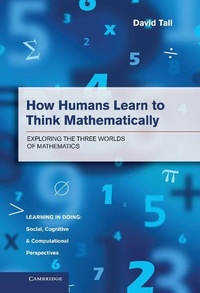
How Humans Learn to Think Mathematically
Exploring the Three Worlds of Mathematics
Published on 2. September 2013
Book
Hardback
484 pages
978-1-107-03570-6 (ISBN)
Description
How Humans Learn to Think Mathematically describes the development of mathematical thinking from the young child to the sophisticated adult. Professor David Tall reveals the reasons why mathematical concepts that make sense in one context may become problematic in another. For example, a child's experience of whole number arithmetic successively affects subsequent understanding of fractions, negative numbers, algebra, and the introduction of definitions and proof. Tall's explanations for these developments are accessible to a general audience while encouraging specialists to relate their areas of expertise to the full range of mathematical thinking. The book offers a comprehensive framework for understanding mathematical growth, from practical beginnings through theoretical developments, to the continuing evolution of mathematical thinking at the highest level.
More details
Series
Language
English
Place of publication
Cambridge
United Kingdom
Target group
Professional and scholarly
College/higher education
Illustrations
4 Tables, unspecified; 21 Halftones, unspecified; 154 Line drawings, unspecified
Dimensions
Height: 235 mm
Width: 157 mm
Thickness: 30 mm
Weight
845 gr
ISBN-13
978-1-107-03570-6 (9781107035706)
Copyright in bibliographic data and cover images is held by Nielsen Book Services Limited or by the publishers or by their respective licensors: all rights reserved.
Schweitzer Classification
Other editions
Additional editions
E-Book
09/2013
1st Edition
Cambridge University Press
€38.49
Available for download
Book
09/2013
Cambridge University Press
€58.90
Shipment within 15-20 days
E-Book
09/2013
Cambridge University Press
€31.99
Available for download
Person
David Tall is Emeritus Professor of Mathematical Thinking at the University of Warwick. He is internationally known for his research into long-term mathematical development at all levels, from preschool to the frontiers of research, including in-depth studies explaining mathematical success and failure.
Content
Part I. Prelude: 1. About this book; Part II. School Mathematics and its Consequences: 2. The foundations of mathematical thinking; 3. Compression, connection and blending of mathematical ideas; 4. Set-befores, met-befores and long-term learning; 5. Mathematics and the emotions; 6. The three worlds of mathematics; 7. Journeys through embodiment and symbolism; 8. Problem-solving and proof; Part III. Interlude: 9. The historical evolution of mathematics; Part IV. University Mathematics and Beyond: 10. The transition to formal knowledge; 11. Blending knowledge structures in calculus; 12. Expert thinking and structure theorems; 13. Contemplating the infinitely large and the infinitely small; 14. Expanding frontiers through mathematical research; 15. Reflections; Appendix: where the ideas came from.