

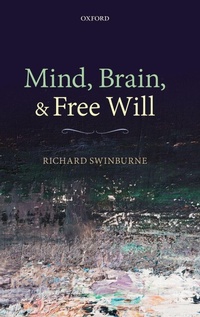
Mind, Brain, and Free Will
Published on 17. January 2013
Book
Hardback
252 pages
978-0-19-966256-2 (ISBN)
Description
Mind, Brain, and Free Will presents a powerful new case for substance dualism (the theory that humans consist of two parts body and soul) and for libertarian free will (that humans have some freedom to choose between alternatives, independently of the causes which influence them). Richard Swinburne begins by analysing the criteria for one event or substance being the same event or substance as another one, and the criteria for an event being metaphysically possible; and then goes on to analyse the criteria for beliefs about these issues being rational or justified. Given these criteria, he then proceeds to argue that pure mental events (including conscious events) are distinct from physical events and interact with them. He claims that no result from neuroscience or any other science could show that there is no such interaction, and illustrates this claim by showing that recent scientific work (such as Libet's experiments) has no tendency whatever to show that our intentions do not cause brain events. Swinburne goes on to argue for agent causation, that-to speak precisely-it is we, and not our intentions, that cause our brain events. It is metaphysically possible that each of us could acquire a new brain or continue to exist without a brain; and so we are essentially souls. Brain events and conscious events are so different from each other that it would not be possible to establish a scientific theory which would predict what each of us would do in situations of moral conflict. Hence given a crucial epistemological principle (the Principle of Credulity), we should believe that things are as they seem to be: that we make choices independently of the causes which influence us. According to Swinburne's lucid and ambitious account, it follows that we are morally responsible for our actions.
Reviews / Votes
Swinburne's philosophical system certainly gives us much to think about. Even if one disagrees with Swinburne's conclusions, it is a task to locate which premise is mistaken and to clearly explain why. Swinburne's latest book makes it even more difficult to resist his views about the nature of human beings. * Ted Poston,Journal of Analytic Theology * This is an interesting and provocative book. It defends a view about human beings and their nature, which, for better or for worse, is a minority view nowadays among philosophers but which, as Swinburne points out, has probably been the "traditional majority Western view on these issues" . . . The scope of the book is especially impressive, and the picture it paints is powerful and suggestive * David Palmer, Notre Dame Philosophical Reviews *More details
Language
English
Place of publication
Oxford
United Kingdom
Target group
College/higher education
Professional and scholarly
Dimensions
Height: 240 mm
Width: 161 mm
Thickness: 18 mm
Weight
546 gr
ISBN-13
978-0-19-966256-2 (9780199662562)
Copyright in bibliographic data and cover images is held by Nielsen Book Services Limited or by the publishers or by their respective licensors: all rights reserved.
Schweitzer Classification
Other editions
Additional editions
Richard Swinburne
Mind, Brain, and Free Will
Book
01/2013
Oxford University Press
€55.90
Shipment within 15-20 days
Richard Swinburne
Mind, Brain, and Free Will
E-Book
01/2013
1st Edition
OUP eBook
€24.99
Available for download
Person
Richard Swinburne was Professor of the Philosophy of Religion at Oxford University from 1985 until 2002. He is a Fellow of the British Academy. He is the author of many books on philosophical issues, most of them concerned with the philosophy of religion, but others concerned with space and time, probability, epistemology, and mind and body. He lectures frequently in many different countries.
Content
Introduction ; 1. Ontology ; 2. Epistemology ; 3. Property and Event Dualism ; 4. Interactive Dualism ; 5. Agent Causation ; 6. Substance Dualism ; 7. Free Will ; 8. Moral Responsibility ; Additional Notes ; Index