

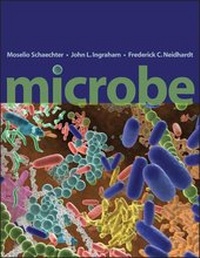
Microbe
Published on 1. June 2016
Book
Hardback
846 pages
978-1-55581-912-5 (ISBN)
Description
Microbe, 2e brings the excitement, breadth and power of the modern microbial sciences to students and scientists in a fun and engaging way, building on key concepts and skills identified in the Curriculum Guidelines by the American Society for Microbiology Education Board. Intended for microbiology course for majors and pre-health professionals.
Reviews / Votes
"This is a fantastic text! Written in a comfortable, conversational style, it grabs the readers' attention immediately, sparking their curiosity and keeping them engaged throughout each chapter while they seek and find answers to questions posed at the beginning of each section. A true joy to read. I recommend it highly for both traditional and flipped classrooms."--Peggy Cotter, PhD, Professor, Department of Microbiology and Immunology, UNC School of Medicine
More details
Series
Edition
2 New edition
Language
English
Place of publication
Washington DC
United States
Target group
College/higher education
professors who potentially adopt
Edition type
New edition
Dimensions
Height: 276 mm
Width: 219 mm
Thickness: 42 mm
Weight
666 gr
ISBN-13
978-1-55581-912-5 (9781555819125)
Schweitzer Classification
Other editions
Persons
Michele S. Swanson was born and raised in the Midwest, majored in biology at Yale, and discovered biomedical research as a laboratory technician at Rockefeller University. She fell in love with microbial genetics while earning a Master's at Columbia and her doctorate at Harvard Medical School and became captivated by microbial pathogenesis as a postdoc at Tufts University School of Medicine. At the University of Michigan Medical School, her research group investigates how metabolic and environmental cues govern the life cycle of the intracellular pathogen Legionella pneumophila. Gemma Reguera is a native of Spain, where she majored in biological sciences at the University of Oviedo. As a Master's student at the University of Massachusetts in Amherst, she discovered her passion for environmental microbiology and later earned a doctorate in microbiology before moving to Harvard Medical School as a postdoc to study the ecology of infectious diseases. At Michigan State University, she studies microbial energy conversions and physiologies of environmental relevance, particularly those that can be harnessed for applications in bioenergy and bioremediation.
Content
Preface ix
About the Authors xi
PART I Fundamenta ls of Microbial Life 1
1 A Microbial Planet 2
2 Prokaryotic Cell Exterior: Envelopes and Appendages 24
3 Prokaryotic Cell Interior 58
4 Microbial Cell Growth and Division 82
5 Microbial Metabolism 114
6 Bioenergetics of Fueling 132
7 Synthesis of Building Blocks 164
8 Building Macromolecules 206
9 Building the Cell Envelope 242
10 Inheritance and Information Flow 268
11 Coordination of Cell Processes 304
12 Succeeding in the Environment 332
13 Differentiation and Development 364
Part II Microbial Diversity 389
14 Bacteria and Archaea 390
15 The Fungi 420
16 Protists 436
17 The Viruses 460
18 Viral Latency 490
Part III Microbial Ecology 515
19 Microbial Communities 516
20 Cycles of Elements 556
21 Microbial Interactions 584
Part IV Microbial Pat hogenesis 621
22 Infection: The Vertebrate Host 622
23 Opportunistic Infections by Microbiota: MRSA 652
24 Intracellular Pathogens: Listeria and Mycobacterium 672
25 Herpes: An Ancient Human Virus Prevails 696
26 Toxins and Epidemic Cholera: Phage Giveth, and Phage Taketh Away 712
27 Zoonoses: How Plague Emerged from a Foodborne Illness 730
Part V Putting Microbes to Work 747
28 A Past, a Present, and a Future with Microbes 748
Coda 773
Glossary 775
Index 807
About the Authors xi
PART I Fundamenta ls of Microbial Life 1
1 A Microbial Planet 2
2 Prokaryotic Cell Exterior: Envelopes and Appendages 24
3 Prokaryotic Cell Interior 58
4 Microbial Cell Growth and Division 82
5 Microbial Metabolism 114
6 Bioenergetics of Fueling 132
7 Synthesis of Building Blocks 164
8 Building Macromolecules 206
9 Building the Cell Envelope 242
10 Inheritance and Information Flow 268
11 Coordination of Cell Processes 304
12 Succeeding in the Environment 332
13 Differentiation and Development 364
Part II Microbial Diversity 389
14 Bacteria and Archaea 390
15 The Fungi 420
16 Protists 436
17 The Viruses 460
18 Viral Latency 490
Part III Microbial Ecology 515
19 Microbial Communities 516
20 Cycles of Elements 556
21 Microbial Interactions 584
Part IV Microbial Pat hogenesis 621
22 Infection: The Vertebrate Host 622
23 Opportunistic Infections by Microbiota: MRSA 652
24 Intracellular Pathogens: Listeria and Mycobacterium 672
25 Herpes: An Ancient Human Virus Prevails 696
26 Toxins and Epidemic Cholera: Phage Giveth, and Phage Taketh Away 712
27 Zoonoses: How Plague Emerged from a Foodborne Illness 730
Part V Putting Microbes to Work 747
28 A Past, a Present, and a Future with Microbes 748
Coda 773
Glossary 775
Index 807