


Japanese Management Structures, 1920-80
Published in February 1991
Book
Hardback
304 pages
978-0-333-47520-1 (ISBN)
Description
Part of a series on the modern Japanese economy which explores all the major areas of Japanese economic life, this book examines the managerial hierarchies of large-scale Japanese industrial companies since their emergence.
More details
Series
Language
English
Place of publication
Basingstoke
United Kingdom
Target group
College/higher education
Professional and scholarly
Illustrations
tables, figures, index
Dimensions
Height: 222 mm
Width: 148 mm
Weight
545 gr
ISBN-13
978-0-333-47520-1 (9780333475201)
Copyright in bibliographic data is held by Nielsen Book Services Limited or its licensors: all rights reserved.
Schweitzer Classification
Other editions
Additional editions
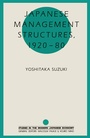
Yoshitaka Suzuki
Japanese Management Structures, 1920-80
E-Book
07/2016
Palgrave Macmillan
€26.99
Available for download
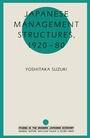
Yoshitaka Suzuki
Japanese Management Structures, 1920-80
Book
02/1991
Palgrave Macmillan
€28.88
Shipment within 15-20 days
Content
Part 1 Management resources and the structures of modern firms: modern business enterprise and managerial hierarchies; some implications of Chandler's hypotheses; management resources and the types of hierarchies; aspects of Japanese management structures. Part 2 The formation of managerial hierarchies 1920-40: management structures and large-scale industrial companies in pre-war Japan; internalization of human resources; management strategies and generating the flow of goods inside firms; decentralized structures. Part 3 Holding companies and corporate control 1920-40: external institutions of pre-war large-scale industrial companies; the development of holding companies; corporate control and strategic decision making; segmented allocation of management resources; change and continuity during the war. Part 4 Hierarchies and federations in the post-war era: the post-war business groups and big business - new evidence; the six largest business groups and the largest 100; industrial companies - interpretation of evidence; giant companies and their affiliated large-scale industrial firms. Part 5 The development of large-scale industrial companies 1950-80: large-scale firms and their products; entry and exit; their positions and sizes; direction of development - mergers and horizontal combinations, vertical integration, diversification; strategy and structure of Japanese firms. Part 6 The traditionally established companies in fabricated basic materials: textile companies; paper, printing, and materials enterprises; steel companies; nonferrous metals companies. Part 7 New industries in the traditional companies: chemical and pharmaceutical companies; electric and electronic companies; heavy engineering companies. Part 8 New companies in the post-war mass market: food and drink companies; oil companies; automobile companies; miscellaneous companies in durable consumer's goods. Part 9 Management resources and their development: the development of management structures in Japanese industrial companies; the direction of the development of modern firms - types and stages.