

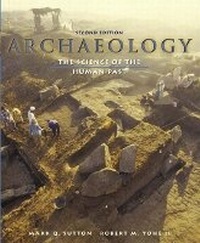
Archaeology
The Science of the Human Past
2nd Edition
Published on 5. September 2005
Book
Paperback/Softback
464 pages
978-0-205-45540-9 (ISBN)
Description
The Second Edition of this recent entry into the introductory archaeology market conveys the excitement of archaeological discovery while it explains how archaeologists think as they scientifically find, analyze, and interpret evidence. Brief enough to accompany prehistory or physical anthropology texts, the text is also comprehensive enough to stand alone.
Archaeology: The Science of the Human Past, 2/e continues to provide a comprehensive overview of archaeological history, theory, and method comprehensively at a reasonable level of detail and in language accessible to students. Archaeological theory and its various approaches are presented in a balanced manner, along with the interpretation of gender, ethnicity, and individuality in the archaeological record. Each chapter begins with a compelling story of a real archaeological adventure that expresses the main theme of the chapter. A related activity appears at the end of the chapter and invites critical analysis or application.
"Highlight" features in every chapter provide interesting details on sites ranging widely in time and geography. "Highlights" include "The Archaeology of Enslaved Africans in the New World," "Easter Island's Ecological Disaster," "Ethnoarchaeology Among the Aka of Central Africa," "The Roman Mummies of Tell El-Hibeh," and "Dating the Shroud of Turin." "Highlights" conclude with critical thinking questions that relate chapter content to the story. Examples of historical archaeology are integrated throughout and cultural resource management is emphasized throughout the text.
The Second Edition features a new annotated "Suggested Readings" section at the end of each chapter. Additional historical archaeological examples that further emphasizes this important subfield of archaeology to students are also included, as are updated discussions of postprocessual archaeology, remote sensing, and geophysical survey.
Archaeology: The Science of the Human Past, 2/e continues to provide a comprehensive overview of archaeological history, theory, and method comprehensively at a reasonable level of detail and in language accessible to students. Archaeological theory and its various approaches are presented in a balanced manner, along with the interpretation of gender, ethnicity, and individuality in the archaeological record. Each chapter begins with a compelling story of a real archaeological adventure that expresses the main theme of the chapter. A related activity appears at the end of the chapter and invites critical analysis or application.
"Highlight" features in every chapter provide interesting details on sites ranging widely in time and geography. "Highlights" include "The Archaeology of Enslaved Africans in the New World," "Easter Island's Ecological Disaster," "Ethnoarchaeology Among the Aka of Central Africa," "The Roman Mummies of Tell El-Hibeh," and "Dating the Shroud of Turin." "Highlights" conclude with critical thinking questions that relate chapter content to the story. Examples of historical archaeology are integrated throughout and cultural resource management is emphasized throughout the text.
The Second Edition features a new annotated "Suggested Readings" section at the end of each chapter. Additional historical archaeological examples that further emphasizes this important subfield of archaeology to students are also included, as are updated discussions of postprocessual archaeology, remote sensing, and geophysical survey.
More details
Edition
2nd edition
Language
English
Place of publication
New York
United States
Publishing group
Taylor & Francis Inc
Target group
Professional and scholarly
Dimensions
Height: 232 mm
Width: 191 mm
Weight
778 gr
ISBN-13
978-0-205-45540-9 (9780205455409)
Copyright in bibliographic data and cover images is held by Nielsen Book Services Limited or by the publishers or by their respective licensors: all rights reserved.
Schweitzer Classification
Other editions
New editions
Book
12/2007
3rd Edition
Routledge
Unfortunately, price unknown
No shipping information available
Previous edition
Book
12/2003
Routledge
Unfortunately, price unknown
No shipping information available
Persons
Mark Q. Sutton
decided to become an archaeologist when he was 10 years old after reading a book on archaeology. In 1968, while still in high school, he took advantage of the opportunity to participate in archaeological excavations conducted by the local community college. He went on to earn a B.A. (1972), an M.A. (1977), and a Ph.D. (1987) in anthropology. He worked as an archaeologist for the U.S. Air Force, the U.S. Bureau of Land Management, and various private consulting firms and taught at a number of community colleges and universities. He has been at California State University, Bakersfield, since 1987 and is a professor of anthropology. Dr. Sutton has conducted hundreds of surveys and has excavated at more than 100 sites in western North America. He has published over 140 books, monographs, and articles on archaeology.
Robert M. Yohe II received his B.A. in anthropology at California State University, San Bernardino, in 1983 and his M.A. and Ph.D. in anthropology from the University of California, Riverside, in 1990 and 1992, respectively. From 1990 to 1993, he served as assistant director and then director of the Cultural Resources Facility at California State University, Bakersfield, and was an adjunct lecturer in the Department of Sociology and Anthropology. In 1993, Dr. Yohe was appointed State Archaeologist and administrator of the Idaho State Historic Preservation Office. He also served as director of the Archaeological Survey of Idaho and Deputy State Historic Preservation Officer. During this same period, he taught anthropology courses at Boise State University. In 1996 he was appointed interim State Historic Preservation Officer, a position he held until his departure in late 1999 to join the faculty at California State University, Bakersfield, as an assistant professor of anthropology. He is now an associate professor of anthropology and also serves as director of the Museum of Anthropology at CSUB and coordinator of the Southern San Joaquin Valley Historic Resource Information Center. In mid-2003, he was made director of the Laboratory of Archaeological Sciences at CSUB.Dr.Yohe has conducted research in the deserts of western North America for the past 24 years.More recently, he has conducted excavations in Middle Egypt to recover mummies dating to the Roman period.
decided to become an archaeologist when he was 10 years old after reading a book on archaeology. In 1968, while still in high school, he took advantage of the opportunity to participate in archaeological excavations conducted by the local community college. He went on to earn a B.A. (1972), an M.A. (1977), and a Ph.D. (1987) in anthropology. He worked as an archaeologist for the U.S. Air Force, the U.S. Bureau of Land Management, and various private consulting firms and taught at a number of community colleges and universities. He has been at California State University, Bakersfield, since 1987 and is a professor of anthropology. Dr. Sutton has conducted hundreds of surveys and has excavated at more than 100 sites in western North America. He has published over 140 books, monographs, and articles on archaeology.
Robert M. Yohe II received his B.A. in anthropology at California State University, San Bernardino, in 1983 and his M.A. and Ph.D. in anthropology from the University of California, Riverside, in 1990 and 1992, respectively. From 1990 to 1993, he served as assistant director and then director of the Cultural Resources Facility at California State University, Bakersfield, and was an adjunct lecturer in the Department of Sociology and Anthropology. In 1993, Dr. Yohe was appointed State Archaeologist and administrator of the Idaho State Historic Preservation Office. He also served as director of the Archaeological Survey of Idaho and Deputy State Historic Preservation Officer. During this same period, he taught anthropology courses at Boise State University. In 1996 he was appointed interim State Historic Preservation Officer, a position he held until his departure in late 1999 to join the faculty at California State University, Bakersfield, as an assistant professor of anthropology. He is now an associate professor of anthropology and also serves as director of the Museum of Anthropology at CSUB and coordinator of the Southern San Joaquin Valley Historic Resource Information Center. In mid-2003, he was made director of the Laboratory of Archaeological Sciences at CSUB.Dr.Yohe has conducted research in the deserts of western North America for the past 24 years.More recently, he has conducted excavations in Middle Egypt to recover mummies dating to the Roman period.
Content
Each chapter concludes with "Chapter Summary," "Key Concepts" and "Suggested Readings."
PART I.WHAT IS ARCHAEOLOGY?
1. The Science of Archaeology.
What Is Archaeology?
Branches of Archaeology.
Key Concepts in Archaeology.
Archaeology as Science.
The Importance of Archaeology.
2. Backgrounds of Archaeology.
The Antiquarians.
The Discovery of a Prehistory.
The Classical Civilizations.
The Emergence of Professional Archaeology.
Developing the Outline of World Prehistory.
Political Influences in the History of Archaeology.
3. The Development of Contemporary Archaeology.
Archaeology after World War II.
The Rise of Scientific Archaeology.
Expanding Theoretical Horizon
Archaeological Frontiers.
Careers in Archaeology.
PART II. OBTAINING INFORMATION ABOUT THE PAST.
4. The Archaeological Record.
Archaeological Sites.
Archaeological Evidence.
Site Formation and Transformation.
Preservation.
Recognizing and Recovering Evidence.
Ongoing Impacts on the Archaeological Record.
5. Conducting Fieldwork.
Finding Sites.
Conducting Archaeological Surveys
Excavating Sites.
Practical Aspects of Fieldwork.
Ethics in Archaeological Fieldwork.
6. Classification and Analysis of Artifacts.
Classification and Typology.
Classifying Types of Artifacts.
Analyzing Artifacts.
7. Determining Time.
What Is So Important About Time?
Older or Younger? Relative Dating in Archaeology.
Real Time: Chronometric Dating.
8. Bioarchaeology: Human Remains.
The Study of Human Remains: Getting to Know Past Peoples.
Preserved Bodies.
Skeletal Remains.
Analytical Approaches in Bioarchaeology.
PART III. INTERPRETING THE PAST.
9. Environment and Adaptation.
The Environment.
Environmental Archaeology.
Human Biological Adaptation.
Human Cultural Adaptation.
Domestication and the Agricultural Revolution.
10. Understanding Past Settlement and Subsistence.
How Did People Make a Living? Subsistence.
Where Did People Live? Past Settlement Systems.
The Interplay between Subsistence and Settlement.
11. Interpreting Past Cultural Systems.
How Can Archaeology Answer Anthropological Questions?
Interpreting Past Social Structures.
Interpreting Past Political Organization.
Interpreting Past Belief Systems.
Remembering the Individual.
12. Understanding Culture Change.
The Archaeology of Change.
Interpreting Evidence of Change.
Cultural Contact and Conflict.
PART IV. APPLIED ARCHAEOLOGY.
13. Public Archaeology.
The Impact of Population Growth and Development on Archaeology.
The Field of Cultural Resource Management.
The Role of Public Education in Archaeological Preservation.
Cultural Resource Management among Traditional Peoples.
Archaeology and Ethics.
14. Archaeology in the Real World.
Archaeology Today.
Archaeology and Politics.
Who Owns the Past?
Learning from the Past: Applying Archaeology to Contemporary Problems.
Archaeology and Computer Technology.
Archaeology, Mass Media, and Public Perception.
So What? The Significance of Archaeology.
Glossary.
References.
Index.
PART I.WHAT IS ARCHAEOLOGY?
1. The Science of Archaeology.
What Is Archaeology?
Branches of Archaeology.
Key Concepts in Archaeology.
Archaeology as Science.
The Importance of Archaeology.
2. Backgrounds of Archaeology.
The Antiquarians.
The Discovery of a Prehistory.
The Classical Civilizations.
The Emergence of Professional Archaeology.
Developing the Outline of World Prehistory.
Political Influences in the History of Archaeology.
3. The Development of Contemporary Archaeology.
Archaeology after World War II.
The Rise of Scientific Archaeology.
Expanding Theoretical Horizon
Archaeological Frontiers.
Careers in Archaeology.
PART II. OBTAINING INFORMATION ABOUT THE PAST.
4. The Archaeological Record.
Archaeological Sites.
Archaeological Evidence.
Site Formation and Transformation.
Preservation.
Recognizing and Recovering Evidence.
Ongoing Impacts on the Archaeological Record.
5. Conducting Fieldwork.
Finding Sites.
Conducting Archaeological Surveys
Excavating Sites.
Practical Aspects of Fieldwork.
Ethics in Archaeological Fieldwork.
6. Classification and Analysis of Artifacts.
Classification and Typology.
Classifying Types of Artifacts.
Analyzing Artifacts.
7. Determining Time.
What Is So Important About Time?
Older or Younger? Relative Dating in Archaeology.
Real Time: Chronometric Dating.
8. Bioarchaeology: Human Remains.
The Study of Human Remains: Getting to Know Past Peoples.
Preserved Bodies.
Skeletal Remains.
Analytical Approaches in Bioarchaeology.
PART III. INTERPRETING THE PAST.
9. Environment and Adaptation.
The Environment.
Environmental Archaeology.
Human Biological Adaptation.
Human Cultural Adaptation.
Domestication and the Agricultural Revolution.
10. Understanding Past Settlement and Subsistence.
How Did People Make a Living? Subsistence.
Where Did People Live? Past Settlement Systems.
The Interplay between Subsistence and Settlement.
11. Interpreting Past Cultural Systems.
How Can Archaeology Answer Anthropological Questions?
Interpreting Past Social Structures.
Interpreting Past Political Organization.
Interpreting Past Belief Systems.
Remembering the Individual.
12. Understanding Culture Change.
The Archaeology of Change.
Interpreting Evidence of Change.
Cultural Contact and Conflict.
PART IV. APPLIED ARCHAEOLOGY.
13. Public Archaeology.
The Impact of Population Growth and Development on Archaeology.
The Field of Cultural Resource Management.
The Role of Public Education in Archaeological Preservation.
Cultural Resource Management among Traditional Peoples.
Archaeology and Ethics.
14. Archaeology in the Real World.
Archaeology Today.
Archaeology and Politics.
Who Owns the Past?
Learning from the Past: Applying Archaeology to Contemporary Problems.
Archaeology and Computer Technology.
Archaeology, Mass Media, and Public Perception.
So What? The Significance of Archaeology.
Glossary.
References.
Index.