

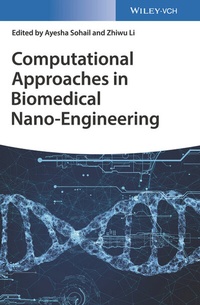
Computational Approaches in Biomedical Nano-Engineering
1st Edition
Published on 7. November 2018
Book
Hardback
296 pages
978-3-527-34471-0 (ISBN)
Description
This book comprehensively and systematically treats modern understanding of the Nano-Bio-Technology and its therapeutic applications. The contents range from the nanomedicine, imaging, targeted therapeutic applications, experimental results along with modelling approaches. It will provide the readers with fundamentals on computational and modelling aspects of advanced nano-materials and nano-technology specifically in the field of biomedicine, and also provide the readers with inspirations for new development of diagnostic imaging and targeted therapeutic applications.
More details
Edition
1. Auflage
Language
English
Place of publication
Berlin
Germany
Target group
Professional and scholarly
Illustrations
17
14 farbige Abbildungen, 17 s/w Abbildungen
Dimensions
Height: 24.4 cm
Width: 17 cm
Thickness: 1.8 cm
Weight
700 gr
ISBN-13
978-3-527-34471-0 (9783527344710)
Schweitzer Classification
Other editions
Additional editions
Hao Sun | ZhiWu Li
Computational Approaches in Biomedical Nano-Engineering
E-Book
08/2018
1st Edition
Wiley-VCH
€133.99
Available for download
Hao Sun | ZhiWu Li
Computational Approaches in Biomedical Nano-Engineering
E-Book
08/2018
1st Edition
Wiley-VCH
€133.99
Available for download
Persons
Ayesha Sohail obtained her PhD from Department of Chemical Enginerring and Mathematical, Sheffield UK. She is an expert on nonlinear science, nanobiotechnolgoy and numerical analysis. She has successfully developed and implemented numerical tools to solve systems governing the nano-technology problems.
ZhiWu Li received his B.S., M.S., and Ph.D. degrees in Mechanical Engineering, Automatic Control, and Manufacturing Engineering, respectively, all from Xidian University, Xi'an, China, in 1989, 1992, and 1995, respectively. He joined Xidian University in 1992. Over the past decade, he was a Visiting Professor at the University of Toronto, Technion (Israel Institute of Technology), Martin-Luther University, Conservatoire National des Arts et Métiers (Cnam), Meliksah Universitesi, King Saudi University, and the University of Cagliari. His current research interest includes Petri net theory and application, supervisory control of discrete event systems, workflow modeling and analysis, system reconfiguration, game theory, and data and process mining. He is a member of Discrete Event Systems Technical Committee of the IEEE Systems, Man, and Cybernetics Society, and a member of IFAC Technical Committee on Discrete Event and Hybrid Systems from 2011 to 2014. He serves(d) as the Associate Editor IEEE Transactions on Automation Science and Engineering (2008-2013), IEEE Transactions on Systems, Man, and Cybernetics Part A (2010-2012), IEEE Transactions on Systems, Man, and Cybernetics: Systems (2012-2016), and Information Sciences (2014-). Professor Li is a recipient of an Alexander von Humboldt Research Grant, Alexander von Humboldt Foundation, Germany, and Research in Paris, France and he is also a Fellow of IEEE.
ZhiWu Li received his B.S., M.S., and Ph.D. degrees in Mechanical Engineering, Automatic Control, and Manufacturing Engineering, respectively, all from Xidian University, Xi'an, China, in 1989, 1992, and 1995, respectively. He joined Xidian University in 1992. Over the past decade, he was a Visiting Professor at the University of Toronto, Technion (Israel Institute of Technology), Martin-Luther University, Conservatoire National des Arts et Métiers (Cnam), Meliksah Universitesi, King Saudi University, and the University of Cagliari. His current research interest includes Petri net theory and application, supervisory control of discrete event systems, workflow modeling and analysis, system reconfiguration, game theory, and data and process mining. He is a member of Discrete Event Systems Technical Committee of the IEEE Systems, Man, and Cybernetics Society, and a member of IFAC Technical Committee on Discrete Event and Hybrid Systems from 2011 to 2014. He serves(d) as the Associate Editor IEEE Transactions on Automation Science and Engineering (2008-2013), IEEE Transactions on Systems, Man, and Cybernetics Part A (2010-2012), IEEE Transactions on Systems, Man, and Cybernetics: Systems (2012-2016), and Information Sciences (2014-). Professor Li is a recipient of an Alexander von Humboldt Research Grant, Alexander von Humboldt Foundation, Germany, and Research in Paris, France and he is also a Fellow of IEEE.
Content
1. Computational Approaches in
Biomedical Nano-Engineering - An Overview
2. Nanotechnology Applications - The Future Arrived Suddenly
3. Biosynthesized Nanobullets for Microbes and Biofilms
4. The Physics of Nanosensor Systems in Medicine and the Development of Physiological Monitoring Equipment
5. Non-Linear Multi-Physical Laminar Nanofluid Bioconvection Flows: Models and Computation
6. Exploring Nanotechnology Applications in Medicine
7. Microtubules: Nanobiomechanical Simulation
8. Simulations of Flowing Red Blood Cells with and without Nanoparticles Dispersion using Particle Based Numerical Methods
9. Impact of Nanofluid in Medical Treatment by Mathematical Modeling
10. Physiological Modeling and Simulation of Fluid Flows
Biomedical Nano-Engineering - An Overview
2. Nanotechnology Applications - The Future Arrived Suddenly
3. Biosynthesized Nanobullets for Microbes and Biofilms
4. The Physics of Nanosensor Systems in Medicine and the Development of Physiological Monitoring Equipment
5. Non-Linear Multi-Physical Laminar Nanofluid Bioconvection Flows: Models and Computation
6. Exploring Nanotechnology Applications in Medicine
7. Microtubules: Nanobiomechanical Simulation
8. Simulations of Flowing Red Blood Cells with and without Nanoparticles Dispersion using Particle Based Numerical Methods
9. Impact of Nanofluid in Medical Treatment by Mathematical Modeling
10. Physiological Modeling and Simulation of Fluid Flows