

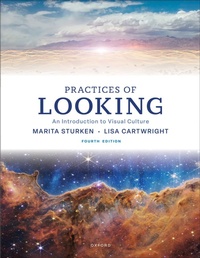
Practices of Looking
An Introduction to Visual Culture
4th Edition
Published on 20. August 2025
Book
Paperback/Softback
608 pages
978-0-19-762715-0 (ISBN)
Description
An engaging introduction to the study of visual culture, Practices of Looking bridges visual, communication, media, and cultural studies to investigate how images and the activity of looking carry meaning within and between different arenas in everyday life. The fourth edition has been updated to represent the contemporary visual cultural landscape and includes topics like the increasingly rapid global circulation of media, the rise of design and DIY cultures, digital media art and activism, and challenges to photojournalism and news media. Engaging and accessible, Practices of Looking is ideal for courses across a range of disciplines.
Reviews / Votes
The greatest strength of Practices of Looking is its thorough treatment of the conceptual and material landscape of postmodern visual culture, and this definitely distinguishes it from similar textbooks I've seen. * Kent N. Lowery, Texas Tech University* Practices of Looking, Third Edition, is a great and valuable textbook for teaching a broad range of critical and theoretical approaches in modern and contemporary visual practices. * Whitney Huber, Columbia College Chicago * Practices of Looking's ambitions are unparalleled and it's clear that the writers are deeply engaged with the social, psychological and economic consequences of the ways in which images influence how we see ourselves and the world around us. * Jawad Ali, Art Institute of California, Hollywood * The greatest strength of Practices of Looking, Third Edition, is its relentless drive to instill critical awareness in students. This book contributes greatly to promoting the type of visual literacy that is needed in society both now and in the foreseeable future. * William H. Lawson, California State University, East Bay * This is that rarest of textbooks * clear enough for undergraduates and challenging enough to use with graduate students. It is simply the best introduction to the most important issues in thinking about the visual from an interdisciplinary perspective.Michael Coventry, Georgetown University *
More details
Edition
4th Revised edition
Language
English
Place of publication
New York
United States
Target group
College/higher education
Edition type
Revised edition
Dimensions
Height: 273 mm
Width: 214 mm
Thickness: 26 mm
Weight
1640 gr
ISBN-13
978-0-19-762715-0 (9780197627150)
Copyright in bibliographic data and cover images is held by Nielsen Book Services Limited or by the publishers or by their respective licensors: all rights reserved.
Schweitzer Classification
Persons
Marita Sturken, New York University
Lisa Cartwright, University of California at San Diego
Lisa Cartwright, University of California at San Diego
Content
Acknowledgements Introduction Chapter 1. Images, Power, and Politics Representation Vision and Visuality The Myth of Photographic Truth Myth, Connotation, and the Meaning of Images Semiotics and Signs Images and Ideology Image Icons Chapter 2. Viewers Make Meaning Producers' Intended Meanings Aesthetics and Taste Value, Collecting, and Institutional Critique Reading Images as Ideological Subjects Viewing Strategies Appropriation and Re-Appropriation Chapter 3. Modernity: Spectatorship, the Gaze, and Power Modernity and the Modern City Modernism The Concept of the Modern Subject Spectatorship and the Gaze Power and the Surveillance Gaze
The Other Gender and the Gaze Gaming and the Gaze Chapter 4. Realism and Perspective:
From Renaissance Painting to Digital Media Types of Realism Perspective Perspective and the Body The Camera Obscura Challenges to Perspective Perspective in Digital Media Chapter 5. Visual Technologies:
Image Reproduction, Generation, and the Copy Visualization and Technology Visual Technologies The Reproduced Image and the Copy Walter Benjamin and Mechanical Reproduction The Politics of Reproducibility Ownership and Copyright Reproduction and the Digital Image 3D Reproduction and Simulation Chapter 6. Media Culture Media, Singular and Plural Propaganda and the Media Environment Popular Culture Studies Media Geographies Media Infrastructures Media as Nation and Public Sphere Citizen Journalism Global Media Events Chapter 7. Brand Culture: Visual Culture and the Spaces of Consumption Consumer Societies and the Spaces of
Modern Consumerism Brands as Image, Symbol, and Icon Brand Ideologies and Commodity Fetishism The Knowing Consumer Selling Social Awareness Chapter 8. The Postmodernism Condition and Twenty-First Futurisms The Postmodern Condition Poststructuralism in the Wake of the Holocaust Atomic Media Postmodern Architecture in Social Context Kitsch and the Vernacular Futurisms and Simulation Reflexivity And Distanced Knowing Appropriation and Postmodern Subjectivity Remix, Parody, and Pastiche Chapter 9. Visual Cultures of Data and Science Numbers and Structures of Feeling Modern Western Science and the Data Body Evidence, Classification, and Normative Science Bodily Interiors and Biomedical Personhood Biopower and the Quantified Self The Genetic and Digital Body Data in the Global Pandemic The Infodemic: Data in the Service of Propaganda The Sensory Body, the Cyborg, and Disability Chapter 10. The World Image and Globalization Being in the World The Universal Image: A Star is Born The World Image Geolocation The Digital Twin and the Point Cloud The World Ocean The Cloud Image Concepts of Globalization Social Movements and Visual Activism
The Global Museum Refugees and Borders Glossary Credits Index
The Other Gender and the Gaze Gaming and the Gaze Chapter 4. Realism and Perspective:
From Renaissance Painting to Digital Media Types of Realism Perspective Perspective and the Body The Camera Obscura Challenges to Perspective Perspective in Digital Media Chapter 5. Visual Technologies:
Image Reproduction, Generation, and the Copy Visualization and Technology Visual Technologies The Reproduced Image and the Copy Walter Benjamin and Mechanical Reproduction The Politics of Reproducibility Ownership and Copyright Reproduction and the Digital Image 3D Reproduction and Simulation Chapter 6. Media Culture Media, Singular and Plural Propaganda and the Media Environment Popular Culture Studies Media Geographies Media Infrastructures Media as Nation and Public Sphere Citizen Journalism Global Media Events Chapter 7. Brand Culture: Visual Culture and the Spaces of Consumption Consumer Societies and the Spaces of
Modern Consumerism Brands as Image, Symbol, and Icon Brand Ideologies and Commodity Fetishism The Knowing Consumer Selling Social Awareness Chapter 8. The Postmodernism Condition and Twenty-First Futurisms The Postmodern Condition Poststructuralism in the Wake of the Holocaust Atomic Media Postmodern Architecture in Social Context Kitsch and the Vernacular Futurisms and Simulation Reflexivity And Distanced Knowing Appropriation and Postmodern Subjectivity Remix, Parody, and Pastiche Chapter 9. Visual Cultures of Data and Science Numbers and Structures of Feeling Modern Western Science and the Data Body Evidence, Classification, and Normative Science Bodily Interiors and Biomedical Personhood Biopower and the Quantified Self The Genetic and Digital Body Data in the Global Pandemic The Infodemic: Data in the Service of Propaganda The Sensory Body, the Cyborg, and Disability Chapter 10. The World Image and Globalization Being in the World The Universal Image: A Star is Born The World Image Geolocation The Digital Twin and the Point Cloud The World Ocean The Cloud Image Concepts of Globalization Social Movements and Visual Activism
The Global Museum Refugees and Borders Glossary Credits Index