

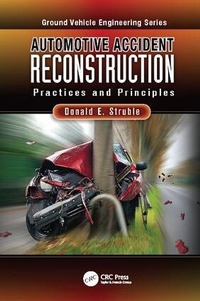
Automotive Accident Reconstruction
Practices and Principles
1st Edition
Published on 29. March 2017
Book
Paperback/Softback
498 pages
978-1-138-07672-3 (ISBN)
Description
Automotive Accident Reconstruction: Practices and Principles introduces techniques for gathering information and interpreting evidence, and presents computer-based tools for analyzing crashes. This book provides theory, information and data sources, techniques of investigation, an interpretation of physical evidence, and practical tips for beginners. It also works as an ongoing reference for experienced reconstructionists. The book emphasizes three things: the theoretical foundation, the presentation of data sources, and the computer programs and spread sheets used to apply both theory and collected data in the reconstruction of actual crashes.
It discusses the specific requirements of reconstructing rollover crashes, offers background in structural mechanics, and describes how structural mechanics and impact mechanics are applied to automobiles that crash. The text explores the treatment of crush energy when vehicles collide with each other and with fixed objects. It delves into various classes of crashes, and simulation models. The framework of the book starts backward in time, beginning with the analysis of post-crash vehicle motions that occurred without driver control.
Applies time-reverse methods, in a detailed and rigorous way, to vehicle run-out trajectories, utilizing the available physical evidence
Walks the reader through a collection of digital crash test data from public sources, with detailed instructions on how to process and filter the information
Shows the reader how to build spread sheets detailing calculations involving crush energy and vehicle post-crash trajectory characteristics
Contains a comprehensive treatment of crush energy
This text can also serve as a resource for industry professionals, particularly with regard to the underlying physics.
It discusses the specific requirements of reconstructing rollover crashes, offers background in structural mechanics, and describes how structural mechanics and impact mechanics are applied to automobiles that crash. The text explores the treatment of crush energy when vehicles collide with each other and with fixed objects. It delves into various classes of crashes, and simulation models. The framework of the book starts backward in time, beginning with the analysis of post-crash vehicle motions that occurred without driver control.
Applies time-reverse methods, in a detailed and rigorous way, to vehicle run-out trajectories, utilizing the available physical evidence
Walks the reader through a collection of digital crash test data from public sources, with detailed instructions on how to process and filter the information
Shows the reader how to build spread sheets detailing calculations involving crush energy and vehicle post-crash trajectory characteristics
Contains a comprehensive treatment of crush energy
This text can also serve as a resource for industry professionals, particularly with regard to the underlying physics.
More details
Series
Language
English
Place of publication
London
United Kingdom
Publishing group
Taylor & Francis Ltd
Target group
Professional and scholarly
Engineers working with simulation software, automotive engineers working in accident reconstruction, and law enforcement agencies working in accident analysis.
Illustrations
119 s/w Abbildungen, 14 farbige Abbildungen, 18 s/w Tabellen
18 Tables, black and white; 14 Illustrations, color; 119 Illustrations, black and white
Dimensions
Height: 234 mm
Width: 156 mm
Weight
839 gr
ISBN-13
978-1-138-07672-3 (9781138076723)
Copyright in bibliographic data and cover images is held by Nielsen Book Services Limited or by the publishers or by their respective licensors: all rights reserved.
Schweitzer Classification
Other editions
Additional editions
Book
09/2013
1st Edition
CRC Press
€259.98
Article exhausted; check for reprint
Person
Donald E. Struble holds a BS, MS, and PhD from California Polytechnic State University, Stanford University, and Georgia Institute of Technology, respectively, all in engineering with an emphasis on structuralmechanics. Dr. Struble was assistant professor of aeronautical engineering at Cal Poly, manager of the Research Safety Vehicle program and senior vice president of Engineering and Research at Minicars, Inc., and president of Dynamic Science in Phoenix, Arizona. He is a member of SAE, AAAM, and Sigma Xi, the Scientific Research Society. Formerly senior engineer at Collision Safety Engineering in Phoenix, Arizona, and president of Struble-Welsh Engineering in San Luis Obispo, California, he is now retired.
Content
General Principles. Tire Models. Subdividing Noncollision Trajectories with Splines. A Program for Reverse Trajectory Calculation Using Splines. Time-Distance Studies. Vehicle Data Sources for the Accident Reconstructionist. Accident Investigation. Getting Information from Photographs. Filtering Impulse Data. Digital Filters for Airbag Applications. Obtaining NHTSA Crash Test Data. Processing NHTSA Crash Test Acceleration Data. Analyzing Crash Pulse Data. Downloading and Analyzing NHTSA Load Cell Barrier Data. Rollover Forensics. Rollover Analysis. Vehicle Structure Crash Mechanics . Impact Mechanics. Uniaxial Collisions. Momentum Conservation for Central Collisions. Assessing the Crush Energy. Measuring Vehicle Crush. Reconstructing Coplanar Collisions, Including Energy Dissipation. Checking the Results in Coplanar Collision Analysis. Narrow Fixed-Object Collisions. Underride/Override Collisions. Simulations and Other Computer Programs. References. Index.