

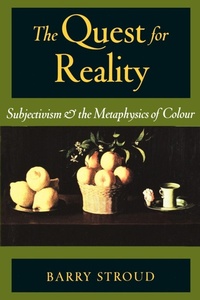
The Quest for Reality
Subjectivism and the Metaphysics of Colour
Published on 4. April 2002
Book
Paperback/Softback
256 pages
978-0-19-515188-6 (ISBN)
Description
We say "the grass is green" or "lemons are yellow" to state what everyone knows. But are the things we see around us really colored, or do they only look that way because of the effects of light rays on our eyes and brains? Is color somehow "unreal" or "subjective" and dependent on our human perceptions and the conditions under which we see things?
Distinguished scholar Barry Stroud investigates these and related questions in The Quest for Reality. In this long-awaited book, he examines what a person would have to do and believe in order to reach the conclusion that everyone's perceptions and beliefs about the color of things are "illusions" and do not accurately represent the way things are in the world as it is independently of us. Arguing that no such conclusion could be consistently reached, Stroud finds that the conditions of a successful unmasking of color cannot all be fulfilled. The discussion extends beyond color to present a serious challenge to many other philosophical attempts to discover the way things really are. A model of subtle, elegant, and rigorous philosophical writing, this study will attract a wide audience from all areas of philosophy.
Distinguished scholar Barry Stroud investigates these and related questions in The Quest for Reality. In this long-awaited book, he examines what a person would have to do and believe in order to reach the conclusion that everyone's perceptions and beliefs about the color of things are "illusions" and do not accurately represent the way things are in the world as it is independently of us. Arguing that no such conclusion could be consistently reached, Stroud finds that the conditions of a successful unmasking of color cannot all be fulfilled. The discussion extends beyond color to present a serious challenge to many other philosophical attempts to discover the way things really are. A model of subtle, elegant, and rigorous philosophical writing, this study will attract a wide audience from all areas of philosophy.
Reviews / Votes
This strange and absorbing book sets out to undermine the central metaphysical ambition which has dominated philosophy since the 17th century - that of reachinga comprehensive understanding of the world, consistent with modern science, which distinguishes between what exists objectively, independent of our minds, and what is merely subjective - due to the effects of the world on our minds and our responses to it. Barry Stroud writes against the temper of the times. His style is clear, explicit, methodical and relentless. He tries to block every exit. The Quest for Reality displays a profound grasp of the history and logical structure of philosophical problems and theories, and a feeling for the derangement of thought that underlies them. Whatever one thinks of the conclusion, it is illuminating to think through the argument. This is philosophy of an exemplary purity, tenacity, and depth. * Thomas Nagel, The London Review of Books *More details
Language
English
Place of publication
New York
United States
Target group
Professional and scholarly
Dimensions
Height: 229 mm
Width: 152 mm
Thickness: 15 mm
Weight
408 gr
ISBN-13
978-0-19-515188-6 (9780195151886)
Copyright in bibliographic data and cover images is held by Nielsen Book Services Limited or by the publishers or by their respective licensors: all rights reserved.
Schweitzer Classification
Other editions
Additional editions
E-Book
03/2002
1st Edition
OUP USA
€37.99
Available for download
E-Book
12/2000
1st Edition
Oxford University Press
€37.99
Available for download
Person
Barry Stroud is Mills Professor of Metaphysics and Epistemology at the University of California, Berkeley, and author of Hume (1977) and The Significance of Philosophical Scepticism (1984).
Content
Chapter 1. Introduction: The Philosophical Project ; Chapter 2. The Philosophical Conception of an Independent Reality ; Chapter 3. The Idea of Physical Reality ; Chapter 4. Unmasking Explanation and the "Unreality" of Colour ; Chapter 5. Perception, Predication, and Belief ; Chapter 6. Perceptions of Colour and the Colour of Things ; Chapter 7. Perception, Judgement, and Error ; Chapter 8. Discomforts and Distortions of Metaphysical Theory ; Chapter 9. Engagement, Invulnerability, and Dissatisfaction ; Chapter 10 Morals ; Bibliography ; Index