

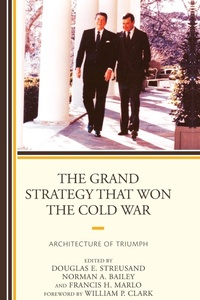
The Grand Strategy that Won the Cold War
Architecture of Triumph
Published on 24. July 2017
Book
Paperback/Softback
296 pages
978-1-4985-3050-7 (ISBN)
Description
This book demonstrates that under the leadership of President Ronald Reagan and through the mechanism of his National Security Council staff, the United States developed and executed a comprehensive grand strategy, involving the coordinated use of the diplomatic, informational, military, and economic instruments of national power, and that grand strategy led to the collapse of the Soviet Union. In doing so, it refutes three orthodoxies: that Reagan and his administration deserve little credit for the end of the Cold War, with most of credit going to Mikhail Gorbachev; that Reagan's management of the National Security Council staff was singularly inept; and that the United States is incapable of generating and implementing a grand strategy that employs all the instruments of national power and coordinates the work of all executive agencies. The Reagan years were hardly a time of interagency concord, but the National Security Council staff managed the successful implementation of its program nonetheless.
Reviews / Votes
This is an excellent and outright indispensable book for understanding the literal strategy of President Ronald Reagan and his administration in attempting to peacefully take down the Soviet Union and win the Cold War. There have been few more just causes, and the accomplishment of that historic mission by Reagan and his staff-many of which are contributors to this volume-is one of the great stories of our time. How did Reagan and his team do it? This book lays out the answer. Most important, it does so via direct testimony of those who actually did it. Thanks to this important book, we know the inside story from the actual insiders, rather than some erroneous speculation by distant academics who never got anywhere near the inside or the truth. We owe a great debt of gratitude to Streusand, Bailey, Marlo, and their cast of outstanding contributors-Bill Clark, Richard Pipes, Roger Robinson, Richard Allen, John Lenczowski, and others-for what they've produced here. This is a must-read and vital point of reference for anyone who wants to understand the grand strategy that secured peaceful victory in the Cold War. You must consult this book to have a complete understanding of that strategy. -- Paul Kengor, author of A Pope and a President: John Paul II, Ronald Reagan, and the Extraordinary Untold Story of the 20th Century This book reveals for the first time the exquisite understanding of the Soviet threat and its weaknesses by President Reagan personally and his team based on their faith in America's first, founding principles of human behavior. Their method was to Seek the Truth, and Speak the Truth against the Soviets and their worshipers in the Western intellectual elite who had capitulated to Soviet domination, and tried to emulate Communist solutions to economic and social problems at home in some cases. Reagan saw the existential evil of and with clarity the weaknesses of the Soviet Empire, and with a hand picked team of faithful believers, set out to design policy solutions to exploit those weaknesses with an iron will and consistency. Several hundred million people were freed from communist slavery and the first Cold War was decisively won. It is a blueprint for a successful American national security policy. -- Hon. Tidal W. McCoy, Acting Secretary of the Airforce and Sr. Assistant Secretary of the Airforce, 1981-88 Ronald Reagan and his NSC staff devised and implemented a coherent, comprehensive, and consistent grand strategy to hasten the end of the Cold War. That is the simple truth amply demonstrated by this book's authoritative and non-tendentious authors. -- Walter A. McDougall, Pulitzer Prize-winning historian and author of The Tragedy of U.S. Foreign Policy: How American Civil Religion Betrayed the National InterestMore details
Language
English
Place of publication
United States
Publishing group
Bloomsbury Publishing Plc
Target group
College/higher education
Illustrations
40 b/w photos;
Dimensions
Height: 229 mm
Width: 152 mm
Thickness: 18 mm
Weight
484 gr
ISBN-13
978-1-4985-3050-7 (9781498530507)
Copyright in bibliographic data and cover images is held by Nielsen Book Services Limited or by the publishers or by their respective licensors: all rights reserved.
Schweitzer Classification
Other editions
Additional editions
Douglas E. Streusand | Norman A. Bailey | Francis H. Marlo
The Grand Strategy that Won the Cold War
Architecture of Triumph
E-Book
01/2016
1st Edition
Lexington Books
€56.49
Available for download
Persons
Douglas E. Streusand is professor of international relations at the Marine Corps Command and Staff College and adjunct professor at the Institute of World Politics.
Norman A. Bailey is professor of economics and national security at the Center for National Security Studies at the University of Haifa and professor of economic statecraft at the Institute of World Politics. He served as President Reagan's special assistant for national security and international economic affairs from 1981 to 1984 and in the Office of the Director of National Intelligence in 2006-2007.
Francis H. Marlo is associate professor of international relations at the Marine Corps Command and Staff College.
Norman A. Bailey is professor of economics and national security at the Center for National Security Studies at the University of Haifa and professor of economic statecraft at the Institute of World Politics. He served as President Reagan's special assistant for national security and international economic affairs from 1981 to 1984 and in the Office of the Director of National Intelligence in 2006-2007.
Francis H. Marlo is associate professor of international relations at the Marine Corps Command and Staff College.
Content
Part I: Ronald W. Reagan and the Cold War
Chapter One: The Historiography of the End of the Cold War, Francis H. Marlo
Chapter Two: Ronald Reagan: the Spirit of Behind the Strategy, Francis H. Marlo
Chapter Three: The Cold War in Context, Norman A. Bailey
Chapter Four: On the National Security Council Staff, Richard Pipes
Part II: The Grand Strategy That Won the Cold War
Chapter Five: Defining the Strategy: NSDD 75, Norman A. Bailey
Chapter Six: Political and Ideological Warfare, John Lenczowski
Chapter Seven: Public Diplomacy and Psychological Warfare, Carnes Lord
Chapter Eight: Pope John Paul II, Ronald Reagan and the Collapse of Communism: An Historic Confluence, Richard V. Allen
Chapter Nine: The Economic Instruments of Power, Roger W. Robinson
Chapter Ten: Military Display: Continuity of Government and the Strategic Defense Initiative, Ronald B. Frankum
Part III: Conclusions
Chapter Eleven: Setting the Record Straight, Derek Leebaert
Chapter One: The Historiography of the End of the Cold War, Francis H. Marlo
Chapter Two: Ronald Reagan: the Spirit of Behind the Strategy, Francis H. Marlo
Chapter Three: The Cold War in Context, Norman A. Bailey
Chapter Four: On the National Security Council Staff, Richard Pipes
Part II: The Grand Strategy That Won the Cold War
Chapter Five: Defining the Strategy: NSDD 75, Norman A. Bailey
Chapter Six: Political and Ideological Warfare, John Lenczowski
Chapter Seven: Public Diplomacy and Psychological Warfare, Carnes Lord
Chapter Eight: Pope John Paul II, Ronald Reagan and the Collapse of Communism: An Historic Confluence, Richard V. Allen
Chapter Nine: The Economic Instruments of Power, Roger W. Robinson
Chapter Ten: Military Display: Continuity of Government and the Strategic Defense Initiative, Ronald B. Frankum
Part III: Conclusions
Chapter Eleven: Setting the Record Straight, Derek Leebaert