


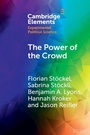
The Power of the Crowd
How the Public Can Both Spoil and Improve Social Media as a Source of Information
Published on 6. November 2025
Book
Hardback
98 pages
978-1-009-67717-2 (ISBN)
Description
This Element explores misinformation as a challenge for democracies, using experiments from Germany, Italy, and the UK to assess the role of user-generated corrections on social media. A sample of more than 170,000 observations across a wide range of topics (COVID, climate change, 5G etc.) is used to test whether social corrections help reduce the perceived accuracy of false news and whether miscorrections decrease the credibility of true news. Corrections reduce the perceived accuracy of misinformation, but miscorrections can harm perceptions of true news. The Element also assesses the mechanisms of social corrections, finding evidence for recency effects rather than systematic processing. Additional analyses show the characteristics of individuals who have more difficulties identifying false news. Survey data is included on characteristics of people who write comments often. The conclusion highlights that social corrections can mislead, but also work as remedy. The Element ends with best practices for effective corrections.
More details
Series
Language
English
Place of publication
Cambridge
United Kingdom
Illustrations
Worked examples or Exercises
Dimensions
Height: 235 mm
Width: 157 mm
Thickness: 10 mm
Weight
305 gr
ISBN-13
978-1-009-67717-2 (9781009677172)
Copyright in bibliographic data and cover images is held by Nielsen Book Services Limited or by the publishers or by their respective licensors: all rights reserved.
Schweitzer Classification
Other editions
Additional editions
Florian Stoeckel | Sabrina Stoeckli | Benjamin A. Lyons
The Power of the Crowd
How the Public Can Both Spoil and Improve Social Media as a Source of Information
Book
11/2025
Cambridge University Press
€26.90
Shipment within 15-20 days
Persons
Content
1. Misinformation as a challenge for democracy; 2. Who believes false news?; 3. The core experimental setup; 4. Social corrections, miscorrections, and accuracy perceptions; 5. Who writes comments?; 6. Implications and outlook; References.