

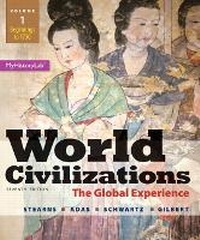
World Civilizations
The Global Experience, Volume 1
7th Edition
Published on 18. February 2014
Book
Paperback/Softback
576 pages
978-0-205-98629-3 (ISBN)
Description
ALERT: Before you purchase, check with your instructor or review your course syllabus to ensure that you select the correct ISBN. Several versions of Pearson's MyLab & Mastering products exist for each title, including customized versions for individual schools, and registrations are not transferable. In addition, you may need a CourseID, provided by your instructor, to register for and use Pearson's MyLab & Mastering products.
Packages
Access codes for Pearson's MyLab & Mastering products may not be included when purchasing or renting from companies other than Pearson; check with the seller before completing your purchase.
Used or rental books
If you rent or purchase a used book with an access code, the access code may have been redeemed previously and you may have to purchase a new access code.
Access codes
Access codes that are purchased from sellers other than Pearson carry a higher risk of being either the wrong ISBN or a previously redeemed code. Check with the seller prior to purchase.
0133828182 / 9780133828184 World Civilizations: The Global Experience, Volume 1, Plus NEW MyHistoryLab with eText -- Access Card Package Package consists of:
0205206549 / 9780205206544 NEW MyHistoryLab with Pearson eText -- Valuepack Access Card
0205986293 / 9780205986293 World Civilizations: The Global Experience, Volume 1
--
Presents a truly global history
This global world history text emphasizes the major stages in societies' different interactions and assesses the development of major societies. Encompassing social, cultural, political and economic history, the authors examine key civilizations in world history. World Civilizations balances the discussion of independent developments in the world's major civilizations with comparative analysis of the results of global contact.
MyHistoryLab is an integral part of the Stearns/Adas/Schwartz/Gilbert program. An integrated etext and and engaging resources bring history to life for students.
Packages
Access codes for Pearson's MyLab & Mastering products may not be included when purchasing or renting from companies other than Pearson; check with the seller before completing your purchase.
Used or rental books
If you rent or purchase a used book with an access code, the access code may have been redeemed previously and you may have to purchase a new access code.
Access codes
Access codes that are purchased from sellers other than Pearson carry a higher risk of being either the wrong ISBN or a previously redeemed code. Check with the seller prior to purchase.
0133828182 / 9780133828184 World Civilizations: The Global Experience, Volume 1, Plus NEW MyHistoryLab with eText -- Access Card Package Package consists of:
0205206549 / 9780205206544 NEW MyHistoryLab with Pearson eText -- Valuepack Access Card
0205986293 / 9780205986293 World Civilizations: The Global Experience, Volume 1
--
Presents a truly global history
This global world history text emphasizes the major stages in societies' different interactions and assesses the development of major societies. Encompassing social, cultural, political and economic history, the authors examine key civilizations in world history. World Civilizations balances the discussion of independent developments in the world's major civilizations with comparative analysis of the results of global contact.
MyHistoryLab is an integral part of the Stearns/Adas/Schwartz/Gilbert program. An integrated etext and and engaging resources bring history to life for students.
More details
Edition
7th edition
Language
English
Place of publication
United States
Publishing group
Pearson Education (US)
Target group
College/higher education
Dimensions
Height: 276 mm
Width: 229 mm
ISBN-13
978-0-205-98629-3 (9780205986293)
Copyright in bibliographic data and cover images is held by Nielsen Book Services Limited or by the publishers or by their respective licensors: all rights reserved.
Schweitzer Classification
Other editions
Previous edition
Peter N. Stearns | Michael B. Adas | Stuart B. Schwartz
World Civilizations
The Global Experience, Volume 1
Book
04/2010
6th Edition
Pearson
€144.08
Article exhausted; check for reprint
Persons
Peter N. Stearns is provost and professor of history at George Mason University. He received his Ph.D.
from Harvard University. Before moving to George Mason University, he taught at Rutgers University,
the University of Chicago, and Carnegie Mellon, where he won the Robert Doherty Educational
Leadership Award and the Elliott Dunlap Smith Teaching Award. He has taught world history for more than 15 years. He currently serves as chair of the Advanced Placement World History Committee and also founded and is the editor of the Journal of Social History. In addition to textbooks and readers, he has written studies of gender and consumerism in a world history context. Other books address modern social and cultural history and include studies on gender, old age, work, dieting, and emotion. His most recent book in this area is American Fear: Causes and Consequences of High Anxiety.
Michael Adas is the Abraham Voorhees Professor of History and a board of governor's chair at Rutgers
University in New Brunswick, New Jersey. Over the past couple of decades his teaching has focused on
patterns and processes of global and comparative history. His courses on race and empire in the early
modern and industrial eras and on world history in the 20th century have earned him a number of teaching prizes. In addition to texts on world history, Adas has written mainly on the comparative history of colonialism and its impact on the peoples and societies of Asia and Africa. His books include Machines as the Measure of Men: Science, Technology, and Ideologies of Western Dominance, which won the Dexter Prize, and the recently published Dominance by Design: Technological Imperatives and America's Civilizing Mission. He is currently writing a global history of the First World War.
Stuart B. Schwartz was born and educated in Springfield, Massachusetts, and then attended Middlebury
College and the Universidad Autonoma de Mexico. He has an M.A. and Ph.D. from Columbia University
in Latin American history. He taught for many years at the University of Minnesota and joined the faculty at Yale University in 1996. He has also taught in Brazil, Puerto Rico, Spain, France, and Portugal. He is a specialist on the history of colonial Latin America, especially Brazil, and is the author of numerous books, notably Sugar Plantations in the Formation of Brazilian Society (1985), which won the Bolton Prize for the best book in Latin American History. He is also the author of Slaves, Peasants, and Rebels (1992), Early
Latin America(1983), and Victors and Vanquished (1999). He has held fellowships from the Guggenheim Foundation and the Institute for Advanced Study (Princeton). For his work on Brazil he was recently decorated by the Brazilian government. He continues to read widely in the history and anthropology of Latin America, Africa, and early modern Europe.
Marc Jason Gilbert is the holder of an NEH supported Chair in World History at Hawaii Pacific
University in Honolulu, Hawaii. He is a former University System of Georgia Distinguished Professor of
Teaching and Learning. He received his Ph.D in history in 1978 at UCLA, where he built his own program
in world history out of a mixture of more traditional fields. He is a founding member of the World History Association and one of its initial elected officers. More than a decade ago, he founded and served as executive director of the Southeastern World History Association. He has codirected two Summer Institutes for Teaching Advanced Placement World History. He has attempted to bring a global dimension to the study of south and southeast Asian history in numerous articles and books, such as Why the North Won the Vietnam War.
from Harvard University. Before moving to George Mason University, he taught at Rutgers University,
the University of Chicago, and Carnegie Mellon, where he won the Robert Doherty Educational
Leadership Award and the Elliott Dunlap Smith Teaching Award. He has taught world history for more than 15 years. He currently serves as chair of the Advanced Placement World History Committee and also founded and is the editor of the Journal of Social History. In addition to textbooks and readers, he has written studies of gender and consumerism in a world history context. Other books address modern social and cultural history and include studies on gender, old age, work, dieting, and emotion. His most recent book in this area is American Fear: Causes and Consequences of High Anxiety.
Michael Adas is the Abraham Voorhees Professor of History and a board of governor's chair at Rutgers
University in New Brunswick, New Jersey. Over the past couple of decades his teaching has focused on
patterns and processes of global and comparative history. His courses on race and empire in the early
modern and industrial eras and on world history in the 20th century have earned him a number of teaching prizes. In addition to texts on world history, Adas has written mainly on the comparative history of colonialism and its impact on the peoples and societies of Asia and Africa. His books include Machines as the Measure of Men: Science, Technology, and Ideologies of Western Dominance, which won the Dexter Prize, and the recently published Dominance by Design: Technological Imperatives and America's Civilizing Mission. He is currently writing a global history of the First World War.
Stuart B. Schwartz was born and educated in Springfield, Massachusetts, and then attended Middlebury
College and the Universidad Autonoma de Mexico. He has an M.A. and Ph.D. from Columbia University
in Latin American history. He taught for many years at the University of Minnesota and joined the faculty at Yale University in 1996. He has also taught in Brazil, Puerto Rico, Spain, France, and Portugal. He is a specialist on the history of colonial Latin America, especially Brazil, and is the author of numerous books, notably Sugar Plantations in the Formation of Brazilian Society (1985), which won the Bolton Prize for the best book in Latin American History. He is also the author of Slaves, Peasants, and Rebels (1992), Early
Latin America(1983), and Victors and Vanquished (1999). He has held fellowships from the Guggenheim Foundation and the Institute for Advanced Study (Princeton). For his work on Brazil he was recently decorated by the Brazilian government. He continues to read widely in the history and anthropology of Latin America, Africa, and early modern Europe.
Marc Jason Gilbert is the holder of an NEH supported Chair in World History at Hawaii Pacific
University in Honolulu, Hawaii. He is a former University System of Georgia Distinguished Professor of
Teaching and Learning. He received his Ph.D in history in 1978 at UCLA, where he built his own program
in world history out of a mixture of more traditional fields. He is a founding member of the World History Association and one of its initial elected officers. More than a decade ago, he founded and served as executive director of the Southeastern World History Association. He has codirected two Summer Institutes for Teaching Advanced Placement World History. He has attempted to bring a global dimension to the study of south and southeast Asian history in numerous articles and books, such as Why the North Won the Vietnam War.
Content
In this Section:
1) Brief Table of Contents
2) Full Table of Contents
1) Brief Table of Contents
Part I: Early Human Societies, 2.5 Million- 600 B.C.E.: Origins and Development
Chapter 1: The Neolithic Revolution and the Birth of Civilization
Chapter 2: The Rise of Civilization in the Middle East and Africa
Chapter 3: Asia's First Civilizations: India and China
Part II: The Classical Period, 600 B.C.E.-600 C.E.: Uniting Large Regions
Chapter 4: Unification and the Consolidation of Civilization in China
Chapter 5: Classical Civilizations in the Eastern Mediterranean and Middle East
Chapter 6: Religious Rivalries and India's Golden Age
Chapter 7: Rome and Its Empire
Chapter 8: The Peoples and Civilizations of the Americas
Chapter 9: The Spread of Civilizations and the Movement of Peoples
Chapter 10: The End of the Classical Era: World History in Transition, 200-700 C.E.
Part III: The Postclassical Period, 600-1450: New Faith and New Commerce
Chapter 11: The First Global Civilization: The Rise and Spread of Islam
Chapter 12: Abbasid Decline and the Spread of Islamic Civilization to South and Southeast Asia
Chapter 13: African Civilizations and the Spread of Islam
Chapter 14: Civilization in Eastern Europe: Byzantium and Orthodox Europe
Chapter 15: A New Civilization Emerges in Western Europe
Chapter 16: The Americas on the Eve of Invasion
Chapter 17: Reunification and Renaissance in Chinese Civilization: The Era of the Tang and Song Dynasties
Chapter 18: The Spread of Chinese Civilization: Japan, Korea, and Vietnam
Chapter 19: The Last Great Nomadic Challenges: From Chinggis Khan to Timur
Chapter 20: The World in 1450: Changing Balance of World Power
Part IV: The Early Modern Period, 1450-1750: The World Shrinks
Chapter 21: The World Economy
Chapter 22: The Transformation of the West, 1450-1750
2) Full Table of Contents
Part I: Early Human Societies, 2.5 million - 600 B.C.E.: Origins and Development?
Chapter 1: The Neolithic Revolution and the Birth of Civilization
Human Life in the Era of Hunters and Gatherers Agriculture and the Origins of Civilization: The Neolithic Transformations
The First Towns: Seedbeds of Civilization
Chapter 2: The Rise of Civilization in the Middle East and Africa
Early Civilization in Mesopotamia
Later Mesopotamian Civilization: A Series of Conquests
Ancient Egypt
Egypt and Mesopotamia Compared
Civilization Centers in Africa and the Eastern Mediterranean
The Issue of Heritage
Civilizations and the World
Chapter 3: Asia's First Civilizations: India and China
The Indus Valley and the Birth of South Asian Civilization
Indo-European Incursions and Early Vedic Society in India
A Bend in the River and the Beginnings of China
The Decline of the Shang and the Era of Zhou Dominance
Part II: The Classical Period, 600 B.C.C.- 600 C.E.: Uniting Large Regions??
Chapter 4: Unification and the Consolidation of Civilization in China
Philosophical Remedies for the Prolonged Crisis of the Later Zhou
The Triumph of the Qin and Imperial Unity
The Han Dynasty and the Foundations of China's Classical Age
Chapter 5: Classical Civilizations in the Eastern Mediterranean and Middle East
The Persian Empire: A New Perspective in the Middle East
The Political Character of Classical Greece
The Hellenistic Period
Greek And Hellenistic Culture
Patterns of Mediterranean and Middle Eastern Society
Chapter 6: Religious Rivalries and India's Golden Age
The Age of Brahman Dominance An Era of Widespread Social Change
Religious Ferment and the Rise of Buddhism
The Rise and Decline of the Mauryas
Brahmanical Recovery and the Splendors of the Gupta Age
Intensifying Caste and Gender Inequities and Gupta Decline
Chapter 7: Rome and Its Empire
The Development of Rome's Republic
Roman Culture
How Rome Ruled its Empire
The Evolution of Rome's Economic and Social Structure
The Origins of Christianity
The Decline of Rome
Chapter 8: The Peoples and Civilizations of the Americas
Origins of American Societies Spread of Civilization in Mesoamerica
The Peoples to the North
The Andean World
Chapter 9: The Spread of Civilizations and the Movement of Peoples
The Spread of Civilization in Africa
Nomadic Societies and Indo-European Migrations
The Spread of Chinese Civilization to Japan
The Scattered Societies of Polynesia
Chapter 10: The End of the Classical Era: World History in Transition, 200-700 C.E.
Upheavals in Eastern and Southern Asia
The Decline and Fall of the Roman Empire
The Development and Spread of World Religions
Part III: The Postclassical Period , 600-1450: New Faith and New Commerce??
Chapter 11: The First Global Civilization: The Rise and Spread of Islam
Desert and Town: The Harsh Environment of the Pre-Islamic Arabian World The Life of Muhammad and the Genesis of Islam
The Arab Empire of the Umayyads
From Arab to Islamic Empire: The Early Abbasid Era
Chapter 12: Abbasid Decline and the Spread of Islamic Civilization to South and Southeast Asia
The Islamic Heartlands in the Middle and Late Abbasid Eras
An Age of Learning and Artistic Refinements
The Coming of Islam to South Asia
The Spread of Islam to Southeast Asia
Chapter 13: African Civilizations and the Spread of Islam
African Societies: Diversity and Similarities
Kingdoms of the Grasslands
The Swahili Coast of East Africa
Peoples of the Forest and Plains
Chapter 14: Civilization in Eastern Europe: Byzantium and Orthodox Europe
Civilization in Eastern Europe The Byzantine Empire
The Split between Eastern and Western Christianity
The Spread of Civilization in Eastern Europe
The Emergence of Kievan Rus'
Chapter 15: A New Civilization Emerges in Western Europe
Stages of Postclassical Development
Western Culture in the Postclassical Era
Changing Economic and Social Forms in the Postclassical Centuries
The Decline of the Medieval Synthesis
Chapter 16: The Americas on the Eve of Invasion
Postclassic Mesoamerica, 1000-1500 C.E. Aztec Society in Transition
Twantinsuyu: World of the Incas
The Other Peoples of the Americas
Chapter 17: Reunification and Renaissance in Chinese Civilization: The Era of the Tang and Song Dynasties
Rebuilding the Imperial Edifice in the Sui-Tang Era
Tang Decline and the Rise of the Song
Tang and Song Prosperity: The Basis of A Golden Age
Chapter 18: The Spread of Chinese Civilization: Japan, Korea, and Vietnam
Japan: The Imperial Age
The Era of Warrior Dominance
Korea: Between China and Japan
Between China and Southeast Asia: The Making of Vietnam
Chapter 19: The Last Great Nomadic Challenges: From Chinggis Khan to Timur
The Transcontinental Empire of Chinggis Khan The Mongol Drive to the West
The Mongol Interlude in Chinese History
Chapter 20: The World in 1450: Changing Balance of World Power
Key Changes in the Middle East
The Structure of Transregional Trade
The Rise of the West
Outside the World Network
Part IV: The Early Modern Period , 1450-1750: The World Shrinks??
Chapter 21: The World Economy
The West's First Outreach: Maritime Power The Columbian Exchange of Disease and Food
Toward a World Economy
Colonial Expansion
Chapter 22: The Transformation of the West, 1450-1750
The First Big Changes: Culture and Commerce, 1450-1650
The Commercial Revolution
The Scientific Revolution: The Next Phase of Change
Political Change
1) Brief Table of Contents
2) Full Table of Contents
1) Brief Table of Contents
Part I: Early Human Societies, 2.5 Million- 600 B.C.E.: Origins and Development
Chapter 1: The Neolithic Revolution and the Birth of Civilization
Chapter 2: The Rise of Civilization in the Middle East and Africa
Chapter 3: Asia's First Civilizations: India and China
Part II: The Classical Period, 600 B.C.E.-600 C.E.: Uniting Large Regions
Chapter 4: Unification and the Consolidation of Civilization in China
Chapter 5: Classical Civilizations in the Eastern Mediterranean and Middle East
Chapter 6: Religious Rivalries and India's Golden Age
Chapter 7: Rome and Its Empire
Chapter 8: The Peoples and Civilizations of the Americas
Chapter 9: The Spread of Civilizations and the Movement of Peoples
Chapter 10: The End of the Classical Era: World History in Transition, 200-700 C.E.
Part III: The Postclassical Period, 600-1450: New Faith and New Commerce
Chapter 11: The First Global Civilization: The Rise and Spread of Islam
Chapter 12: Abbasid Decline and the Spread of Islamic Civilization to South and Southeast Asia
Chapter 13: African Civilizations and the Spread of Islam
Chapter 14: Civilization in Eastern Europe: Byzantium and Orthodox Europe
Chapter 15: A New Civilization Emerges in Western Europe
Chapter 16: The Americas on the Eve of Invasion
Chapter 17: Reunification and Renaissance in Chinese Civilization: The Era of the Tang and Song Dynasties
Chapter 18: The Spread of Chinese Civilization: Japan, Korea, and Vietnam
Chapter 19: The Last Great Nomadic Challenges: From Chinggis Khan to Timur
Chapter 20: The World in 1450: Changing Balance of World Power
Part IV: The Early Modern Period, 1450-1750: The World Shrinks
Chapter 21: The World Economy
Chapter 22: The Transformation of the West, 1450-1750
2) Full Table of Contents
Part I: Early Human Societies, 2.5 million - 600 B.C.E.: Origins and Development?
Chapter 1: The Neolithic Revolution and the Birth of Civilization
Human Life in the Era of Hunters and Gatherers Agriculture and the Origins of Civilization: The Neolithic Transformations
The First Towns: Seedbeds of Civilization
Chapter 2: The Rise of Civilization in the Middle East and Africa
Early Civilization in Mesopotamia
Later Mesopotamian Civilization: A Series of Conquests
Ancient Egypt
Egypt and Mesopotamia Compared
Civilization Centers in Africa and the Eastern Mediterranean
The Issue of Heritage
Civilizations and the World
Chapter 3: Asia's First Civilizations: India and China
The Indus Valley and the Birth of South Asian Civilization
Indo-European Incursions and Early Vedic Society in India
A Bend in the River and the Beginnings of China
The Decline of the Shang and the Era of Zhou Dominance
Part II: The Classical Period, 600 B.C.C.- 600 C.E.: Uniting Large Regions??
Chapter 4: Unification and the Consolidation of Civilization in China
Philosophical Remedies for the Prolonged Crisis of the Later Zhou
The Triumph of the Qin and Imperial Unity
The Han Dynasty and the Foundations of China's Classical Age
Chapter 5: Classical Civilizations in the Eastern Mediterranean and Middle East
The Persian Empire: A New Perspective in the Middle East
The Political Character of Classical Greece
The Hellenistic Period
Greek And Hellenistic Culture
Patterns of Mediterranean and Middle Eastern Society
Chapter 6: Religious Rivalries and India's Golden Age
The Age of Brahman Dominance An Era of Widespread Social Change
Religious Ferment and the Rise of Buddhism
The Rise and Decline of the Mauryas
Brahmanical Recovery and the Splendors of the Gupta Age
Intensifying Caste and Gender Inequities and Gupta Decline
Chapter 7: Rome and Its Empire
The Development of Rome's Republic
Roman Culture
How Rome Ruled its Empire
The Evolution of Rome's Economic and Social Structure
The Origins of Christianity
The Decline of Rome
Chapter 8: The Peoples and Civilizations of the Americas
Origins of American Societies Spread of Civilization in Mesoamerica
The Peoples to the North
The Andean World
Chapter 9: The Spread of Civilizations and the Movement of Peoples
The Spread of Civilization in Africa
Nomadic Societies and Indo-European Migrations
The Spread of Chinese Civilization to Japan
The Scattered Societies of Polynesia
Chapter 10: The End of the Classical Era: World History in Transition, 200-700 C.E.
Upheavals in Eastern and Southern Asia
The Decline and Fall of the Roman Empire
The Development and Spread of World Religions
Part III: The Postclassical Period , 600-1450: New Faith and New Commerce??
Chapter 11: The First Global Civilization: The Rise and Spread of Islam
Desert and Town: The Harsh Environment of the Pre-Islamic Arabian World The Life of Muhammad and the Genesis of Islam
The Arab Empire of the Umayyads
From Arab to Islamic Empire: The Early Abbasid Era
Chapter 12: Abbasid Decline and the Spread of Islamic Civilization to South and Southeast Asia
The Islamic Heartlands in the Middle and Late Abbasid Eras
An Age of Learning and Artistic Refinements
The Coming of Islam to South Asia
The Spread of Islam to Southeast Asia
Chapter 13: African Civilizations and the Spread of Islam
African Societies: Diversity and Similarities
Kingdoms of the Grasslands
The Swahili Coast of East Africa
Peoples of the Forest and Plains
Chapter 14: Civilization in Eastern Europe: Byzantium and Orthodox Europe
Civilization in Eastern Europe The Byzantine Empire
The Split between Eastern and Western Christianity
The Spread of Civilization in Eastern Europe
The Emergence of Kievan Rus'
Chapter 15: A New Civilization Emerges in Western Europe
Stages of Postclassical Development
Western Culture in the Postclassical Era
Changing Economic and Social Forms in the Postclassical Centuries
The Decline of the Medieval Synthesis
Chapter 16: The Americas on the Eve of Invasion
Postclassic Mesoamerica, 1000-1500 C.E. Aztec Society in Transition
Twantinsuyu: World of the Incas
The Other Peoples of the Americas
Chapter 17: Reunification and Renaissance in Chinese Civilization: The Era of the Tang and Song Dynasties
Rebuilding the Imperial Edifice in the Sui-Tang Era
Tang Decline and the Rise of the Song
Tang and Song Prosperity: The Basis of A Golden Age
Chapter 18: The Spread of Chinese Civilization: Japan, Korea, and Vietnam
Japan: The Imperial Age
The Era of Warrior Dominance
Korea: Between China and Japan
Between China and Southeast Asia: The Making of Vietnam
Chapter 19: The Last Great Nomadic Challenges: From Chinggis Khan to Timur
The Transcontinental Empire of Chinggis Khan The Mongol Drive to the West
The Mongol Interlude in Chinese History
Chapter 20: The World in 1450: Changing Balance of World Power
Key Changes in the Middle East
The Structure of Transregional Trade
The Rise of the West
Outside the World Network
Part IV: The Early Modern Period , 1450-1750: The World Shrinks??
Chapter 21: The World Economy
The West's First Outreach: Maritime Power The Columbian Exchange of Disease and Food
Toward a World Economy
Colonial Expansion
Chapter 22: The Transformation of the West, 1450-1750
The First Big Changes: Culture and Commerce, 1450-1650
The Commercial Revolution
The Scientific Revolution: The Next Phase of Change
Political Change