

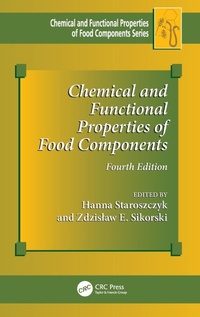
Chemical and Functional Properties of Food Components
4th Edition
Published on 22. May 2023
Book
Hardback
548 pages
978-1-032-19922-1 (ISBN)
Description
Over three editions, this book described the contents of food raw materials and products, the chemistry/biochemistry of food components, as well as the changes occurring during post-harvest storage and processing affecting the quality of foods. The fourth edition of Chemical and Functional Properties of Food Components discusses the role of chemical compounds in the structure of raw materials and the formation of different attributes of food quality, including nutritional value, safety, and sensory properties. This new edition contains four new chapters: "Non-Protein Nitrogenous Compounds"; "Prooxidants and Antioxidants in Food"; "Non-Nutritive Bioactive Compounds in Food of Plant Origin"; and "Analytical Methods Used for Assessing the Quality of Food Products."
These chapters have been included because new research results have brought increasing knowledge on the effect of non-protein nitrogenous compounds, especially bioactive peptides, nucleic acids, and biogenic amines on the biological properties of foods; the role of natural and added prooxidants and antioxidants in the processing and biological impact of foods; numerous beneficial and harmful effects of bioactive components of plant foods; and new systems for control of food composition and the safety of foods.
Features:
Stresses the effect of the chemical/biochemical reactions on the selection of optimum parameters of food processing without presenting details of the technological processes
Describes naturally occurring elements and compounds as well as those generated during food handling in view of health hazards they may bring to consumers
Discusses the risks and benefits of reactions occurring during food handling
The knowledge of the chemistry and biochemistry of the components and their interactions presented in this book aids food scientists in making the right decisions for controlling the rate of beneficial and undesirable reactions, selecting optimal storage and processing parameters, as well as the best use of food raw materials.
These chapters have been included because new research results have brought increasing knowledge on the effect of non-protein nitrogenous compounds, especially bioactive peptides, nucleic acids, and biogenic amines on the biological properties of foods; the role of natural and added prooxidants and antioxidants in the processing and biological impact of foods; numerous beneficial and harmful effects of bioactive components of plant foods; and new systems for control of food composition and the safety of foods.
Features:
Stresses the effect of the chemical/biochemical reactions on the selection of optimum parameters of food processing without presenting details of the technological processes
Describes naturally occurring elements and compounds as well as those generated during food handling in view of health hazards they may bring to consumers
Discusses the risks and benefits of reactions occurring during food handling
The knowledge of the chemistry and biochemistry of the components and their interactions presented in this book aids food scientists in making the right decisions for controlling the rate of beneficial and undesirable reactions, selecting optimal storage and processing parameters, as well as the best use of food raw materials.
More details
Series
Edition
4th edition
Language
English
Place of publication
London
United Kingdom
Publishing group
Taylor & Francis Ltd
Target group
Professional and scholarly
Professional Reference
Illustrations
148 s/w Abbildungen, 148 s/w Zeichnungen, 65 s/w Tabellen
65 Tables, black and white; 148 Line drawings, black and white; 148 Illustrations, black and white
Dimensions
Height: 240 mm
Width: 161 mm
Thickness: 35 mm
Weight
1001 gr
ISBN-13
978-1-032-19922-1 (9781032199221)
Copyright in bibliographic data and cover images is held by Nielsen Book Services Limited or by the publishers or by their respective licensors: all rights reserved.
Schweitzer Classification
Other editions
Additional editions
Hanna Staroszczyk | Zdzislaw E. Sikorski
Chemical and Functional Properties of Food Components
Book
12/2024
4th Edition
CRC Press
€99.90
Shipment within 10-20 days
Hanna Staroszczyk | Zdzislaw E. Sikorski
Chemical and Functional Properties of Food Components
E-Book
05/2023
4th Edition
CRC Press
€90.99
Available for download
Hanna Staroszczyk | Zdzislaw E. Sikorski
Chemical and Functional Properties of Food Components
E-Book
05/2023
4th Edition
CRC Press
€90.99
Available for download
Previous edition
Zdzislaw E. Sikorski
Chemical and Functional Properties of Food Components
Book
10/2006
3rd Edition
CRC Press
€284.74
Article exhausted; check for reprint
Persons
HANNA STAROSZCZYK earned her BS and MS at the Cracow University of Technology, her PhD at the Hugon Kollataj University of Agriculture in Cracow, and her D.Sc. at the Gdansk University of Technology (GUT), Poland. Currently she is head of the Department of Chemistry, Technology and Biotechnology of Food in GUT. She also worked as researcher/postdoc/visiting professor at the Institute of Food Research, Norwich, UK, Academia Sinica, Tajpej, Taiwan, and University of Arkansas, Fayetteville. Her research is focused mainly on biopolymer chemistry. She is an author/co-author of original papers on the modification of proteins and polysaccharides, as well as editor of books on food chemistry. She is a member of the Polish Society of Food Technologists.
ZDZISLAW E. SIKORSKI received the B.S., M.S, Ph.D., and D.Sc. from the Gdansk University of Technology (GUT), Dr honoris causa from the Agricultural University in Szczecin and is a fellow of the International Academy of Food Science and Technology. He gained industrial experience in breweries, in fish, meat, and vegetable processing plants, and on a deep-sea fishing trawler. He was organizer, professor, and head of the Department of Food Chemistry and Technology in GUT, served as Dean of the Faculty of Chemistry, was chairman of the Committee of Food Technology and Chemistry of the Polish Academy of Sciences, chaired the scientific board of the Sea Fisheries Institute in Gdynia, and was an elected member of the Main Council of Science and Tertiary Education in Poland. He worked also as researcher/professor in Ohio State University; CSIRO in Hobart; DSIR in Auckland; and National Taiwan Ocean University in Keelung. Currently he is a honorary professor emeritus in the Faculty of Chemistry at GUT. His research concentrated on the technology of fish processing and changes in food proteins due to storage and handling. He published numerous papers containing the results of his investigations in the field of food chemistry and technology and is the author/editor of a number of books in English, Polish, Russian, and Spanish.
ZDZISLAW E. SIKORSKI received the B.S., M.S, Ph.D., and D.Sc. from the Gdansk University of Technology (GUT), Dr honoris causa from the Agricultural University in Szczecin and is a fellow of the International Academy of Food Science and Technology. He gained industrial experience in breweries, in fish, meat, and vegetable processing plants, and on a deep-sea fishing trawler. He was organizer, professor, and head of the Department of Food Chemistry and Technology in GUT, served as Dean of the Faculty of Chemistry, was chairman of the Committee of Food Technology and Chemistry of the Polish Academy of Sciences, chaired the scientific board of the Sea Fisheries Institute in Gdynia, and was an elected member of the Main Council of Science and Tertiary Education in Poland. He worked also as researcher/professor in Ohio State University; CSIRO in Hobart; DSIR in Auckland; and National Taiwan Ocean University in Keelung. Currently he is a honorary professor emeritus in the Faculty of Chemistry at GUT. His research concentrated on the technology of fish processing and changes in food proteins due to storage and handling. He published numerous papers containing the results of his investigations in the field of food chemistry and technology and is the author/editor of a number of books in English, Polish, Russian, and Spanish.
Content
1. Food components and quality. 2. Chemical composition and structure of foods. 3. Water and food quality. 4. The role of mineral components. 5. Saccharides. 6. The role of proteins in food. 7. Nonprotein nitrogenous compounds. 8. Lipids and food quality. 9. Factors affecting the rheological properties of foods. 10. Food colorants. 11. Prooxidants and antioxidants in food. 12. Food allergens. 13. Food flavors. 14. The role of food additives. 15. Food safety. 16. Prebiotics and probiotics in food. 17. Mood food. 18. Mutagenic, carcinogenic, and chemopreventive compounds in food. 19. Non-nutrive bioactive compounds in food of plant origin. 20. Methods used for control of the sensory and biological properties of foods.