

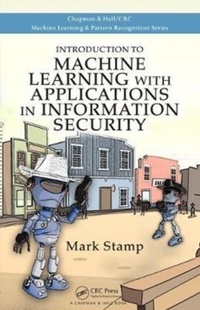
Introduction to Machine Learning with Applications in Information Security
1st Edition
Published on 7. September 2017
Book
Hardback
346 pages
978-1-138-62678-2 (ISBN)
Description
Introduction to Machine Learning with Applications in Information Security provides a class-tested introduction to a wide variety of machine learning algorithms, reinforced through realistic applications. The book is accessible and doesn't prove theorems, or otherwise dwell on mathematical theory. The goal is to present topics at an intuitive level, with just enough detail to clarify the underlying concepts.
The book covers core machine learning topics in-depth, including Hidden Markov Models, Principal Component Analysis, Support Vector Machines, and Clustering. It also includes coverage of Nearest Neighbors, Neural Networks, Boosting and AdaBoost, Random Forests, Linear Discriminant Analysis, Vector Quantization, Naive Bayes, Regression Analysis, Conditional Random Fields, and Data Analysis.
Most of the examples in the book are drawn from the field of information security, with many of the machine learning applications specifically focused on malware. The applications presented are designed to demystify machine learning techniques by providing straightforward scenarios. Many of the exercises in this book require some programming, and basic computing concepts are assumed in a few of the application sections. However, anyone with a modest amount of programming experience should have no trouble with this aspect of the book.
Instructor resources, including PowerPoint slides, lecture videos, and other relevant material are provided on an accompanying website: http://www.cs.sjsu.edu/~stamp/ML/. For the reader's benefit, the figures in the book are also available in electronic form, and in color.
About the Author
Mark Stamp has been a Professor of Computer Science at San Jose State University since 2002. Prior to that, he worked at the National Security Agency (NSA) for seven years, and a Silicon Valley startup company for two years. He received his Ph.D. from Texas Tech University in 1992. His love affair with machine learning began in the early 1990s, when he was working at the NSA, and continues today at SJSU, where he has supervised vast numbers of master's student projects, most of which involve a combination of information security and machine learning.
The book covers core machine learning topics in-depth, including Hidden Markov Models, Principal Component Analysis, Support Vector Machines, and Clustering. It also includes coverage of Nearest Neighbors, Neural Networks, Boosting and AdaBoost, Random Forests, Linear Discriminant Analysis, Vector Quantization, Naive Bayes, Regression Analysis, Conditional Random Fields, and Data Analysis.
Most of the examples in the book are drawn from the field of information security, with many of the machine learning applications specifically focused on malware. The applications presented are designed to demystify machine learning techniques by providing straightforward scenarios. Many of the exercises in this book require some programming, and basic computing concepts are assumed in a few of the application sections. However, anyone with a modest amount of programming experience should have no trouble with this aspect of the book.
Instructor resources, including PowerPoint slides, lecture videos, and other relevant material are provided on an accompanying website: http://www.cs.sjsu.edu/~stamp/ML/. For the reader's benefit, the figures in the book are also available in electronic form, and in color.
About the Author
Mark Stamp has been a Professor of Computer Science at San Jose State University since 2002. Prior to that, he worked at the National Security Agency (NSA) for seven years, and a Silicon Valley startup company for two years. He received his Ph.D. from Texas Tech University in 1992. His love affair with machine learning began in the early 1990s, when he was working at the NSA, and continues today at SJSU, where he has supervised vast numbers of master's student projects, most of which involve a combination of information security and machine learning.
More details
Series
Language
English
Place of publication
London
United Kingdom
Publishing group
Taylor & Francis Ltd
Target group
College/higher education
Illustrations
100 s/w Abbildungen
100 Illustrations, black and white
Dimensions
Height: 238 mm
Width: 171 mm
Thickness: 29 mm
Weight
692 gr
ISBN-13
978-1-138-62678-2 (9781138626782)
Copyright in bibliographic data and cover images is held by Nielsen Book Services Limited or by the publishers or by their respective licensors: all rights reserved.
Schweitzer Classification
Other editions
New editions
Book
09/2022
2nd Edition
Chapman & Hall/CRC
€101.80
Shipment within 10-20 days
Additional editions
Book
06/2020
1st Edition
Chapman & Hall/CRC
€53.22
Article exhausted; check for reprint
Person
Mark Stamp is a Professor at San Jose State University, and the author of two textbooks, Information Security: Principles and Practice and Applied Cryptanalysis: Breaking Ciphers in the Real World.
Content
Introduction. I TOOLS OF THE TRADE. A Revealing Introduction to Hidden Markov Models. A Full Frontal View of Profile Hidden Markov Models. Principal Components of Principal. Component Analysis. A Reassuring Introduction to Support Vector Machines. A Comprehensible Collection of Clustering Concepts. Many Mini Topics. Data Analysis. II APPLICATIONS. HMM Applications. PHMM Applications. PCA Applications. SVM Applications. Clustering Applications