

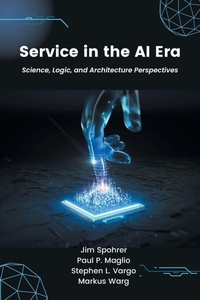
Service in the AI Era
Science, Logic, and Architecture Perspectives
Published on 30. September 2022
Book
Paperback/Softback
154 pages
978-1-63742-303-5 (ISBN)
Description
Are you prepared for the coming AI era?
AI advances will profoundly change your daily service interactions, so this book provides readers with a necessary understanding of service, the application of resources (e.g., knowledge) for the benefit of another. In just minutes, you can learn about today's use of early-stage AI for automation and augmentation, and essential elements of service science, service-dominant (S-D) logic, and Service Dominant Architecture (SDA).
Ultimately improved service for all is possible with human-level AI and digital twins - but requires investing wisely in better models: Better models of the world both complex natural and social systems (science), better mental-models in people to improve interactions (logic), better cultural and structural models of organizations to improve change (architecture), and better trusted and responsible AI models. The service innovation community studies and builds better models to improve interactions and change in business and society.
The book challenges all responsible actors - individuals, businesses, universities, and governments - to invest systematically and wisely to upskill with AI (the X+AI vision). The service innovation community is a growing transdiscipline harnessing all disciplines to become better T-shaped professionals. Extensive end notes, bibliography, and index are provided.
AI advances will profoundly change your daily service interactions, so this book provides readers with a necessary understanding of service, the application of resources (e.g., knowledge) for the benefit of another. In just minutes, you can learn about today's use of early-stage AI for automation and augmentation, and essential elements of service science, service-dominant (S-D) logic, and Service Dominant Architecture (SDA).
Ultimately improved service for all is possible with human-level AI and digital twins - but requires investing wisely in better models: Better models of the world both complex natural and social systems (science), better mental-models in people to improve interactions (logic), better cultural and structural models of organizations to improve change (architecture), and better trusted and responsible AI models. The service innovation community studies and builds better models to improve interactions and change in business and society.
The book challenges all responsible actors - individuals, businesses, universities, and governments - to invest systematically and wisely to upskill with AI (the X+AI vision). The service innovation community is a growing transdiscipline harnessing all disciplines to become better T-shaped professionals. Extensive end notes, bibliography, and index are provided.
More details
Language
English
Place of publication
Sterling Forest
United States
Product notice
Paperback (trade)
Dimensions
Height: 229 mm
Width: 152 mm
Thickness: 8 mm
Weight
213 gr
ISBN-13
978-1-63742-303-5 (9781637423035)
Copyright in bibliographic data and cover images is held by Nielsen Book Services Limited or by the publishers or by their respective licensors: all rights reserved.
Schweitzer Classification
Other editions
Additional editions
Jim Spohrer | Paul P. Maglio | Stephen L. Vargo
Service in the AI Era
Science, Logic, and Architecture Perspectives
E-Book
08/2022
Business Expert Press
€17.49
Available for download
Persons
Jim Spohrer co-founded IBM's service science initiative and the International Society of Service Innovation Professionals (ISSIP.org).
Paul P. Maglio is a Professor of Management and Cognitive Science at the University of California, Merced. He co-founded service science at IBM, was Editor-in-Chief of INFORMS Service Science (2013-2018) and is lead editor of the Handbook of Service Science, Volumes I and II.
Paul P. Maglio is a Professor of Management and Cognitive Science at the University of California, Merced. He co-founded service science at IBM, was Editor-in-Chief of INFORMS Service Science (2013-2018) and is lead editor of the Handbook of Service Science, Volumes I and II.