

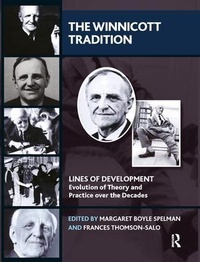
The Winnicott Tradition
Lines of Development-Evolution of Theory and Practice over the Decades
1st Edition
Published on 5. November 2014
Book
Paperback/Softback
432 pages
978-1-78220-007-9 (ISBN)
Description
This volume in a book series on psychoanalytic leaders, provides a geographically global sampler of writing stemming from Winnicott's complex and paradoxical thinking. In the first section, on his work and legacy, his thinking is put into a context to reveal something of the origins, significant milestones, contemporary development, and theoretical expansion of his thinking. In the second section, there is a recognition of the fact that Winnicott privileged clinical work. This section aims to illustrate the evolution of theory, expansion of concepts and applications of Winnicott's body of work to the clinical situation with both children and adults in a variety of settings which include private practice, the health services and residential programmes in a varied array of settings worldwide. The third section on applications of Winnicott's work outside the consulting room celebrates his special capacity as a bridge-builder and as a figure whose work has had a very wide appeal and influence. His work continues to grow in its influence and to an unusual degree it informs the work of allied professionals and those in very many different disciplines, domains of thought and work sectors to that of the traditional clinical ones of health and education. Several chapters indicate how his creativity inspired those in the creative disciplines. Lastly, the fourth section provides personal reflections and accounts from those familiar with Winnicott's work or with the man himself and gives the reader an opportunity to experience the evolution of his thinking and influence through the eyes of contributors who have pertinent historical recollections and experiences.
Reviews / Votes
'I am proud and delighted to endorse this latest and important contribution to the Lines of Development series.' - Anne-Marie Sandler, past Vice-President of the International Psychoanalytical Association and Sigourney Award Recipient 'This book is full of fascinating treasures and constitutes an important and exciting addition to the Winnicott literature.'- Victoria Hamilton, PhD, musician, artist, and author of The Analyst's Preconconscious'As my supervisor, Winnicott never gave me advice. He gave me his ideas and encouraged me to follow my own way. The fruitfulness of this approach is beautifully illustrated in this book where his ideas can be seen to have stimulated a wealth of exciting and original clinical and theoretical developments.'- Juliet Hopkins, PhD, child and adult psychoanalytic psychotherapist and author'This is a book that, now that it exists, makes us wonder that it was not done before. Winnicott's work continues to be of great relevance and value, and in these pages we see more of why: Winnicott not only theorised creativity, freedom of thought, the quest for personal meaning, and the interplay between internal and environmental realities, but he also seems to have enacted them continually in his life and work. The papers collected here locate Winnicott in his context, and show how and why he constantly stretched beyond it. They are a treasure trove that one imagines Winnicott would himself have been intrigued to read.'- Mary Target, Professor of Psychoanalysis, University College London'This book demonstrates the authentic, multifaceted fertility of Winnicott's ideas, language, and style of thinking. His innovative psychoanalytic concepts, his fascinating clinical stories about child and adult patients, and his unique ability to talk to laypeople - putting his ideas to work outside the consulting room - started a new way in psychoanalysis. We can see here how his heritage flourishes today in many fields thanks to his followers, who share a generative attitude, open to new ideas. This book confirms a very special, personal heritage left by Winnicott: how opening the door to the potential and to the unexpected can become a fruitful tradition. This heritage, this tradition, is now in good hands.'- Stefano Bolognini, President of the International Psychoanalytical AssociationMore details
Series
Language
English
Place of publication
London
United Kingdom
Publishing group
Taylor & Francis Ltd
Target group
Professional Practice & Development
Product notice
Paperback (trade)
Unsewn / adhesive bound
Dimensions
Height: 244 mm
Width: 188 mm
Thickness: 25 mm
Weight
771 gr
ISBN-13
978-1-78220-007-9 (9781782200079)
Copyright in bibliographic data and cover images is held by Nielsen Book Services Limited or by the publishers or by their respective licensors: all rights reserved.
Schweitzer Classification
Other editions
Additional editions
Margaret Boyle Spelman | Frances Thomson-Salo
The Winnicott Tradition
Lines of Development-Evolution of Theory and Practice over the Decades
Book
07/2019
1st Edition
Routledge
€185.00
Shipment within 15-20 days
Margaret Boyle Spelman | Frances Thomson-Salo
The Winnicott Tradition
Lines of Development-Evolution of Theory and Practice over the Decades
E-Book
05/2018
1st Edition
Routledge
€81.99
Available for download
Margaret Boyle Spelman | Frances Thomson-Salo
The Winnicott Tradition
Lines of Development-Evolution of Theory and Practice over the Decades
E-Book
05/2018
1st Edition
Routledge
€81.99
Available for download
Persons
Margaret Boyle Spelman is a registered clinical psychologist, psychoanalytic psychotherapist, and organisational psychologist working for three decades in the Irish Health Services and in private practice since 1998. Margaret is a member of the European Association for Psychotherapy and has held executive positions in The Psychological Society of Ireland, The Irish Institute of Psychoanalytic Psychotherapy, The Irish Forum for Psychoanalytic Psychotherapy and The Irish Council for Psychotherapy. She has Masters degrees in psychology from the three Dublin Universities and her PhD was completed at the Centre for Psychoanalysis, University of Essex. Frances Thomson Salo trained with the British Society as a child and adult psychoanalyst, is a Training analyst and past President of the Australian Psychoanalytical Society, Chair of the International Psychoanalytical Association Committee of Women in Psychoanalysis, an editorial board member of the 'International Journal of Psychoanalysis', a consultant infant mental health clinician at the Royal Women's Hospital and child psychotherapist at the Royal Children's Hospital, an Honorary Fellow of the Murdoch Children's Research Institute, an Associate Professor on the faculty of the University of Melbourne Graduate Diploma for Infant and Parent Mental Health, and has published on child and infant-parent psychotherapy.
Content
ACKNOWLEDGEMENTS ABOUT THE EDITORS AND CONTRIBUTORS SERIES EDITORS' FOREWORD INTRODUCTION PART I WINNICOTT: HIS WORK AND LEGACY SECTION INTRODUCTION CHAPTER ONE Has Winnicott become a Winnicottian? - Martin James CHAPTER TWO Winnicott's constant search for the life that feels real - James William Anderson CHAPTER THREE "People who think in pictures": the continuing dialogue between Marion Milner and Donald Winnicott in Bothered by Alligators - Emma Letley CHAPTER FOUR Unassimilated aggression and the emergence of the unit self: Winnicott, Jung, and Matte Blanco - William Meredith-Owen CHAPTER FIVE Winnicott and Bion: claiming alternate legacies - R. D. Hinshelwood CHAPTER SIX Winnicott's anni horribiles: the biographical roots of "Hate in the counter-transference" - Brett Kahr CHAPTER SEVEN Between Winnicott and Lacan - Lewis A. Kirshner CHAPTER EIGHT A measure of agreement: an exploration of the relationship of Winnicott and Phyllis Greenacre - Nellie L. ThompsonPART II CLINICAL WORK AND APPLICATIONS OF WINNICOTT'S TRADITION SECTION INTRODUCTION CHAPTER NINE On potential space - Thomas H. Ogden CHAPTER TEN Creating connections - Dilys Daws CHAPTER ELEVEN The paternal function in Winnicott: the psychoanalytical frame, becoming human - Haydee Faimberg CHAPTER TWELVE "Where we start from": thinking with Winnicott and Lacan about the care of homeless adults - Deborah Anna Luepnitz CHAPTER THIRTEEN Seeing and being seen: the psychodynamics of pornography through the lens of Winnicott's thought - John Woods CHAPTER FOURTEEN The isolate and the stranger: Winnicott's model of subjectivity and its implications for theory and technique - James Rose CHAPTER FIFTEEN Hatred and helping: working with our own fear and narcissistic rage - Peter Wilson CHAPTER SIXTEEN "I feel that you are introducing a big problem. I never became human. I have missed it." - Lesley Caldwell CHAPTER SEVENTEEN The analyst's oscillating between interpreting and not interpreting: a peculiar Winnicottian point of view on interpreting and not interpreting - Vincenzo Bonaminio CHAPTER EIGHTEEN Maternal perinatal mental illness: the baby's unexperienced breakdown - Angela Joyce CHAPTER NINETEEN Mind the gap: dysynchrony in the writings of Winnicott and associated clinical thoughts - Alexandra M. HarrisonPART III SPECIALISED WORK IN THE WINNICOTT TRADITION SECTION INTRODUCTION CHAPTER TWENTY The importance of being seen: Winnicott, dance movement psychotherapy, and the embodied experience - Suzi Tortora CHAPTER TWENTY-ONE The location of authenticity - Graham Lee CHAPTER TWENTY-TWO Transitional/transitive - pictures from an exhibition - Ann Murphy CHAPTER TWENTY-THREE The seriousness of playfulness - Campbell Paul CHAPTER TWENTY-FOUR Maternal form in artistic creation - Kenneth Wright CHAPTER TWENTY-FIVE Ways of being: transitional objects and the work of art - Elizabeth Presa CHAPTER TWENTY-SIX Unintegrated states and the process of integration: a new formulation -Christopher Reeves CHAPTER TWENTY-SEVEN The reflected self - Louise K. Newman CHAPTER TWENTY-EIGHT "Oedipus, schmedipus: so long as he loves his mother": teaching Winnicott to a non-analytic audience - Bernard BarnettPART IV PERSONAL AND THEORETICAL REFLECTIONS FROM CLINICIANS SECTION INTRODUCTION CHAPTER TWENTY-NINE Two pioneers in the history of infant mental health: Winnicott and Bowlby - Eric Rayner CHAPTER THIRTY Winnicott's influence on paediatrics then and now - Ann Morgan and Robin Wilson CHAPTER THIRTY-ONE Anna Freud and Winnicott: developmental stages, aggression, and infantile sexuality - Elisabeth Young-Bruehl CHAPTER THIRTY-TWO A personal reflection: claiming alternate legacies - Jennifer JohnsINDEX