

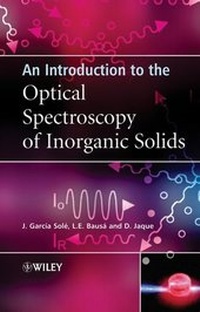
An Introduction to the Optical Spectroscopy of Inorganic Solids
Published on 18. February 2005
Book
Hardback
304 pages
978-0-470-86885-0 (ISBN)
Description
This practical guide to spectroscopy and inorganic materials meets the demand from academia and the science community for an introductory text that introduces the different optical spectroscopic techniques, used in many laboratories, for material characterisation.
* Treats the most basic aspects to be introduced into the field of optical spectroscopy of inorganic materials, enabling a student to interpret simple optical (absorption, reflectivity, emission and scattering) spectra
* Contains simple, illustrative examples and solved exercises
* Covers the theory, instrumentation and applications of spectroscopy for the characterisation of inorganic materials, including lasers, phosphors and optical materials such as photonics
This is an ideal beginner's guide for students with some previous knowledge in quantum mechanics and optics, as well as a reference source for professionals or researchers in materials science, especially the growing field of optical materials.
Reviews / Votes
"This is a useful book for an undergraduate or an early-stage postgraduate course in spectroscopy." (The Higher Education Academy Physical Sciences Centre, June 2008)More details
Product info
gebunden
Edition
1. Auflage
Language
English
Place of publication
New York
United States
Target group
Professional and scholarly
College/higher education
Dimensions
Height: 23.6 cm
Width: 16.5 cm
Thickness: 2.1 cm
Weight
560 gr
ISBN-13
978-0-470-86885-0 (9780470868850)
Schweitzer Classification
Other editions
Additional editions
Jose Solé | Luisa Bausa | Daniel Jaque
An Introduction to the Optical Spectroscopy of Inorganic Solids
E-Book
06/2005
Wiley
€76.99
Available for download
Jose Solé | Luisa Bausa | Daniel Jaque
An Introduction to the Optical Spectroscopy of Inorganic Solids
Book
02/2005
Wiley
€111.50
Shipment within 10-20 days
Persons
Jose Sole, Department of Material Science, University of Madrid, Spain.
Luis Bausa, Department of Material Science, University of Madrid, Spain.
Daniel Jaque, Department of Material Science, University of Madrid, Spain.
Luis Bausa, Department of Material Science, University of Madrid, Spain.
Daniel Jaque, Department of Material Science, University of Madrid, Spain.
Content
Preface.
Acknowledgments.
Some Physical Constants of Interest in Spectroscopy.
A Periodic Table of the Elements for Optical Spectroscopy.
1. Fundamentals.
1.1 Origin of the Spectroscopy.
1.2 Electromagnetic Spectrum. Optical Spectroscopy.
1.3 Absorption. The Spectrophotometer.
1.4 Luminescence. The Spectrofluorimeter. Time Resolved Luminescence.
1.5 Scattering. The Raman effect.
1.6 Advanced topic: The Fourier Transform Spectrophotometer.
Exercises.
2. Light Sources.
2.1 Introduction.
2.2 Lamps.
2.3 The Laser. Basic Principles.
2.4 Types of Lasers.
2.5 Tunability of laser radiation. The Optical Parametric Oscillator.
2.6 Advanced Topic:1) Site Selective Spectroscopy. 2) Excited State Absorption.
Exercises.
3. Monochromators and Detectors.
3.1 Introduction.
3.2 Monochromators.
3.3 Types of Detectors. Basic Parameters.
3.4 The Photomultiplier.
3.5 Signal/noise ratio Optimisation.
3.6 Detection of Pulses.
3.7 Advanced Topic: Detection of Very Fast Pulses; The Streak Camera; The Correlator.
Exercises.
4. The Optical Transparency of Solids.
4.1 Introduction.
4.2 Optical Magnitudes and the Dielectric Constant.
4.3The Lorentz Oscillator.
4.4 Metals.
4.5 Semiconductors and Insulators.
4.6 Spectral Shape of the Fundamental Absorption Edge.
4.7 Excitons.
4.8 Advanced Topic: The Colour of Metals.
Exercises.
5. Optically Active Centers.
5.1 Introduction.
5.2 Static Interaction. The Crystalline Field.
5.3 Band Intensities. The Oscillator Strength.
5.4 Dynamic Interaction. The Coordinate Configuration Diagram.
5.5 Band Shape. The Huang-Rhys Factor.
5.6 Non Radiative Transitions. Energy Transfer.
5.7 Advanced Topic: Determination of Quantum Efficiencies.
Exercises.
6. Applications: Rare Earth and Transition Metal Ions, and Color Centers.
6.1 Introduction.
6.2 Trivalent Rare Earth Ions. Diagram of Dieke.
6.3 Non Radiative Transitions in Rare Earth Ions; The "Energy Gap" Law.
6.4 Transition Metal Ions. Tanabe- Sugano Diagrams.
6.5 Colour Centres.
6.6 Advanced topic: 1) The Judd and Ofelt method. 2) Optical Cooling of Solids.
7. Group Theory and Spectroscopy.
7.1 Introduction.
7.2 Symmetry Operations and Classes.
7.3 Representations. The Character Table.
7.4 Reduction in Symmetry and Splitting of Energy Levels.
7.5 Selection Rules for Optical Transitions.
7.6 Illustrative Examples.
7.7 Advanced Topic: Applications to Optical Transitions of Kramers Ions.
Exercises.
Appendix A1: The Joint Density of States.
Appendix A2: The Effect of an Octahedral Field on a d1 Valence Electron.
Appendix A3: The Calculation of the Probability of Spontaneous Emission by Means of Einstein Thermodynamic Treatment.
Appendix A4: Determination of the Smakula´s Formula.
Index.