

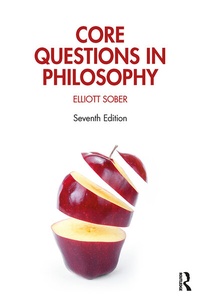
Core Questions in Philosophy
A Text with Readings
7th Edition
Published on 5. March 2020
Book
Hardback
332 pages
978-1-138-48735-2 (ISBN)
Description
Writing in an engaging lecture-style format, Elliott Sober shows students how philosophy is best used to evaluate many different kinds of arguments and to construct sound theories. Well-known historical texts are discussed, not as a means to honor the dead or merely to discuss what various philosophers have thought, but to engage with, criticize, and even improve ideas from the past. In addition-because philosophy cannot function apart from its engagement with the wider society-traditional and contemporary philosophical problems are brought into dialogue with the physical, biological, and social sciences. Text boxes highlight key concepts, and review questions, discussion questions, and a glossary of terms are also included.
Core Questions in Philosophy has served as a premier introductory textbook for more than two decades, with updates to each new edition. New improvements to this seventh edition include a lower price and a new Routledge companion website that includes:
Updated supplementary readings, with the inclusion of more work from female philosophers
New videos and podcasts, organized by their relevance to each chapter in the book.
Visit the companion website at: www.routledge.com/cw/sober.
Core Questions in Philosophy has served as a premier introductory textbook for more than two decades, with updates to each new edition. New improvements to this seventh edition include a lower price and a new Routledge companion website that includes:
Updated supplementary readings, with the inclusion of more work from female philosophers
New videos and podcasts, organized by their relevance to each chapter in the book.
Visit the companion website at: www.routledge.com/cw/sober.
Reviews / Votes
"A really excellent introduction to philosophy does the following: meets the student at their level, then takes them up a notch, and approaches traditional topics in unique and interesting ways. This book does those things."Fred Adams, University of Delaware
More details
Edition
7th edition
Language
English
Place of publication
London
United Kingdom
Publishing group
Taylor & Francis Ltd
Target group
College/higher education
Illustrations
29 s/w Abbildungen, 29 s/w Zeichnungen, 1 s/w Tabelle
1 Tables, black and white; 29 Line drawings, black and white; 29 Illustrations, black and white
Dimensions
Height: 254 mm
Width: 178 mm
Weight
830 gr
ISBN-13
978-1-138-48735-2 (9781138487352)
Copyright in bibliographic data and cover images is held by Nielsen Book Services Limited or by the publishers or by their respective licensors: all rights reserved.
Schweitzer Classification
Other editions
New editions
Elliott Sober
Core Questions in Philosophy
Book
05/2021
8th Edition
Routledge
€179.51
Shipment within 15-20 days
Additional editions
Book
03/2020
7th Edition
Routledge
€94.27
Article exhausted; check for reprint
Person
Elliott Sober is Hans Reichenbach Professor and William F. Vilas Research Professor in the Philosophy Department at the University of Wisconsin-Madison, USA. His most recent book is The Design Argument (2018).
Content
Preface Part I: Introduction 1. What Is Philosophy? 2. Deductive Arguments 3. Inductive and Abductive Arguments Part II: Philosophy of Religion 4. Aquinas's First Four Ways 5. The Design Argument 6. Evolution and Creationism 7. Can Science Explain Everything? 8. The Ontological Argument 9. Is the Existence of God Testable? 10. Pascal and Irrationality 11. The Argument from Evil Part III: Theory of Knowledge 12. What Is Knowledge? 13. Descartes' Foundationalism 14. The Reliability Theory of Knowledge 15. Justified Belief and Hume's Problem of Induction 16. Can Hume's Skepticism Be Refuted? 17. Beyond Foundationalism 18. Locke on the Existence of External Objects Part IV: Philosophy of Mind 19. Dualism and the Mind/Body Problem 20. Logical Behaviorism 21. Methodological Behaviorism 22. The Mind/Brain Identity Theory 23. Functionalism 24. Freedom, Determinism, and Causality 25. A Menu of Positions on Free Will 26. Compatibilism 27. Psychological Egoism Part V: Ethics 28. Ethics-Normative and Meta 29. The Is/Ought Gap and the Naturalistic Fallacy 30. Observation and Explanation in Ethics 31. Conventionalist Theories 32. Utilitarianism 33. Kant's Moral Theory 34. Aristotle on the Good Life