

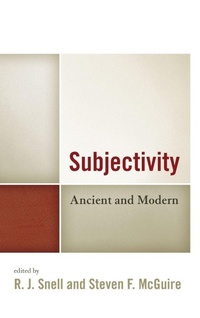
Subjectivity
Ancient and Modern
Published on 4. March 2016
Book
Hardback
262 pages
978-1-4985-1318-0 (ISBN)
Description
In Subjectivity, sixteen leading scholars examine the turn to the subject in modern philosophy and consider its historical antecedents in ancient and medieval thought. Some critics of modernity reject the turn to the subject as a specifically modern error, arguing that it logically leads to nihilism and moral relativism by divorcing the human mind from objective reality. Yet, some important thinkers of the last half-century--including Leo Strauss, Eric Voegelin, John Finnis, and Bernard Lonergan--consider a subjective starting point and claim to find a similar position in ancient and medieval thought. If correct, their positions suggest that one can adopt the subjective turn and remain true to the tradition.
This is a timely question. The common good of our polity encounters a situation in which many believe that there is no objective reality to which human minds and wills ought to conform, a conclusion that suggests we can define and construct reality. In light of this, the notion of a natural or objective reality to which human beings ought to conform becomes particularly vital. Should we, then, adopt the modern turn to subjectivity and argue for objective truth and moral order on its basis, or reject the subjective turn as part of the problem and return to an earlier approach that grounds these things in nature or some other external reality? Critics of modern subjectivity argue that the modern turn to subjectivity must be abandoned because it is the very source of the nominalism that threatens to undermine liberal democracy. Others argue, however, that subjectivity itself logically leads to the recognition of an objective reality beyond the mind of the individual. Edited by R. J. Snell and Steven F. McGuire, this collection will be of particular interest to intellectual historians, political philosophers, theologians, and philosophers.
This is a timely question. The common good of our polity encounters a situation in which many believe that there is no objective reality to which human minds and wills ought to conform, a conclusion that suggests we can define and construct reality. In light of this, the notion of a natural or objective reality to which human beings ought to conform becomes particularly vital. Should we, then, adopt the modern turn to subjectivity and argue for objective truth and moral order on its basis, or reject the subjective turn as part of the problem and return to an earlier approach that grounds these things in nature or some other external reality? Critics of modern subjectivity argue that the modern turn to subjectivity must be abandoned because it is the very source of the nominalism that threatens to undermine liberal democracy. Others argue, however, that subjectivity itself logically leads to the recognition of an objective reality beyond the mind of the individual. Edited by R. J. Snell and Steven F. McGuire, this collection will be of particular interest to intellectual historians, political philosophers, theologians, and philosophers.
Reviews / Votes
For those who already have an interest in these debates, the anthology makes some significant contributions. A primary strength of the book is that, reading essays side-by-side on thinkers that you would prima facie rarely associate with one another, you come to see overlapping themes regarding subjectivity across philosophical schools.... This book is a[n]...important contribution to a central debate of our times. * Notre Dame Philosophical Reviews * In Subjectivity: Ancient and Modern, editors R. J. Snell and Steven F. McGuire have assembled a high-quality group of scholars to take up the philosophical and political roots of the problematic question not only of "subjective rights" but of subjectivity more broadly conceived.... This volume would be of obvious appeal to anyone interested in the question of the modern subject and the manner with which a variety of premodern voices can help both to understand it and to bring out its better potential. * Anamnesis Journal *More details
Language
English
Place of publication
United States
Publishing group
Bloomsbury Publishing Plc
Target group
Professional and scholarly
Dimensions
Height: 235 mm
Width: 157 mm
Thickness: 20 mm
Weight
584 gr
ISBN-13
978-1-4985-1318-0 (9781498513180)
Copyright in bibliographic data and cover images is held by Nielsen Book Services Limited or by the publishers or by their respective licensors: all rights reserved.
Schweitzer Classification
Other editions
Additional editions
Subjectivity
Ancient and Modern
E-Book
03/2016
1st Edition
Lexington Books
€107.99
Available for download
Subjectivity
Ancient and Modern
E-Book
03/2016
1st Edition
Lexington Books
€107.99
Available for download
Persons
R. J. Snell is professor of philosophy at Eastern University and executive director of the Agora Institute for Civic Virtue and the Common Good.
Steven F. McGuire is assistant professor of political science at Eastern University and a research director at the Agora Institute for Civic Virtue and the Common Good.
Steven F. McGuire is assistant professor of political science at Eastern University and a research director at the Agora Institute for Civic Virtue and the Common Good.
Content
Introduction
1.Subjectivity and Metaphysics in Voegelin's Reading of Aristotle
Steven F. McGuire
Response by Lee Trepanier
2.Objectivity as Authentic Subjectivity
Elizabeth A. Murray
Response by Matthew B. O'Brien
3.Subjectivity without Subjectivism: Revisiting the Is/Ought Gap
Sherif Girgis
Response by Mark Shiffman
4.First and Third Person Standpoints in the New Natural Law Theory
Christopher O. Tollefsen
Response by Amy Gilbert Richards
5.The Claims of Subjectivity and the Limits of Politics
Ralph C. Hancock
Response by Richard Velkley
6.The Turn to the Subject as the Turn to the Person
David Walsh
Response by Phillip Cary
7.Personalism and Common Good: Thomistic Political Philosophy and the Turn to Subjectivity
V. Bradley Lewis
Response by Daniel Mark
8.Existential Authority, Belonging, and the Commissioning that is Subjectivity: A Medieval Philosophical Anthropology
James Greenaway
Response by Jeremy D. Wilkins
1.Subjectivity and Metaphysics in Voegelin's Reading of Aristotle
Steven F. McGuire
Response by Lee Trepanier
2.Objectivity as Authentic Subjectivity
Elizabeth A. Murray
Response by Matthew B. O'Brien
3.Subjectivity without Subjectivism: Revisiting the Is/Ought Gap
Sherif Girgis
Response by Mark Shiffman
4.First and Third Person Standpoints in the New Natural Law Theory
Christopher O. Tollefsen
Response by Amy Gilbert Richards
5.The Claims of Subjectivity and the Limits of Politics
Ralph C. Hancock
Response by Richard Velkley
6.The Turn to the Subject as the Turn to the Person
David Walsh
Response by Phillip Cary
7.Personalism and Common Good: Thomistic Political Philosophy and the Turn to Subjectivity
V. Bradley Lewis
Response by Daniel Mark
8.Existential Authority, Belonging, and the Commissioning that is Subjectivity: A Medieval Philosophical Anthropology
James Greenaway
Response by Jeremy D. Wilkins