

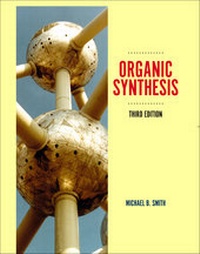
Organic Synthesis
3rd Edition
Published on 29. July 2011
Book
Hardback
1534 pages
978-1-890661-40-3 (ISBN)
Description
A reactions oriented course is a staple of most graduate organic programs, and synthesis is taught either as a part of that course or as a special topic. Ideally, the incoming student is an organic major, who has a good working knowledge of basic reactions, stereochemistry and conformational principles. In fact, however, many (often most) of the students in a first year graduate level organic course have deficiencies in their undergraduate work, are not organic majors and are not synthetically inclined.
To save students much time catching up this text provides a reliable and readily available source for background material that will enable all graduate students to reach the same high level of proficiency in organic chemistry. Produced over many years with extensive feedback from students taking an organic chemistry course this book provides a reaction based approach. The first two chapters provide an introduction to functional groups; these are followed by chapters reviewing basic organic transformations (e.g. oxidation, reduction). The book then looks at carbon-carbon bond formation reactions and ways to 'disconnect' a bigger molecule into simpler building blocks.
Most chapters include an extensive list of questions to test the reader's understanding. There is also a new chapter outlining full retrosynthetic analyses of complex molecules which highlights common problems made by scientists.
The book is intended for graduate and postgraduate students, scientific researchers in chemistry
To save students much time catching up this text provides a reliable and readily available source for background material that will enable all graduate students to reach the same high level of proficiency in organic chemistry. Produced over many years with extensive feedback from students taking an organic chemistry course this book provides a reaction based approach. The first two chapters provide an introduction to functional groups; these are followed by chapters reviewing basic organic transformations (e.g. oxidation, reduction). The book then looks at carbon-carbon bond formation reactions and ways to 'disconnect' a bigger molecule into simpler building blocks.
Most chapters include an extensive list of questions to test the reader's understanding. There is also a new chapter outlining full retrosynthetic analyses of complex molecules which highlights common problems made by scientists.
The book is intended for graduate and postgraduate students, scientific researchers in chemistry
More details
Edition
3rd edition
Language
English
Place of publication
Irvine
United States
Target group
Professional and scholarly
advanced undergraduates, post graduates, postdocs in organic chemistry and organic synthesis
Illustrations
Approx. 1000 illustrations
Dimensions
Height: 279 mm
Width: 210 mm
Weight
2760 gr
ISBN-13
978-1-890661-40-3 (9781890661403)
Copyright in bibliographic data and cover images is held by Nielsen Book Services Limited or by the publishers or by their respective licensors: all rights reserved.
Schweitzer Classification
Other editions
New editions
Michael Smith
Organic Synthesis
Book
10/2024
5th Edition
Academic Press
€161.50
Shipment within 15-20 days
Michael Smith
Organic Synthesis
Book
12/2016
4th Edition
Academic Press
€146.32
Article exhausted; check for reprint
Additional editions
Person
Content
Chapter 1: Retrosynthesis, Stereochemistry, and Conformations
Chapter 2: Acids, Bases and Functional Group Exchange Reactions
Chapter 3: Oxidation
Chapter 4: Reduction
Chapter 5: Hydroboration
Chapter 6: Stereocontrol and Ring Formation
Chapter 7: Protecting Groups
Chapter 8: Cd Disconnect Products: Nucleophilic Species that Form Carbon-Carbon Bonds
Chapter 9: Cd Disconnect Products: Nucleophilic Species that Form Carbon-Carbon Bonds: Enolate Anions
Chapter 10: Synthetic Strategies
Chapter 11: Pericyclic carbon-carbon Bond Forming reactions: Multiple Bond disconnections
Chapter 12: Ca Disconnect Products: Electrophilic Carbon-Carbon Bond-Forming Reactions
Chapter 13: Carbon Radical Disconnect Products: Formation of Carbon-Carbon Bonds via Radicals and Carbenes
Chapter 14: Student Synthesis: The First Synthetic Problem
Chapter 2: Acids, Bases and Functional Group Exchange Reactions
Chapter 3: Oxidation
Chapter 4: Reduction
Chapter 5: Hydroboration
Chapter 6: Stereocontrol and Ring Formation
Chapter 7: Protecting Groups
Chapter 8: Cd Disconnect Products: Nucleophilic Species that Form Carbon-Carbon Bonds
Chapter 9: Cd Disconnect Products: Nucleophilic Species that Form Carbon-Carbon Bonds: Enolate Anions
Chapter 10: Synthetic Strategies
Chapter 11: Pericyclic carbon-carbon Bond Forming reactions: Multiple Bond disconnections
Chapter 12: Ca Disconnect Products: Electrophilic Carbon-Carbon Bond-Forming Reactions
Chapter 13: Carbon Radical Disconnect Products: Formation of Carbon-Carbon Bonds via Radicals and Carbenes
Chapter 14: Student Synthesis: The First Synthetic Problem