

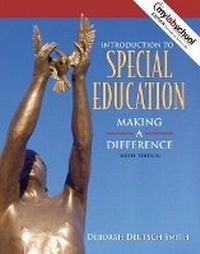
Introduction to Special Education
Making a Difference (with MyLabSchool)
6th Edition
Published on 31. May 2006
Book
Mixed media product
593 pages
978-0-205-49805-5 (ISBN)
Description
With Making a Difference as its central theme, the Sixth Edition of this best selling text recognizes that students are expected to demonstrate social responsibility, and that the actions and attitudes of individuals do matter.
Students and teachers have long relied on this comprehensive overview of the field of special education and the ways in which all teachers can help students with special needs to succeed in school and reach their full potential. The text is brimming with evidence-based practices, ready-to-use teaching tips, and up-to-the minute information about technology applications and contemporary inclusive practices ... all tools that teachers can use with students of all abilities, from those who struggle to the most gifted.
The text uses authentic stories from real people, current news events, and examples from contemporary popular culture to examine the positive effects of 30 years of IDEA, 15 years of ADA, and many years of social activism on the lives of individuals with disabilities, their families, and the educators and professionals who work with them.
The Sixth Edition features: a new chapter (6) on ADHD; "Making a Difference" sections that open every chapter with examples of social responsibility, philanthropy, advocacy and volunteerism; "What IDEA 2004/No Child Left Behind Says About ..." boxes in every chapter clarify, in a convenient bullet-list format, the practical meaning for teachers of these two federal initiatives; "Professional Standards and Licensure Tests" tables at the end of each chapter that correlate major sections with CEC, INTASC and Praxis II exam; and "Tips for Classroom Management" and "Tips for Effective Teachers" boxes in all chapters provide bulleted lists of practical ideas and suggestions.
In addition to being the author of Introduction to Special Education, 6e, and other major textbooks and articles, Deborah Deutsch Smith is a Research Professor of Special Education and Director of the IRIS Center for Faculty Enhancement at Vanderbilt University, which is funded by the U.S. Department of Education's Office of Special Education Programs. She has served on numerous editorial boards, and was recently appointed Associate Editor of TESE and has assumed the responsibility for an annual special feature translating research to practice. She is a past president of the Higher Education Consortium for Special Education (HECSE). She recently completed a term as a member of the Diversity Advisory Task Force of the federal National Council on Disability (NCD). Since 1984, Deb has served on the Board of Trustees for Pitzer College, Claremont Colleges, and was recognized in 2003 as a Life Trustee.
Students and teachers have long relied on this comprehensive overview of the field of special education and the ways in which all teachers can help students with special needs to succeed in school and reach their full potential. The text is brimming with evidence-based practices, ready-to-use teaching tips, and up-to-the minute information about technology applications and contemporary inclusive practices ... all tools that teachers can use with students of all abilities, from those who struggle to the most gifted.
The text uses authentic stories from real people, current news events, and examples from contemporary popular culture to examine the positive effects of 30 years of IDEA, 15 years of ADA, and many years of social activism on the lives of individuals with disabilities, their families, and the educators and professionals who work with them.
The Sixth Edition features: a new chapter (6) on ADHD; "Making a Difference" sections that open every chapter with examples of social responsibility, philanthropy, advocacy and volunteerism; "What IDEA 2004/No Child Left Behind Says About ..." boxes in every chapter clarify, in a convenient bullet-list format, the practical meaning for teachers of these two federal initiatives; "Professional Standards and Licensure Tests" tables at the end of each chapter that correlate major sections with CEC, INTASC and Praxis II exam; and "Tips for Classroom Management" and "Tips for Effective Teachers" boxes in all chapters provide bulleted lists of practical ideas and suggestions.
In addition to being the author of Introduction to Special Education, 6e, and other major textbooks and articles, Deborah Deutsch Smith is a Research Professor of Special Education and Director of the IRIS Center for Faculty Enhancement at Vanderbilt University, which is funded by the U.S. Department of Education's Office of Special Education Programs. She has served on numerous editorial boards, and was recently appointed Associate Editor of TESE and has assumed the responsibility for an annual special feature translating research to practice. She is a past president of the Higher Education Consortium for Special Education (HECSE). She recently completed a term as a member of the Diversity Advisory Task Force of the federal National Council on Disability (NCD). Since 1984, Deb has served on the Board of Trustees for Pitzer College, Claremont Colleges, and was recognized in 2003 as a Life Trustee.
Reviews / Votes
"This book is the rule rather than the exception."~ J'Anne Affeld, Northern Arizona University
"I believe a specific strength is the concise delivery of ideas in the text. The sections have good content but are not too detailed as to be off-putting for the general educator."
~ Patricia McClung, Lee University
"I really like [Chapter 3] and find it significantly superior to the Heward text. In fact, I spend little time with students on this chapter and use my own information. The 'History of the Field' section in Smith provides important background information and is followed by well presented information in this subfield of special education. [...] Smith's Introduction to Special Education is the best overall text I have seen for a survey course in special education. [... ] I would also highly recommend this text to any instructor looking for a new text in any introductory special education course."
~ Karen R. Smith, The University of Texas of the Permian Basin
"I like the fact that she has a chapter that focuses on Multicultural and Bilingual Special Education because this is an area that I believe is overlooked not only in other textbooks but in Special Education classes. [...] In many ways I believe that this book is easier to follow and relate to than the Turnbull book."
~ Josephine Fritts, Ozarks Technical Community College
"Deb has included a great deal of current research to define and explain ADHD. It is refreshing to see her elaborate on the information we do not have as well as what we do know about ADHD. [...] I am particularly delighted to see an emphasis on post-secondary transition planning with a view to higher education."
~ Mary Jane Hayes, Austin Peay State University
"The sections on Families and Technology are not found in all books of this type. These were helpful to me as someone who teaches a course on Collaborating with Families and seeks to implement the requirement of the state standards regarding the use and incorporation of technology. The life-span emphasis [is] appropriate for my students and I particularly like the fact that they reflected different regions of the country."
~ Patricia McClung, Lee University
"The features of this text are interesting and extremely relevant to the topics. They add multiple ways to access the information from different points. [...] The Advanced Organizer is a particular favorite of mine."
~ Barbara West, Bloomsburg University
"Novices to special education would find the writing level and tone acceptable, not talking down or too difficult for their ability. Students with learning disabilities will find the terminology defined within the text and multiple examples to aid their comprehension."
~ Lessie L. Cochran, Bowling Green State University
"The 'Tips for Effective Teaching' are some of the best suggestions that one could ask for."
~ Jerry Neal, Central Missouri State University
More details
Edition
6th edition
Language
English
Place of publication
United States
Publishing group
Pearson Education (US)
Target group
Professional and scholarly
Illustrations
Illustrations
Dimensions
Width: 283 mm
Thickness: 30 mm
Weight
1502 gr
ISBN-13
978-0-205-49805-5 (9780205498055)
Copyright in bibliographic data and cover images is held by Nielsen Book Services Limited or by the publishers or by their respective licensors: all rights reserved.
Schweitzer Classification
Other editions
New editions
Book
03/2009
7th Edition
Pearson
€230.99
Article not available for order
Deborah Deutsch Smith | Naomi Chowdhuri Tyler
Introduction to Special Education
Making A Difference: International Edition
Book
02/2009
7th Edition
Pearson
€230.99
Article is exhausted; no reprint
Previous edition
Deborah Deutsch Smith
Introduction to Special Education
Teaching in an Age of Opportunity, MyLabSchool Edition
Book
01/2005
5th Edition
Pearson
€80.80
Article exhausted; check for reprint
Content
1. Disabilities and Special Education: Making a Difference
DISABILITIES: WHERE WE'VE BEEN...ON THE HORIZON
DISABLITIES DEFINED
PARTICIPATION: COMMUNITY PRESENCE
SPECIAL EDUCATION: WHERE WE'VE BEEN...ON THE HORIZON
LEGAL PROTECTIONS: CIVIL AND EDUCATION RIGHTS
SPECIAL EDUCATION DEFINED
PARTICIPATION: INCLUSIVE SPECIAL EDUCATION
2. Individualized Special Education Programs: Planning and Services
ACCESS TO THE GENERAL EDUCATION CURRICULUM
SETTINGS, SERVICES, AND PERSONNEL
THE IEP PROCESS
TOOLS FOR INDIVIDUALIZED PROGRAMS
EVALUATING PROGRESS AND REVISING PROGRAMS
3. Cultural and Linguistic Diversity
WHERE WE'VE BEEN ... WHAT'S ON THE HORIZON
DEFINED
CHARACTERISTICS
PREVALENCE
CAUSES AND PREVENTION
ASSESSMENT
EARLY INTERVENTION
TEACHING STUDENTS WITH DISABILITIES
TRANSITION
COLLABORATION
PARTNERSHIPS WITH FAMILIES AND COMMUNITIES
4. Speech or Language Impairments
WHERE WE'VE BEEN ... WHAT'S ON THE HORIZON
DEFINED
CHARACTERISTICS
PREVALENCE
CAUSES AND PREVENTION
ASSESSMENT
EARLY INTERVENTION
TEACHING STUDENTS WITH DISABILITIES
TRANSITION
COLLABORATION
PARTNERSHIPS WITH FAMILIES AND COMMUNITIES
5. Learning Disabilities
WHERE WE'VE BEEN ... WHAT'S ON THE HORIZON
DEFINED
CHARACTERISTICS
PREVALENCE
CAUSES AND PREVENTION
ASSESSMENT
EARLY INTERVENTION
TEACHING STUDENTS WITH DISABILITIES
TRANSITION
COLLABORATION
PARTNERSHIPS WITH FAMILIES AND COMMUNITIES
6. Attention Deficit/Hyperactivity Disorders
WHERE WE'VE BEEN ... WHAT'S ON THE HORIZON
DEFINED
CHARACTERISTICS
PREVALENCE
CAUSES AND PREVENTION
ASSESSMENT
EARLY INTERVENTION
TEACHING STUDENTS WITH DISABILITIES
TRANSITION
COLLABORATION
PARTNERSHIPS WITH FAMILIES AND COMMUNITIES
7. Behavioral and Emotional Disorders
WHERE WE'VE BEEN ... WHAT'S ON THE HORIZON
DEFINED
CHARACTERISTICS
PREVALENCE
CAUSES AND PREVENTION
ASSESSMENT
EARLY INTERVENTION
TEACHING STUDENTS WITH DISABILITIES
TRANSITION
COLLABORATION
PARTNERSHIPS WITH FAMILIES AND COMMUNITIES
8. Mental Retardation
WHERE WE'VE BEEN ... WHAT'S ON THE HORIZON
DEFINED
CHARACTERISTICS
PREVALENCE
CAUSES AND PREVENTION
ASSESSMENT
EARLY INTERVENTION
TEACHING STUDENTS WITH DISABILITIES
TRANSITION
COLLABORATION
PARTNERSHIPS WITH FAMILIES AND COMMUNITIES
9. Physical Impairments and Special Health Care Needs
WHERE WE'VE BEEN ... WHAT'S ON THE HORIZON
DEFINED
CHARACTERISTICS
PREVALENCE
CAUSES AND PREVENTION
ASSESSMENT
EARLY INTERVENTION
TEACHING STUDENTS WITH DISABILITIES
TRANSITION
COLLABORATION
PARTNERSHIPS WITH FAMILIES AND COMMUNITIES
10. Hard of Hearing and Deafness
WHERE WE'VE BEEN ... WHAT'S ON THE HORIZON
DEFINED
CHARACTERISTICS
PREVALENCE
CAUSES AND PREVENTION
ASSESSMENT
EARLY INTERVENTION
TEACHING STUDENTS WITH DISABILITIES
TRANSITION
COLLABORATION
PARTNERSHIPS WITH FAMILIES AND COMMUNITIES
11. Low Vision and Blindness
WHERE WE'VE BEEN ... WHAT'S ON THE HORIZON
DEFINED
CHARACTERISTICS
PREVALENCE
CAUSES AND PREVENTION
ASSESSMENT
EARLY INTERVENTION
TEACHING STUDENTS WITH DISABILITIES
TRANSITION
COLLABORATION
PARTNERSHIPS WITH FAMILIES AND COMMUNITIES
12. Autism Spectrum Disorders
WHERE WE'VE BEEN ... WHAT'S ON THE HORIZON
DEFINED
CHARACTERISTICS
PREVALENCE
CAUSES AND PREVENTION
ASSESSMENT
EARLY INTERVENTION
TEACHING STUDENTS WITH DISABILITIES
TRANSITION
COLLABORATION
PARTNERSHIPS WITH FAMILIES AND COMMUNITIES
13. Very Low Incidence Disabilities: Deafblindness, Multiple-Severe Disabilities, and Traumatic Brain Injury
WHERE WE'VE BEEN ... WHAT'S ON THE HORIZON
DEFINED
CHARACTERISTICS
PREVALENCE
CAUSES AND PREVENTION
ASSESSMENT
EARLY INTERVENTION
TEACHING STUDENTS WITH DISABILITIES
TRANSITION
COLLABORATION
PARTNERSHIPS WITH FAMILIES AND COMMUNITIES
14. Giftedness and Talent Development
WHERE WE'VE BEEN ... WHAT'S ON THE HORIZON
DEFINED
CHARACTERISTICS
PREVALENCE
CAUSES AND PREVENTION
ASSESSMENT
EARLY INTERVENTION
TEACHING STUDENTS WITH DISABILITIES
TRANSITION
COLLABORATION
PARTNERSHIPS WITH FAMILIES AND COMMUNITIES
DISABILITIES: WHERE WE'VE BEEN...ON THE HORIZON
DISABLITIES DEFINED
PARTICIPATION: COMMUNITY PRESENCE
SPECIAL EDUCATION: WHERE WE'VE BEEN...ON THE HORIZON
LEGAL PROTECTIONS: CIVIL AND EDUCATION RIGHTS
SPECIAL EDUCATION DEFINED
PARTICIPATION: INCLUSIVE SPECIAL EDUCATION
2. Individualized Special Education Programs: Planning and Services
ACCESS TO THE GENERAL EDUCATION CURRICULUM
SETTINGS, SERVICES, AND PERSONNEL
THE IEP PROCESS
TOOLS FOR INDIVIDUALIZED PROGRAMS
EVALUATING PROGRESS AND REVISING PROGRAMS
3. Cultural and Linguistic Diversity
WHERE WE'VE BEEN ... WHAT'S ON THE HORIZON
DEFINED
CHARACTERISTICS
PREVALENCE
CAUSES AND PREVENTION
ASSESSMENT
EARLY INTERVENTION
TEACHING STUDENTS WITH DISABILITIES
TRANSITION
COLLABORATION
PARTNERSHIPS WITH FAMILIES AND COMMUNITIES
4. Speech or Language Impairments
WHERE WE'VE BEEN ... WHAT'S ON THE HORIZON
DEFINED
CHARACTERISTICS
PREVALENCE
CAUSES AND PREVENTION
ASSESSMENT
EARLY INTERVENTION
TEACHING STUDENTS WITH DISABILITIES
TRANSITION
COLLABORATION
PARTNERSHIPS WITH FAMILIES AND COMMUNITIES
5. Learning Disabilities
WHERE WE'VE BEEN ... WHAT'S ON THE HORIZON
DEFINED
CHARACTERISTICS
PREVALENCE
CAUSES AND PREVENTION
ASSESSMENT
EARLY INTERVENTION
TEACHING STUDENTS WITH DISABILITIES
TRANSITION
COLLABORATION
PARTNERSHIPS WITH FAMILIES AND COMMUNITIES
6. Attention Deficit/Hyperactivity Disorders
WHERE WE'VE BEEN ... WHAT'S ON THE HORIZON
DEFINED
CHARACTERISTICS
PREVALENCE
CAUSES AND PREVENTION
ASSESSMENT
EARLY INTERVENTION
TEACHING STUDENTS WITH DISABILITIES
TRANSITION
COLLABORATION
PARTNERSHIPS WITH FAMILIES AND COMMUNITIES
7. Behavioral and Emotional Disorders
WHERE WE'VE BEEN ... WHAT'S ON THE HORIZON
DEFINED
CHARACTERISTICS
PREVALENCE
CAUSES AND PREVENTION
ASSESSMENT
EARLY INTERVENTION
TEACHING STUDENTS WITH DISABILITIES
TRANSITION
COLLABORATION
PARTNERSHIPS WITH FAMILIES AND COMMUNITIES
8. Mental Retardation
WHERE WE'VE BEEN ... WHAT'S ON THE HORIZON
DEFINED
CHARACTERISTICS
PREVALENCE
CAUSES AND PREVENTION
ASSESSMENT
EARLY INTERVENTION
TEACHING STUDENTS WITH DISABILITIES
TRANSITION
COLLABORATION
PARTNERSHIPS WITH FAMILIES AND COMMUNITIES
9. Physical Impairments and Special Health Care Needs
WHERE WE'VE BEEN ... WHAT'S ON THE HORIZON
DEFINED
CHARACTERISTICS
PREVALENCE
CAUSES AND PREVENTION
ASSESSMENT
EARLY INTERVENTION
TEACHING STUDENTS WITH DISABILITIES
TRANSITION
COLLABORATION
PARTNERSHIPS WITH FAMILIES AND COMMUNITIES
10. Hard of Hearing and Deafness
WHERE WE'VE BEEN ... WHAT'S ON THE HORIZON
DEFINED
CHARACTERISTICS
PREVALENCE
CAUSES AND PREVENTION
ASSESSMENT
EARLY INTERVENTION
TEACHING STUDENTS WITH DISABILITIES
TRANSITION
COLLABORATION
PARTNERSHIPS WITH FAMILIES AND COMMUNITIES
11. Low Vision and Blindness
WHERE WE'VE BEEN ... WHAT'S ON THE HORIZON
DEFINED
CHARACTERISTICS
PREVALENCE
CAUSES AND PREVENTION
ASSESSMENT
EARLY INTERVENTION
TEACHING STUDENTS WITH DISABILITIES
TRANSITION
COLLABORATION
PARTNERSHIPS WITH FAMILIES AND COMMUNITIES
12. Autism Spectrum Disorders
WHERE WE'VE BEEN ... WHAT'S ON THE HORIZON
DEFINED
CHARACTERISTICS
PREVALENCE
CAUSES AND PREVENTION
ASSESSMENT
EARLY INTERVENTION
TEACHING STUDENTS WITH DISABILITIES
TRANSITION
COLLABORATION
PARTNERSHIPS WITH FAMILIES AND COMMUNITIES
13. Very Low Incidence Disabilities: Deafblindness, Multiple-Severe Disabilities, and Traumatic Brain Injury
WHERE WE'VE BEEN ... WHAT'S ON THE HORIZON
DEFINED
CHARACTERISTICS
PREVALENCE
CAUSES AND PREVENTION
ASSESSMENT
EARLY INTERVENTION
TEACHING STUDENTS WITH DISABILITIES
TRANSITION
COLLABORATION
PARTNERSHIPS WITH FAMILIES AND COMMUNITIES
14. Giftedness and Talent Development
WHERE WE'VE BEEN ... WHAT'S ON THE HORIZON
DEFINED
CHARACTERISTICS
PREVALENCE
CAUSES AND PREVENTION
ASSESSMENT
EARLY INTERVENTION
TEACHING STUDENTS WITH DISABILITIES
TRANSITION
COLLABORATION
PARTNERSHIPS WITH FAMILIES AND COMMUNITIES