

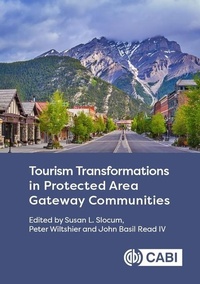
Tourism Transformations in Protected Area Gateway Communities
Published on 20. April 2022
Book
Hardback
216 pages
978-1-78924-903-3 (ISBN)
Description
Gateway communities that neighbour parks and protected areas are impacted by tourism, while facing unique circumstances related to protected area management. Economic dependency remains a serious challenge for these communities, especially in a climate of neoliberalism, top-down policy environments, and park closures related to environmental degradation or government budgets. The collection of works in this edited book provide bottom-up, informed, and nuanced approaches to tourism management using local experiences from gateway communities and protected areas management emerging from a decade of guidelines, rulemaking, and exclusive decision-making. Global perspectives are presented and contextualized at the local level of gateway communities in an attempt to balance nature, community, and commerce, while supporting the triple bottom line of sustainable tourism. While anticipating a post-COVID 19 global shift, readers are encouraged to think through transformation and resiliency in regard to how the flux of supply vs demand alters gateway community perspectives on tourism. Specific features of this book include: ? Focus on transformations, which provides insight into the complex and dynamic nature of gateway communities. ? Multidisciplinary, multi-cultural insights into protected area management. ? Applied and conceptual chapters from global perspectives.
More details
Language
English
Place of publication
Wallingford
United Kingdom
Target group
College/higher education
Professional and scholarly
Product notice
sewn/stitched
Cloth over boards
Dimensions
Height: 244 mm
Width: 172 mm
Thickness: 18 mm
Weight
704 gr
ISBN-13
978-1-78924-903-3 (9781789249033)
Copyright in bibliographic data and cover images is held by Nielsen Book Services Limited or by the publishers or by their respective licensors: all rights reserved.
Schweitzer Classification
Other editions
Additional editions
Susan L. Slocum | Peter Wiltshier | John Basil Read IV
Tourism Transformations in Protected Area Gateway Communities
E-Book
03/2022
CABI Publishing
€130.99
Available for download
Persons
Susan L Slocum (Edited By)
Susan L. Slocum specializes in sustainable economic development through tourism and policy implementation at the regional and national level. Working with communities to enhance backward linkages between tourism and traditional industries, she has worked with rural communities in the US, UK, and indigenous populations in emerging tourism destinations in Tanzania. She has published 4 edited books and authored 2 books, including a textbook on food and agricultural tourism.
Peter Wiltshier (Edited By)
Peter Wiltshier currently teaches at the University of Derby as a Senior Lecturer and Programme Leader for Tourism Management, where his work aims to ensure that the public and private sectors collaborate together to develop resources and skills for communities, pursuing bottom-up planning and policy development. His current research focus is centred around small business and lifestyles in the Peak District. He is also working with the Diocese of Derby to identify how tourism can benefit churches, as well as evaluating the impacts of tourism on host communities through local government offices. He supports the county, district and parishes within Derbyshire and the Peak District in their endeavours to create a better environment for all through purposeful leisure and recreation. He is also a reviewer for the Journal of Marketing Management, the Journal of Tourism Management and the International Society of Travel & Tourism Educators (ISSTE).
John Basil Read IV (Edited By)
John Read is a PhD student at the University of Waterloo in Ontario, Canada. He has a background in Fire Protection with experience working as a firefighter and emergency medical practitioner. Engaging in a career transition, John began working for the National Park Service while pursuing an M.S. in Recreation Administration. John's experience working in Antarctica fostered an interest in visitor codes of conduct especially as they pertain to the polar regions. He currently sits as co-chair for the US Association of Polar Early Career Scientists and national committee representative for the Association of Polar Early Career Scientists.
Susan L. Slocum specializes in sustainable economic development through tourism and policy implementation at the regional and national level. Working with communities to enhance backward linkages between tourism and traditional industries, she has worked with rural communities in the US, UK, and indigenous populations in emerging tourism destinations in Tanzania. She has published 4 edited books and authored 2 books, including a textbook on food and agricultural tourism.
Peter Wiltshier (Edited By)
Peter Wiltshier currently teaches at the University of Derby as a Senior Lecturer and Programme Leader for Tourism Management, where his work aims to ensure that the public and private sectors collaborate together to develop resources and skills for communities, pursuing bottom-up planning and policy development. His current research focus is centred around small business and lifestyles in the Peak District. He is also working with the Diocese of Derby to identify how tourism can benefit churches, as well as evaluating the impacts of tourism on host communities through local government offices. He supports the county, district and parishes within Derbyshire and the Peak District in their endeavours to create a better environment for all through purposeful leisure and recreation. He is also a reviewer for the Journal of Marketing Management, the Journal of Tourism Management and the International Society of Travel & Tourism Educators (ISSTE).
John Basil Read IV (Edited By)
John Read is a PhD student at the University of Waterloo in Ontario, Canada. He has a background in Fire Protection with experience working as a firefighter and emergency medical practitioner. Engaging in a career transition, John began working for the National Park Service while pursuing an M.S. in Recreation Administration. John's experience working in Antarctica fostered an interest in visitor codes of conduct especially as they pertain to the polar regions. He currently sits as co-chair for the US Association of Polar Early Career Scientists and national committee representative for the Association of Polar Early Career Scientists.
Editor
Assistant ProfessorGeorge Mason University, USA
Research Consultancy NZ, New Zealand
University of Waterloo in Ontario, Canada.
Contributions
University of Lapland, Finland
University of the Azores, Portugal
University of Utah, USA
Westfield State University, USA
Autonomous University of Ciudad Juarez, Mexico
Autonomous University of Ciudad Juarez, Mexico
University of the Azores, Portugal
Content
Chapter 1: Introduction Chapter 2: Appalachian Trail Communities: Gateway Partners in Parks and Protected Area Management Chapter 3: Building a Gateway to the Arctic: A Political Economy Perspective on Tourism Development and Conservation in Finnish Lapland Chapter 4: Gateway Community Relationships with a US National Park: A Qualitative Exploration of Community Member, Concessioner and Grand Teton National Park Staff Perspectives Chapter 5: Advocacy for Protected Areas in the Caribbean: A Collaborated Approach to Ecotourism in Antigua and Barbuda Chapter 6: Contribution of Tourism to Sustainable Development: Samalayuca Dunes (Mexico) Chapter 7: Community Engagement with Tourism Management in Small Atlantic islands Chapter 8: Protected Area Tourism in Batanes Islands, Philippines: Issues and impacts Chapter 9: The Praia do Sono (Paraty, Brazil) as a Gateway Community to Achieve the Universalization of Sustainable Development Goal 6 (Water Sanitation) in Tourist Areas Chapter 10: Public-private Partnerships: A Framework for National Park Gateway Community Development Chapter 11: Stories to Engage Protected Area Neighbouring Communities in Tourism Planning and Practice Chapter 12: Sustainable tourism Initiatives and Impediments: The National Mall as an Urban Gateway Community Chapter 13: Conclusion