

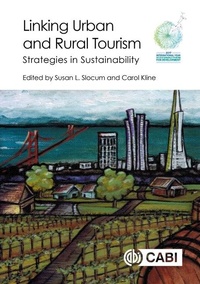
Linking Urban and Rural Tourism
Strategies in Sustainability
Published on 14. June 2017
Book
Hardback
266 pages
978-1-78639-014-1 (ISBN)
Description
Destinations rely on regional strategies to support and enhance the tourism product through regional partnerships and integration. Integrated tourism is defined as tourism that is explicitly linked to the economic, social, cultural, natural and human structures of the region in which it occurs. Integrated tourism has evolved to include numerous meanings and definitions, but generally includes a vertical business or industry approach. The first of its kind, this book applies a more inclusive approach to integration by providing insight into inclusive regional development strategies that support both the needs of urban and rural areas whilst enhancing the tourist experience, supporting the positive impacts of tourism and mitigating the negative. Regional studies tend to portray either an urban or rural focus without acknowledging that often these spaces constitute joint governance structures, similar historical and cultural roots, and economic dependencies. Sustainable tourism promotes sourcing locally, such as using rural agricultural products in urban tourism experiences. Furthermore, innovative rural marketing strategies linking tourism heritage, attractions, food and drink trails, and artisans with urban visitors are emerging. Including theoretical and applied research and international case studies, this will be a valuable resource to academics, students and practitioners working in tourism development and regional policy.
More details
Language
English
Place of publication
Wallingford
United Kingdom
Target group
College/higher education
Product notice
sewn/stitched
Cloth over boards
Dimensions
Height: 246 mm
Width: 173 mm
Thickness: 23 mm
Weight
771 gr
ISBN-13
978-1-78639-014-1 (9781786390141)
Copyright in bibliographic data and cover images is held by Nielsen Book Services Limited or by the publishers or by their respective licensors: all rights reserved.
Schweitzer Classification
Other editions
Additional editions
E-Book
06/2017
CABI Publishing
€152.99
Available for download
Persons
Susan L Slocum (Edited By)
Susan L. Slocum specializes in sustainable economic development through tourism and policy implementation at the regional and national level. Working with communities to enhance backward linkages between tourism and traditional industries, she has worked with rural communities in the US, UK, and indigenous populations in emerging tourism destinations in Tanzania. She has published 4 edited books and authored 2 books, including a textbook on food and agricultural tourism.
Susan L. Slocum specializes in sustainable economic development through tourism and policy implementation at the regional and national level. Working with communities to enhance backward linkages between tourism and traditional industries, she has worked with rural communities in the US, UK, and indigenous populations in emerging tourism destinations in Tanzania. She has published 4 edited books and authored 2 books, including a textbook on food and agricultural tourism.
Editor
Assistant ProfessorGeorge Mason University, USA
Associate ProfessorAppalachian State University, USA
Contributions
Assistant ProfessorUniversity of Waterloo, Canada
Assistant ProfessorCollege of Natural Resources, USA
University of Utah, USA
Stockton University, USA
Walker College of Business, USA
College of Agriculture and Applied Sciences, USA
University of Massachusetts, USA
Clemson University, USA
Content
Part I: Urban Rural Linkages 1: Discussing Rural-Urban Tourism: A Review of the Literature 2: Experiencing and Connecting to Nature: An Urban to Rural Association 3: Addressing Power: Stakeholder Involvement Within an Integrated Tourism Planning Process 4: Foodscapes as Alternate Ways of Knowing: Advancing Sustainability and Climate Consciousness through Tactile Space Part II: Fringe Tourism 5: Cool Suburbs: a Strategy for Sustainable Tourism? 6: The Urban-Rural Tourism Relationship: A Case of Suburban Farm 7: Resident and Tourist Perception of People, Towns and Amenities in Fringe Settings Part III: S trategies in Sustainability 8: The Urban-Rural Tourism Mix: A Partnership of Convenience or Sustainability Imperative 9: From Centre to Periphery: Inequality, Indigeneity and Domestic Tourism in Guatemala 10: Beyond Economic Development: Can the Arts Lead Communities Out of Poverty? 11: Theme Park as a Link between Urban and Rural Territories 12: Connecting Urban to Rural: Can the San Francisco-Napa Valley Relationship be Facilitated in Pennsylvania? 13: Farm and Food Tourism as a Strategy for Linking Rural and Urban Land, People and Place: The Case of Western North Carolina 14: Utah Farm-Chef-Fork: Linking Rural Growers with Urban Chefs to Enhance Local Food Sourcing 15: Corporate Sustainability as an Opportunity for Tourism Partnerships: A Case Study on Fairmont Hotels & Resorts